
Introduction
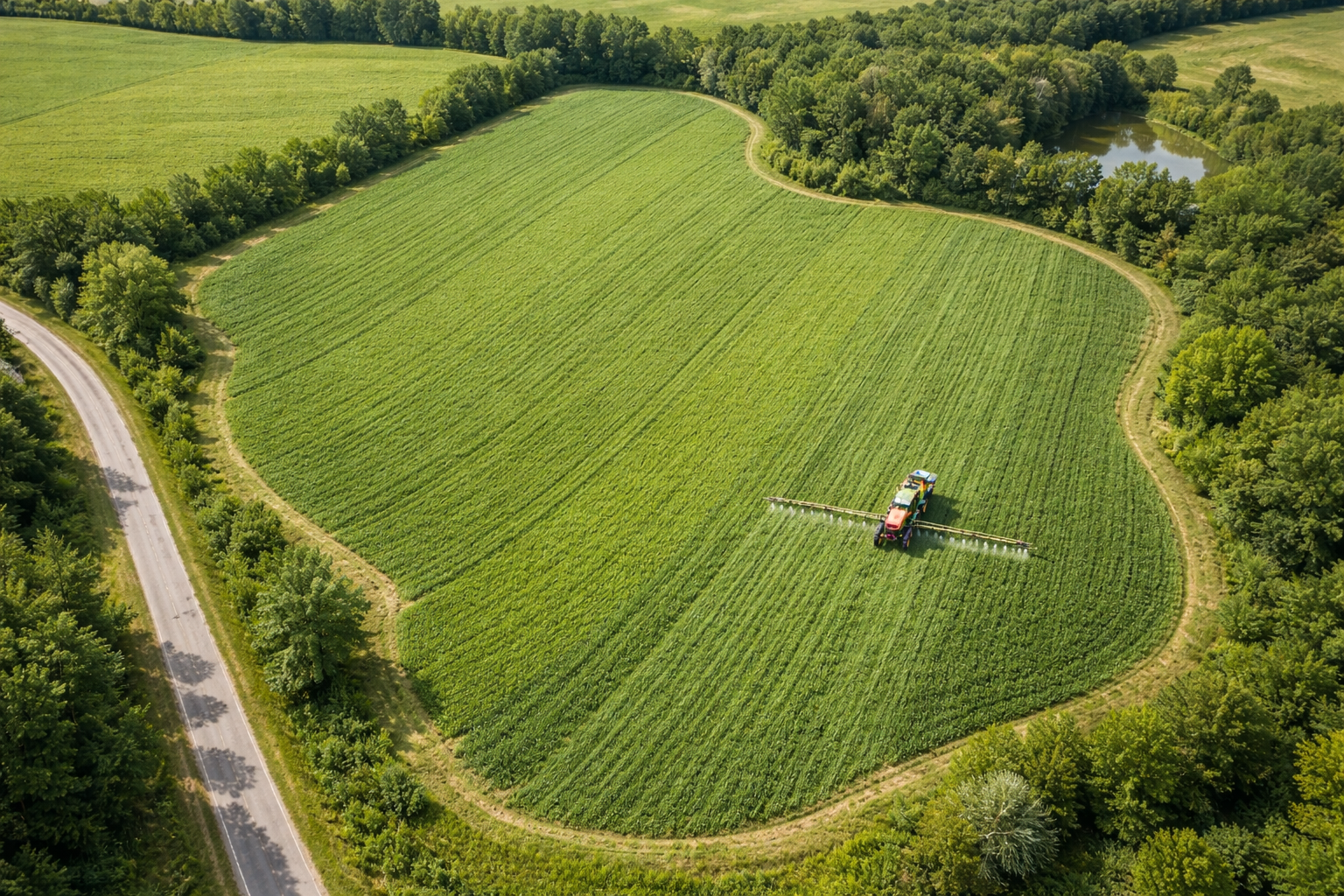
In modern agriculture, curved auto steering farming plays an important role in maintaining efficiency across irregular and non-rectangular fields.
In real-world farming, operators frequently deal with:
- Curved boundaries
- Irregular field shapes
- Fragmented plots
- Obstacles such as trees, irrigation systems, or terrain changes
These conditions make straight-line guidance insufficient. As soon as operations shift from linear passes to curves, manual corrections increase, overlaps become harder to avoid, and overall efficiency declines.
Maintaining precision in these environments requires more than just guidance. It requires adaptive control.
Why Conventional Workflows Struggle in Irregular Fields
Traditional guidance systems are optimized for straight AB lines. While effective in open, rectangular fields, they introduce several limitations in more complex environments.
Operators often face several common problems:
- Constant steering adjustments on curved paths
- Difficulty maintaining consistent pass-to-pass spacing
- Uneven coverage caused by repeated corrections
- Increased fatigue during long operations
In curved paths especially, even small steering inconsistencies can result in:
- Over-application on inner curves
- Missed strips on outer curves
- Reduced operational speed
The result is a trade-off between accuracy and efficiency, something modern farming operations can no longer afford.
A Better Workflow Logic
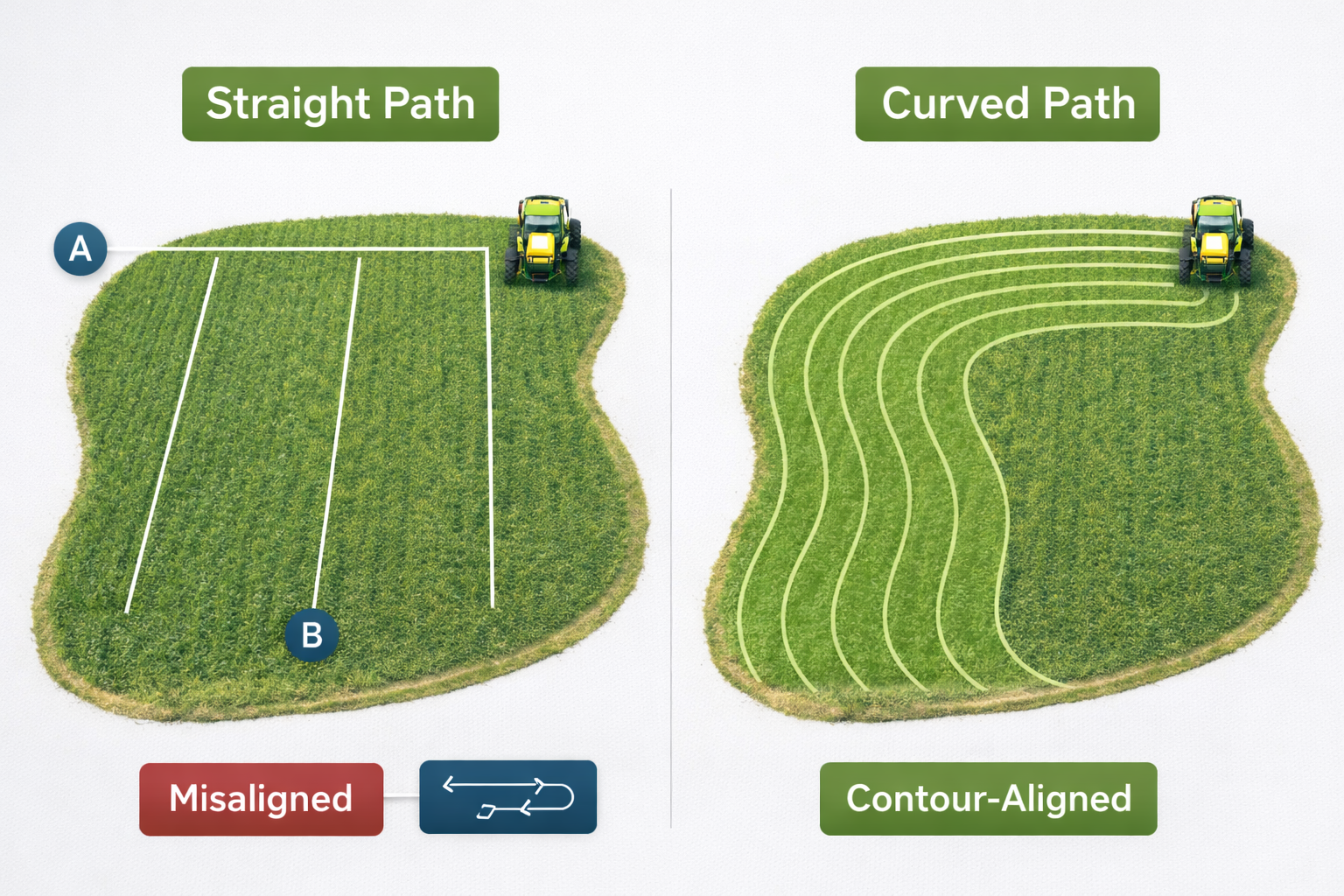
Instead of forcing irregular fields into straight-line workflows, a more effective approach is to adapt the guidance path to the field itself.
This means shifting from:
“Follow fixed straight lines”
to
“Follow dynamic, field-shaped paths”
The goal is not just to stay on track, but to:
- Maintain consistent spacing along curves
- Reduce manual steering input
- Ensure smooth, continuous operation
This is where curve-based auto steering becomes essential.
Key Execution Steps
1. Capture or Import Accurate Field Geometry
Start by defining the actual shape of the field.
- Use boundary mapping or imported field data
- Include curves, edges, and obstacles
- Ensure high-resolution boundary accuracy
This allows the system to understand how the field should be navigated.
2. Generate Curve-Aligned Guidance Paths
Instead of creating straight AB lines:
- Generate guidance lines that follow field contours
- Align paths with the natural curves of the terrain
- Maintain consistent spacing across the entire field
This reduces the need for constant operator correction.
3. Enable Automatic Steering Along Curved Paths
During operation:
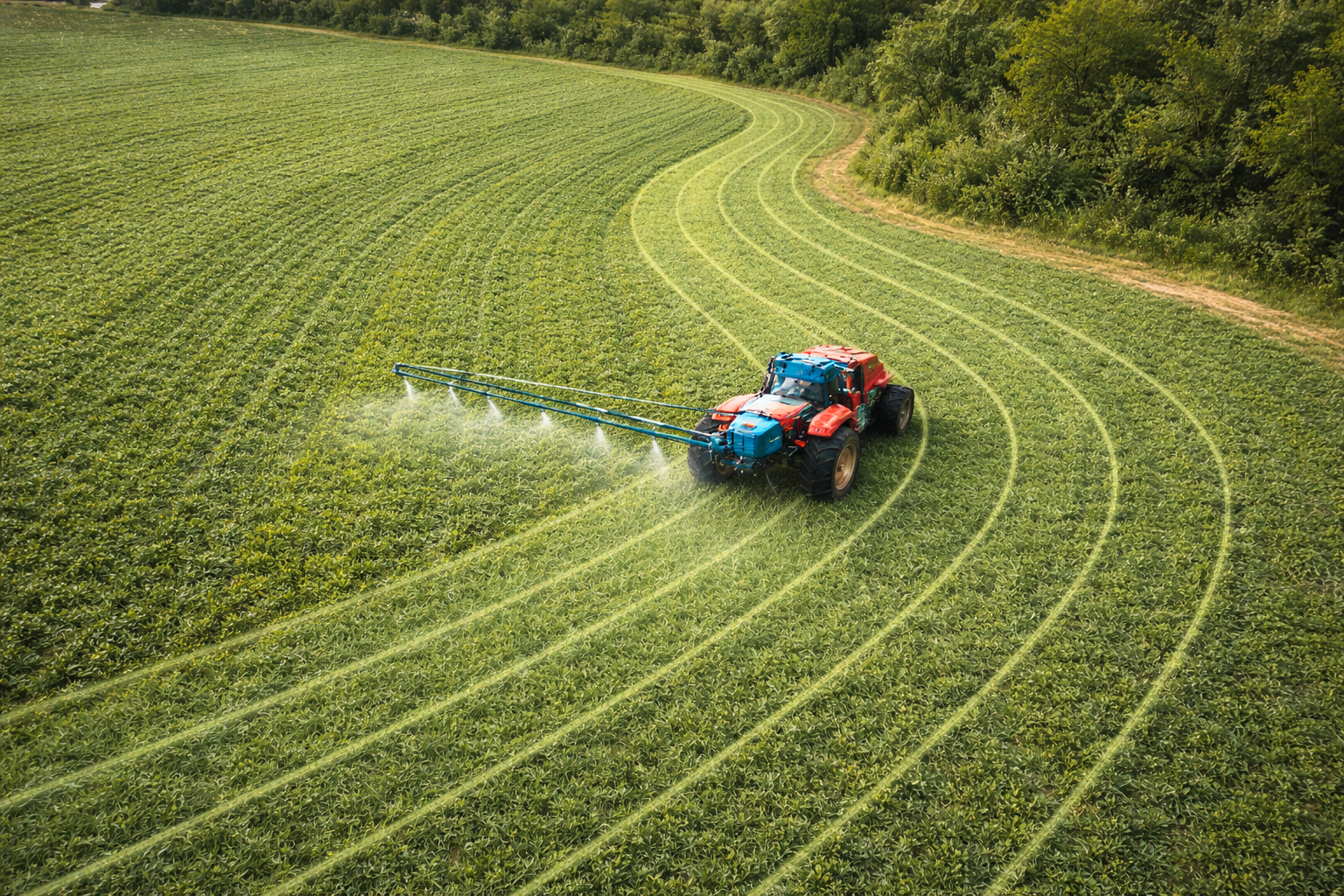
- The system continuously adjusts steering based on the curve
- Operators no longer need to manually correct direction
- Speed remains stable even in complex sections
This is particularly useful in:
- Terraced fields
- Irregular agricultural plots
- Fields with natural boundaries
Curve-based auto steering helps turn a difficult driving task into a smoother and more repeatable workflow.
4. Maintain Consistent Pass-to-Pass Spacing
Curved paths often introduce spacing errors.
To reduce this risk:
- Ensure pass spacing is automatically calculated
- Monitor spacing consistency across inner and outer curves
- Avoid manual compensation during operation
This helps prevent both overlap and missed areas.
5. Optimize Turning Transitions
Transitions between passes are critical in irregular fields.
- Smooth curve-to-curve transitions reduce downtime
- Automatic turning logic minimizes operator intervention
- Re-entry into the next pass is more precise
This keeps the workflow continuous and efficient.
What Affects the Results
Several factors influence performance in curved operations.
GNSS accuracy and stability
High-precision positioning ensures consistent path tracking.
Field geometry quality
Inaccurate boundaries lead to distorted guidance paths.
Machine response time
Steering system responsiveness affects curve smoothness.
Operator speed control
Excessive speed can reduce accuracy in tight curves.
Maintaining balance across these factors is essential for optimal results.
Why This Workflow Fits Modern Farming Operations
As agricultural operations expand into more diverse terrains, flexibility becomes a key requirement.
A system like the PRECISE A Pro enables:
- Curve-based auto steering
- High-precision pass-to-pass consistency of ±2.5 cm
- Integration with ISOBUS and implement control
This allows operators to handle both straight and irregular fields within a unified workflow.
Instead of adapting the field to the machine, the system adapts the machine to the field, resulting in more natural and efficient operations.
Conclusion
Irregular fields are not the exception. They are the reality.
Maintaining efficiency in these environments requires more than precision alone. It requires adaptability.
By shifting to curve-aligned workflows:
- Steering becomes smoother
- Coverage becomes more consistent
- Operator workload decreases
In modern farming, the ability to handle complexity efficiently is what defines true precision.