

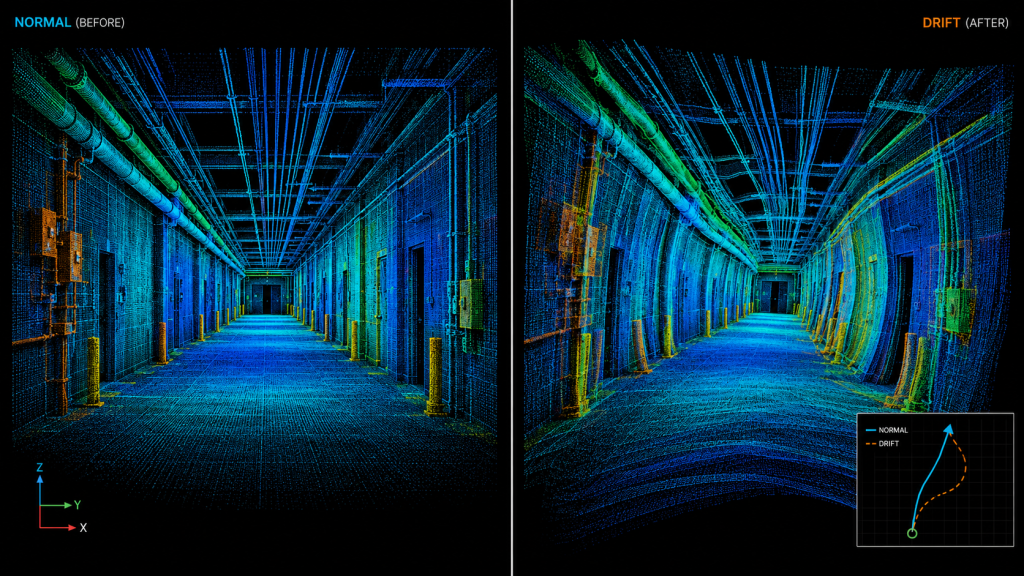
Drift is one of the most common challenges in SLAM-based 3D scanning, especially when working on large-scale or complex environments.
It does not usually appear at the beginning of a scan. Instead, it accumulates gradually as the scanning path becomes longer. A corridor may start to bend slightly, walls may no longer align perfectly, or floors may appear uneven during post-processing.
By the time these issues become visible, the entire dataset may already be affected.
For surveyors working on infrastructure projects, industrial sites, tunnels, large indoor spaces, or complex mapping tasks, reducing drift is not only about improving accuracy. It also directly affects project deliverables, field rework, processing efficiency, and client confidence.
This guide explains how to reduce drift in SLAM scanning through better workflow design, and how multi-sensor SLAM systems such as the PRECISE S7 help support more stable trajectory control in demanding projects.
Why Drift Happens in SLAM Scanning
Drift is not usually caused by one single mistake. It is the result of small positional inaccuracies accumulating over time.
In SLAM scanning, the system continuously estimates its position while building a map of the surrounding environment. When environmental references are weak, movement is inconsistent, or the scanning path does not provide enough correction opportunities, trajectory errors can slowly build up.
This is why drift is especially common in large-scale scanning projects, long corridors, repetitive structures, and complex indoor or underground environments.
Common Causes of SLAM Drift
1. The Environment Lacks Distinct Features
SLAM systems rely on environmental references to maintain positioning. When the scene lacks enough recognizable features, tracking becomes more difficult.
This often happens in:
- Long corridors
- Repetitive industrial spaces
- Uniform walls or floors
- Empty indoor areas
- Tunnels or underground passages
Without clear reference points, the system may have difficulty maintaining consistent positioning throughout the scan.
2. The Trajectory Is Too Linear
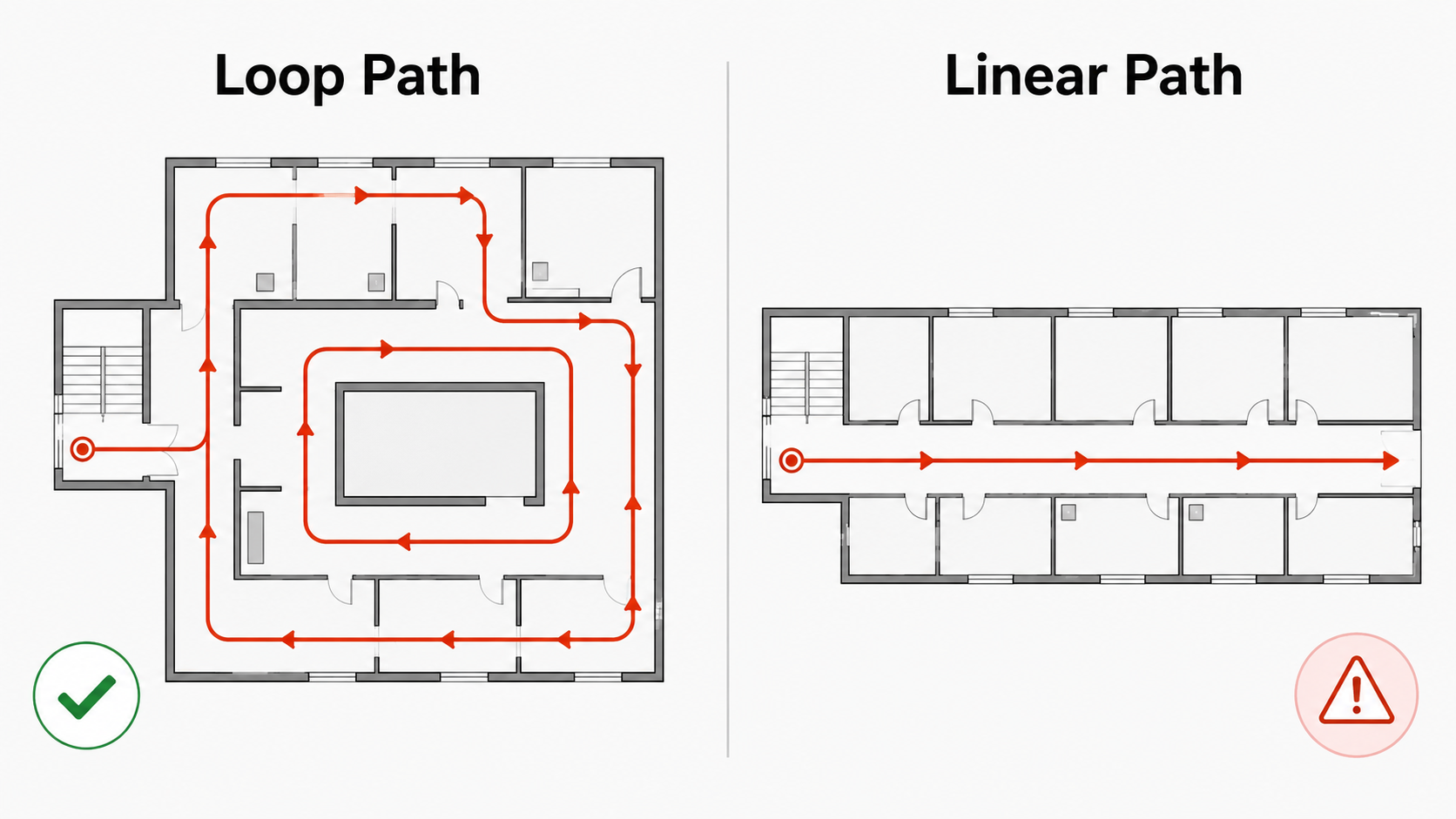
A long, straight, uninterrupted scanning path increases the risk of drift.
When an operator scans in only one direction without returning to known areas, the system has fewer opportunities to correct accumulated errors. This can cause small trajectory deviations to become larger over time.
For large-scale projects, scanning path design should not simply follow the shortest route. It should be planned to support trajectory correction.
3. Movement Is Inconsistent
Operator movement has a direct impact on trajectory quality.
Sudden turns, fast rotations, stops and starts, or irregular walking speed can reduce the stability of IMU-based tracking and make sensor fusion less reliable.
A smooth and steady scanning motion gives the system more consistent data, helping improve trajectory estimation.
4. Sensor Data Is Not Properly Balanced
SLAM systems that rely too heavily on one data source may become vulnerable when that source becomes unreliable.
For example, vision-based tracking can be affected by low light or repetitive surfaces, while LiDAR-based tracking can face challenges in environments with limited geometry. A stronger system should combine multiple sensor inputs to maintain tracking stability across different conditions.
A Better Approach: Drift Control Through Workflow Design
Instead of trying to fix drift after scanning, a better approach is to reduce the chance of drift accumulating during fieldwork.
Effective drift control depends on workflow design. The goal is to keep the system continuously anchored to reliable environmental references throughout the scan.
A practical drift-control workflow should focus on three principles:
1. Introduce natural correction points
Use loops, overlaps, and return paths to help the system correct accumulated errors.
2. Maintain stable motion
Move smoothly and consistently so that sensor fusion can perform more reliably.
3. Use the environment actively
Do not treat the environment as a passive background. Use corners, equipment, structural variation, and feature-rich areas to support tracking.
With the right workflow, drift becomes much easier to control before it affects the final dataset.
Key Execution Steps to Reduce Drift
1. Design Loop Closures Into the Scanning Path
Whenever possible, plan the scanning route so that the operator returns to a known or previously scanned area.
For smaller projects, this may mean starting and ending the scan near the same location. For larger sites, it may mean creating multiple smaller loops within the overall scanning area.
Why it matters:
Loop closure allows the system to recognize previously scanned areas and correct accumulated trajectory errors. This can significantly improve global alignment and reduce long-distance drift.
2. Break Long Paths Into Structured Segments
Avoid scanning long corridors or large linear spaces in one continuous pass without correction points.
Instead, divide the project area into smaller structured sections. Add turns, overlaps, or return paths where possible. This helps prevent drift from accumulating continuously across the entire route.
Why it matters:
Segmented scanning improves local consistency and gives the system more opportunities to stabilize the trajectory.
3. Maintain Consistent Movement Speed
During scanning, walk at a steady and controlled pace. Avoid sudden acceleration, sharp rotations, unnecessary stops, or rapid direction changes.
The operator does not need to move slowly throughout the entire project, but movement should remain predictable and stable.
Why it matters:
Consistent movement improves IMU data reliability and helps LiDAR, visual, and motion data work together more effectively.
4. Intentionally Include Feature-Rich Areas
If the environment is repetitive or lacks strong features, adjust the scanning path to include more reference points.
Useful reference areas may include:
- Corners
- Columns
- Doorways
- Equipment
- Pipes or structural elements
- Intersections
- Objects with clear geometry
In some cases, slightly widening the scanning path can help capture more geometry and improve tracking stability.
Why it matters:
Feature-rich areas provide additional references for SLAM tracking, making the trajectory more robust in difficult environments.
5. Monitor Trajectory Quality in Real Time
If the system supports real-time preview or trajectory monitoring, operators should use it actively during scanning.
Real-time monitoring can help identify early signs of drift, trajectory deviation, missing coverage, or unstable tracking before the scan is complete.
Why it matters:
Detecting drift during fieldwork allows operators to adjust the path immediately. This can be the difference between a usable dataset and a failed scan that requires rework.
What Affects Drift Beyond Workflow?
Even with a strong scanning workflow, drift can still be influenced by site conditions and operator behavior.
Environmental Conditions
Low light, overly bright surfaces, reflective materials, transparent objects, repetitive walls, and open spaces can all affect tracking performance.
Scene Dynamics
Moving people, vehicles, machinery, or temporary obstructions can reduce the stability of the scanning environment and introduce uncertainty into the data.
Device Handling
Operator fatigue, unstable device orientation, and inconsistent handling can also affect trajectory quality, especially during long scanning sessions.
Understanding these factors helps operators anticipate problems before they become serious.
Why Multi-Sensor SLAM Systems Reduce Drift More Effectively
Drift reduction becomes more manageable when multiple sensors work together.
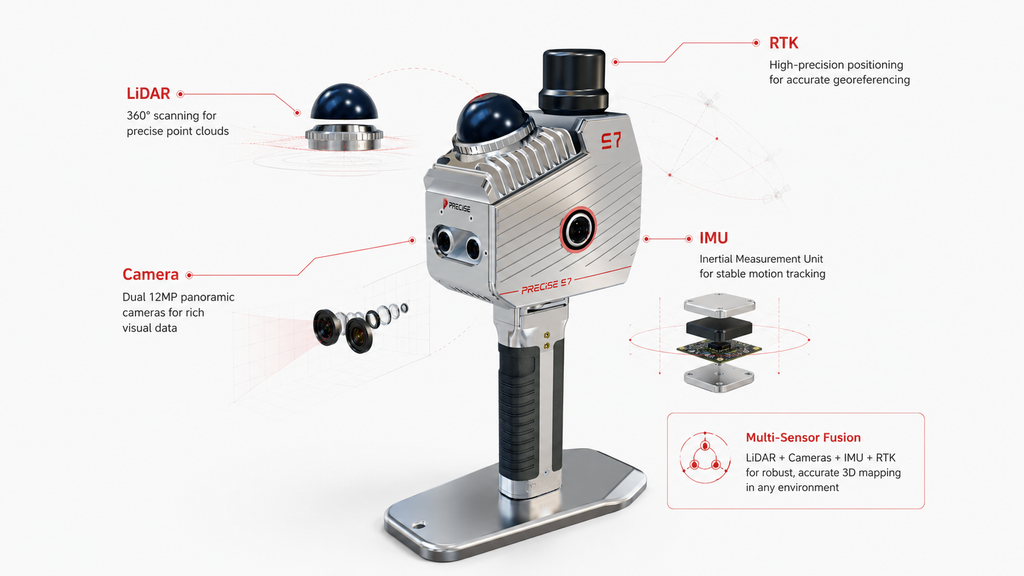
In multi-sensor SLAM systems such as the PRECISE S7, different sensors support each other during scanning. LiDAR provides stable geometric structure, visual SLAM cameras capture environmental features, and IMU data supports motion continuity.
This multi-sensor approach allows the system to maintain tracking when one data source becomes weaker.
For example, in environments with limited visual features, LiDAR geometry can help support positioning. In spaces with complex structures, visual and motion data can strengthen trajectory estimation. When movement changes, IMU data helps maintain continuity.
The PRECISE S7 is designed to support reliable SLAM scanning in complex and large-scale environments through multi-sensor fusion. Its sensor combination helps improve trajectory stability, point cloud alignment, and overall data consistency.
This allows survey teams to:
- Reduce drift in long or complex scanning paths
- Maintain more stable trajectory estimation
- Improve point cloud alignment
- Reduce field rework
- Increase confidence in final deliverables
For infrastructure, industrial, indoor mapping, tunnel, and large facility projects, this can make SLAM scanning more reliable and practical in real field conditions.
Conclusion
Drift in SLAM scanning is not unavoidable. With the right workflow, it can be managed more effectively.
By focusing on loop-based path design, structured scanning segments, stable movement, and feature-aware scanning, survey teams can significantly reduce trajectory errors and improve final data quality.
When these workflow principles are combined with a multi-sensor SLAM system such as the PRECISE S7, large-scale scanning becomes more stable, efficient, and dependable.
For teams working in complex environments, reducing drift is not only a technical requirement. It is an important part of delivering accurate, consistent, and trusted 3D data.