
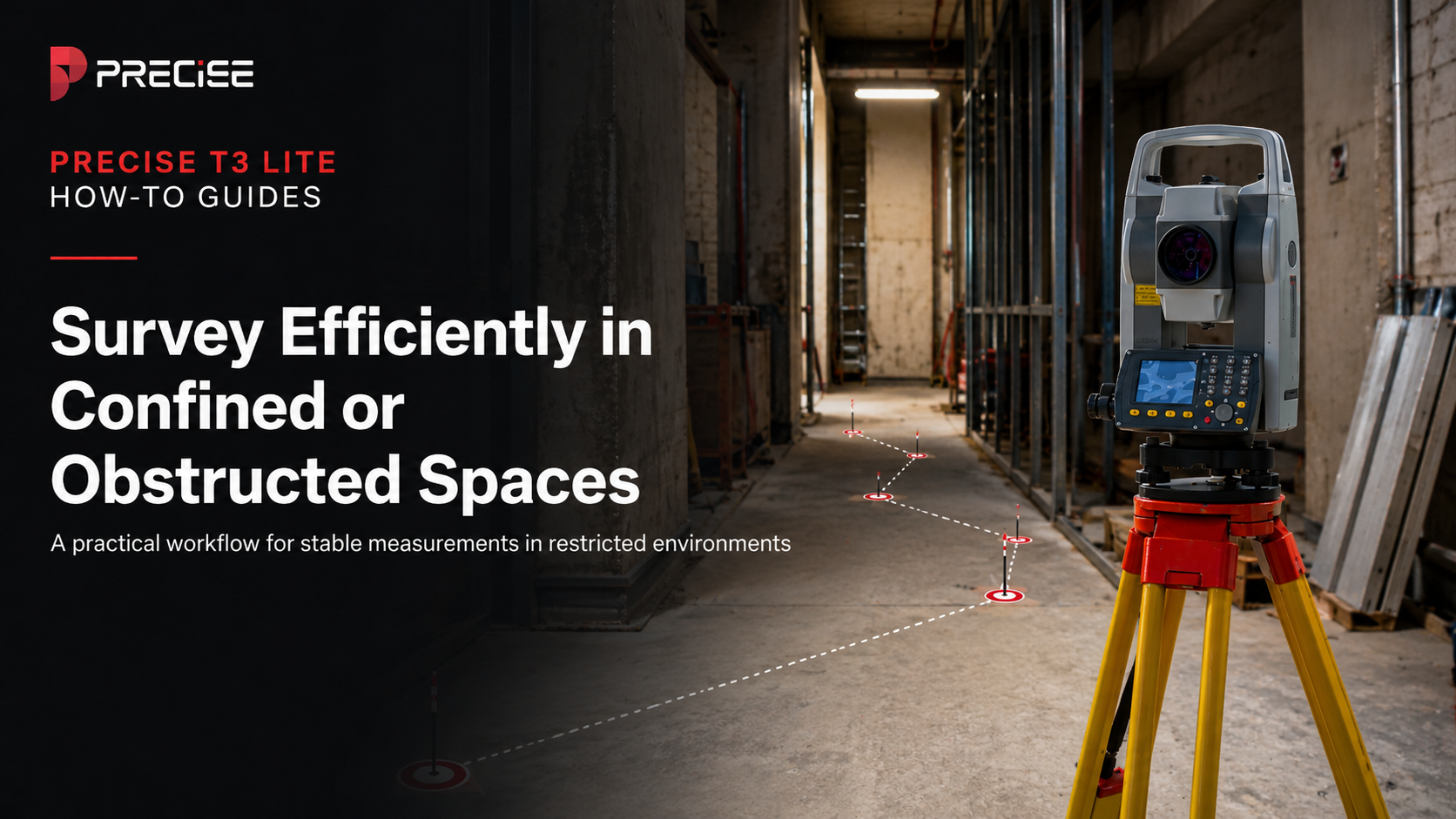
Not all survey environments are open, stable, or easy to work in.
In many real-world projects, especially indoor construction, renovation, or industrial sites, surveyors often need to work in narrow corridors, equipment-dense environments, areas with limited visibility, or spaces where setup options are restricted.
In these conditions, efficiency is no longer just about measurement speed.
It depends on how well the workflow adapts to space constraints and environmental limitations.
That is why a practical total station workflow is especially important when surveying in confined or obstructed spaces.
Why Confined Spaces Slow Down Survey Work
Surveying in confined or obstructed environments introduces a different set of challenges compared with open sites.
Common issues include:
- Limited setup positions for the instrument
- Frequent line-of-sight interruptions
- Restricted movement between points
- Higher likelihood of repositioning the device
- Less room for tripod adjustment and operator movement
These constraints often lead to:
- Increased setup time
- Interrupted workflows
- Reduced measurement consistency
- More frequent task pauses
- Lower overall field productivity
Even experienced surveyors may find their usual workflow less effective in these environments.
In open spaces, surveyors can often choose setup positions more freely. In confined environments, every setup position must be selected more carefully because visibility, access, and movement are all limited.
A More Adaptive Workflow Strategy
Instead of trying to replicate open-site workflows, a better approach is to adapt the workflow to the environment.
An efficient confined-space surveying strategy should focus on:
- Maximizing usable setup positions
- Reducing unnecessary instrument movement
- Maintaining workflow continuity despite interruptions
- Keeping operations simple under spatial constraints
- Completing reachable points before changing setup
This shifts the mindset from:
“How can we cover the whole site quickly?”
to:
“How can we work efficiently within the site’s limitations?”
For confined or obstructed spaces, this difference matters.
A practical workflow helps surveyors maintain control even when space, visibility, and movement are restricted.
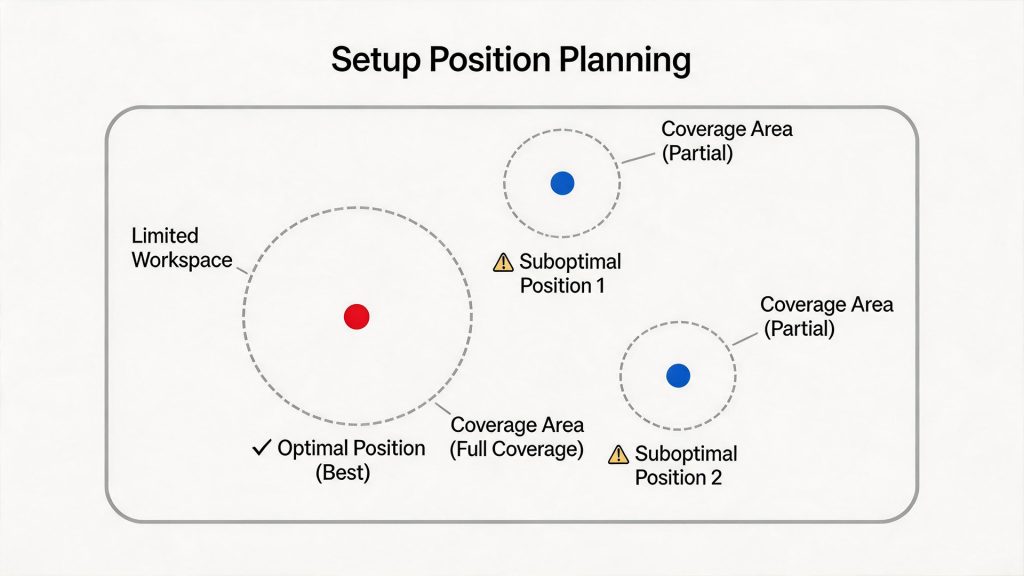
Step 1: Plan Setup Positions More Strategically
In confined spaces, setup flexibility is limited.
A poor setup position can quickly lead to blocked sightlines, repeated relocation, or incomplete point coverage.
Before setting up the instrument, surveyors should evaluate where the total station can provide the widest practical coverage.
To improve setup planning:
- Identify positions that provide visibility to multiple targets
- Avoid placing the instrument where movement is restricted
- Check whether nearby structures may block the line of sight
- Consider where the operator can move safely and comfortably
- Plan the next setup position before completing the current one
A well-chosen setup position reduces the need for relocation.
It also helps maintain a smoother workflow because the operator can complete more points from one position before moving the instrument.
In narrow corridors, indoor spaces, or equipment-dense areas, this planning step is often the key to improving efficiency.
Step 2: Minimize Instrument Relocation
Frequent repositioning is one of the biggest efficiency killers in tight environments.
Each relocation may require the operator to move the tripod, re-level the instrument, re-check the setup, and re-establish the workflow. Over time, these repeated steps can slow down the entire task.
To reduce unnecessary relocation:
- Group measurement tasks within each setup zone
- Complete all reachable points before moving
- Avoid unnecessary re-leveling cycles
- Plan measurement order according to visibility
- Move only when the current setup can no longer support the task
Reducing relocation helps maintain workflow rhythm.
It also reduces operator fatigue, especially when working in spaces where movement is already limited.
For short-distance, high-frequency measurement tasks, fewer setup changes can make a significant difference in overall productivity.
Step 3: Manage Line-of-Sight Limitations
Obstructions are often unavoidable in confined spaces.
Walls, columns, equipment, temporary structures, stored materials, and other site elements can interrupt the line of sight between the instrument and the target.
Instead of reacting to every obstruction after it happens, surveyors can manage visibility more proactively.
Practical methods include:
- Working in logical measurement sequences
- Adjusting measurement order based on visibility conditions
- Anticipating where line-of-sight issues may occur
- Measuring accessible points first before the site condition changes
- Avoiding repeated back-and-forth movement caused by blocked targets
Proactive planning prevents workflow interruptions.
When the operator understands which points are visible from each setup position, the survey task becomes more predictable and easier to control.
This is especially useful in renovation sites, industrial spaces, and indoor construction environments where access conditions may change throughout the day.
Step 4: Keep Operation Simple and Direct
Complex operations become more difficult in constrained environments.
When the operator has limited space to move, limited visibility, or frequent interruptions, complicated device interaction can further slow down the workflow.
To keep operation simple:
- Reduce multi-step procedures where possible
- Avoid frequent mode switching
- Keep commonly used functions easy to access
- Maintain consistent operation steps across tasks
- Use a familiar and intuitive interface
Simplicity improves speed and reduces errors.
In confined spaces, the operator should be able to focus on point measurement, visibility, and movement planning rather than spending too much time navigating complex commands.
A simple and direct workflow helps maintain productivity even when the environment is not ideal.
Step 5: Maintain a Consistent Data Workflow
In confined spaces, interruptions are more frequent. This makes stable data handling even more important.
If measurement data is recorded inconsistently, or if the operator switches between multiple systems during the task, the risk of confusion increases.
To maintain a consistent data workflow:
- Keep data recording continuous
- Avoid switching devices or systems mid-task
- Use a clear point naming structure
- Follow the same classification logic throughout the project
- Organize project data before entering the site
A stable data workflow ensures accuracy even under pressure.
It also helps the operator resume work more easily after interruptions, setup changes, or visibility-related pauses.
For confined-space surveying, consistency is what prevents small workflow breaks from becoming larger productivity problems.
What Affects Performance in Restricted Environments?
Efficiency in confined or obstructed spaces is influenced by several real-world factors.
These include:
- Density of surrounding structures or equipment
- Available working area for setup
- Operator movement limitations
- Task complexity within a limited zone
- Frequency of line-of-sight interruptions
- Safety restrictions on site
- Need for short-distance repeated measurements
A practical workflow must account for these variables and remain adaptable.
The goal is not to make confined spaces behave like open sites. The goal is to build a workflow that remains stable when the environment is narrow, crowded, or difficult to access.
Why Lightweight and Flexible Total Stations Make a Difference
In confined environments, equipment design plays a more direct role in efficiency than it does in open sites.
A lightweight and flexible total station, such as the PRECISE T3 Lite, supports this type of workflow by helping surveyors work more easily in restricted environments.
In practical field use, this can support:
- Easier positioning in tight spaces
- Reduced effort when relocating between setups
- More intuitive operation during short-distance tasks
- Better adaptability to confined or obstructed environments
- Smoother workflow for high-frequency measurements
Rather than optimizing only for extreme range or large-scale projects, this approach focuses on practical usability in restricted environments.
For surveyors working in indoor construction, renovation, industrial facilities, or equipment-dense areas, this practical usability can help improve efficiency throughout the day.
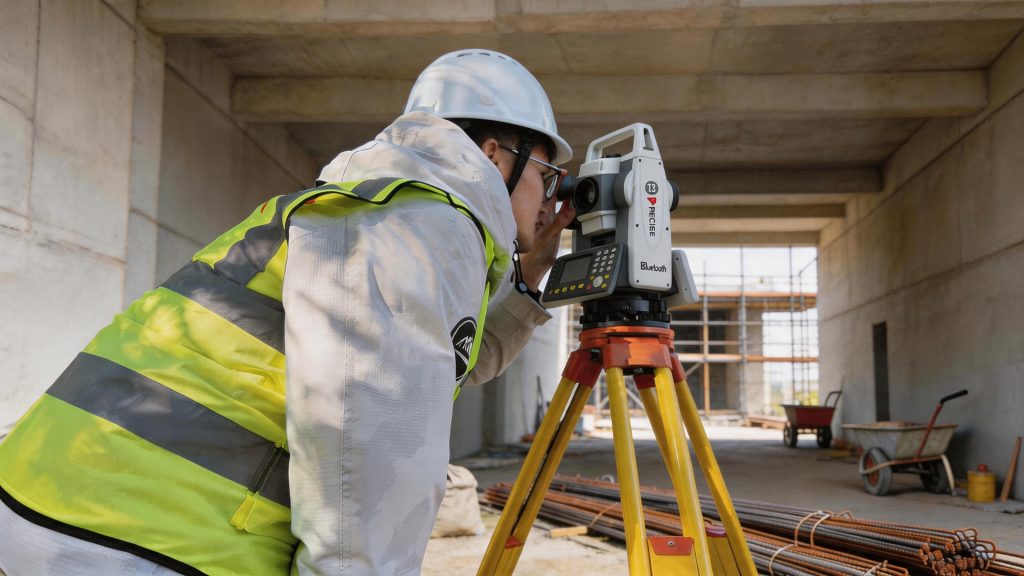
Practical Value of PRECISE T3 Lite in Confined-Space Surveying
The PRECISE T3 Lite is suitable for survey teams that need a practical total station for daily field tasks where space and visibility may be limited.
It can be useful in scenarios such as:
- Indoor construction measurement
- Renovation layout
- Industrial site surveying
- Narrow corridors
- Equipment-dense working areas
- Short-distance layout and checking tasks
- Compact construction environments
By supporting a simpler and more adaptive workflow, T3 Lite helps surveyors reduce unnecessary movement, manage line-of-sight limitations, and maintain more consistent operation in restricted spaces.
For these scenarios, efficiency is not only about measuring quickly.
It is about keeping the workflow stable when the environment makes normal operation more difficult.
Conclusion
Surveying in confined or obstructed spaces requires a different way of working.
Instead of forcing standard open-site workflows into difficult environments, surveyors can improve efficiency by focusing on:
- More strategic setup planning
- Fewer unnecessary relocations
- Better line-of-sight management
- Simpler operation steps
- More consistent data handling
- Equipment that adapts to space limitations
With the right workflow and tools, even constrained environments can be handled efficiently and consistently.
A practical total station workflow, combined with a lightweight and flexible instrument such as the PRECISE T3 Lite, can help survey teams maintain productivity in narrow, crowded, and obstructed spaces.