
Choosing between total station and GNSS workflows is critical for improving survey efficiency, because the right method depends on site conditions, task requirements, accuracy needs, and workflow stability.
In many projects, survey teams may have access to both GNSS and total station equipment. However, deciding which one to use in a specific situation can directly affect efficiency, accuracy, and workflow stability.
The challenge is not about which technology is better.
It is about which workflow fits the job conditions best.
For daily survey work, this decision is especially important. A method that works efficiently in one environment may become slow or unstable in another. By understanding the strengths of each approach, survey teams can choose the right workflow more confidently and reduce unnecessary interruptions.
Why the Wrong Choice Leads to Inefficiency
Both GNSS and total stations are powerful surveying tools.
However, using the wrong method in the wrong scenario often creates extra work instead of saving time.
Common problems include:
- Delays during setup or initialization
- Reduced measurement efficiency
- Increased need for verification or rework
- Workflow interruptions caused by environmental limitations
- Unstable results when site conditions do not match the chosen method
This often happens when the decision is based on habit rather than the actual site environment and task requirements.
For example, GNSS may be fast in open areas, but it can become less efficient in urban canyons, indoor environments, or areas with signal obstruction. A total station may require a more deliberate setup, but it can provide more controlled and stable measurement in structured or obstructed environments.
The key is to choose the method that creates the fewest workflow interruptions.
Understanding the Core Difference in Workflow
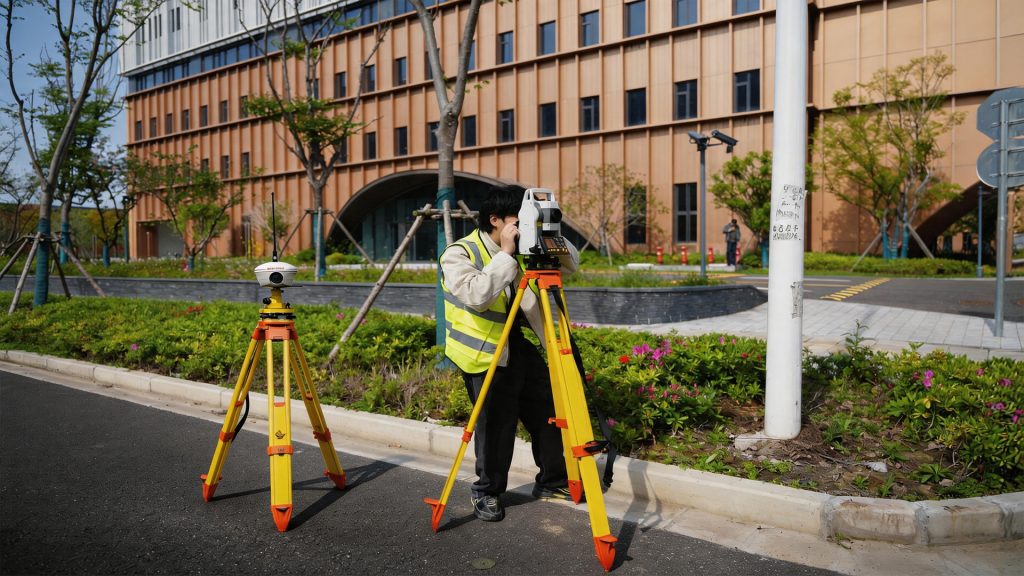
Before choosing between GNSS and a total station, it is important to understand how their workflows differ.
The two methods are not simply different instruments. They represent different ways of working.
GNSS Workflow Characteristics
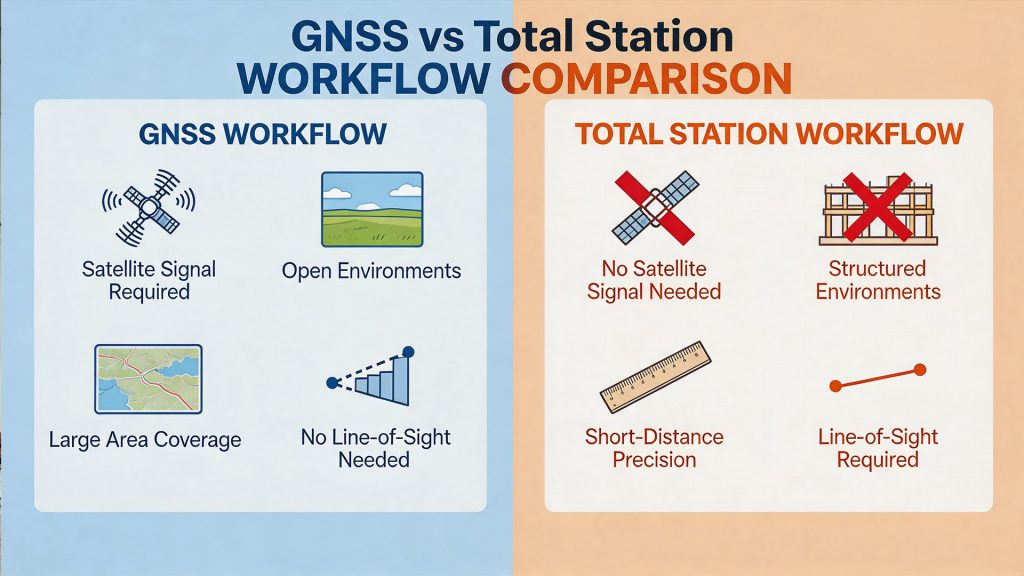
GNSS workflows are often preferred when the working environment is open and satellite signal conditions are stable.
Typical characteristics include:
- Works best in open environments
- Requires stable satellite signal conditions
- Efficient for large-area coverage
- Less dependent on line-of-sight between instrument and target
- Suitable for tasks where fast positioning across wider areas is required
GNSS can be highly efficient when the sky view is clear and the survey area is large enough to benefit from rapid point collection.
However, when signals are blocked, reflected, or unstable, the workflow may slow down due to initialization issues, accuracy checks, or repeated verification.
Total Station Workflow Characteristics
Total station workflows are more suitable when survey teams need controlled measurements in structured environments.
Typical characteristics include:
- Works independently of satellite signals
- Requires clear line-of-sight to targets
- More suitable for structured or obstructed environments
- Offers higher control in short-distance precision tasks
- Performs well in layout, verification, and detailed construction measurement
A total station may require careful setup, but once positioned properly, it can provide a stable and predictable workflow in environments where GNSS may struggle.
The goal is not to compare specifications directly. The goal is to match the workflow to the environment.
Step 1: Evaluate the Site Environment
The physical environment is often the most important decision factor.
Different environments create different workflow limitations.
In general:
- Open fields are usually better suited for GNSS
- Large outdoor areas with clear sky view favor GNSS workflows
- Urban construction sites often require total station workflows
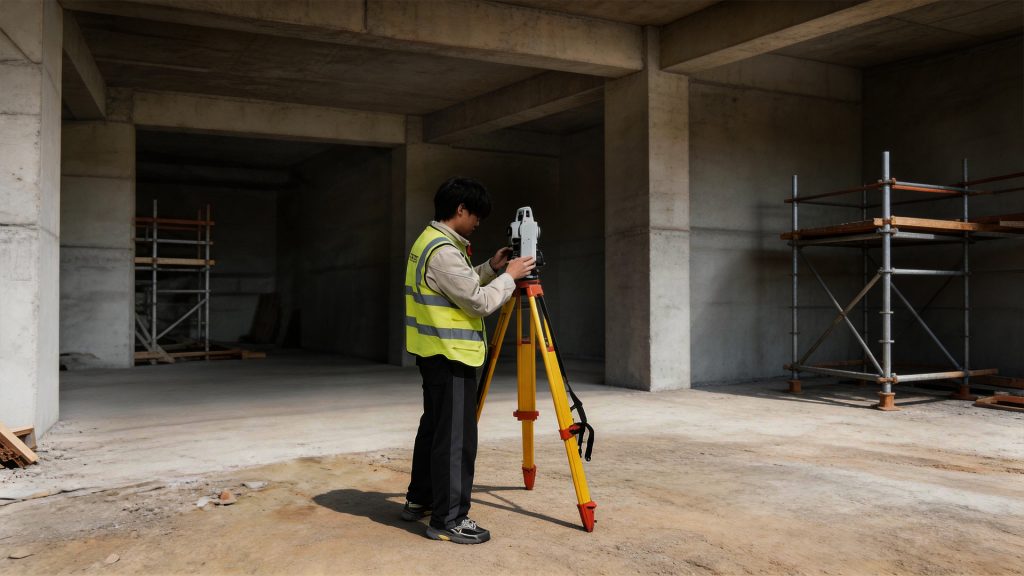
- Indoor or semi-indoor spaces are more suitable for total stations
- Obstructed areas with poor satellite visibility may reduce GNSS efficiency
Signal availability and visibility define workflow stability.
If the site is open and satellite conditions are stable, GNSS can help the team work quickly across a large area. If the site is surrounded by buildings, structural elements, equipment, or other obstructions, a total station may offer a more reliable workflow.
Before choosing the method, surveyors should ask:
Will this environment support stable measurement throughout the task?
If the answer is uncertain, the method with greater workflow stability should be prioritized.
Step 2: Match the Method to the Task Type
Different survey tasks require different levels of control.
The best method depends not only on the environment, but also on what the team needs to accomplish.
GNSS is often suitable for:
- Large-scale mapping
- Open-area point collection
- Topographic surveys
- General outdoor positioning
- Tasks requiring wide-area coverage
Total stations are often more suitable for:
- Construction layout
- Building measurement
- Indoor or semi-indoor surveying
- Short-distance precision tasks
- Repeated point checking and verification
- Structured environments with defined targets
The more structured and detail-oriented the task, the more suitable a total station becomes.
For example, construction layout often requires clear control over specific points, repeated verification, and stable measurement in a busy job-site environment. In these cases, workflow consistency is more important than simply collecting points quickly.
Step 3: Consider Precision and Control Needs
Accuracy requirements also affect the workflow decision.
In some projects, the main goal is efficient area coverage. In others, the priority is precise point positioning and layout control.
GNSS can be efficient when:
- The task covers a broad area
- The site has stable satellite visibility
- The required precision fits GNSS working conditions
- The operator can maintain reliable positioning throughout the task
A total station can be more practical when:
- The task requires higher control over specific points
- The work area is structured or compact
- Layout points need to be verified carefully
- Small deviations may cause rework
- Measurements must remain stable despite limited satellite signal conditions
For tasks where point-level control is critical, total stations often provide a more predictable workflow.
This is especially true in construction environments, where a small layout issue may affect installation, alignment, or later verification.
Step 4: Evaluate Workflow Continuity
Efficiency depends on how smoothly the workflow can be maintained from start to finish.
Both GNSS and total stations can be efficient, but both can also slow down when their workflow limitations appear.
GNSS workflows may be interrupted by:
- Poor satellite visibility
- Signal blockage near buildings or structures
- Multipath effects in dense urban areas
- Initialization delays
- Unstable positioning conditions
Total station workflows may be interrupted by:
- Blocked line-of-sight
- Poor setup position selection
- Frequent instrument relocation
- Restricted movement between points
- Inefficient target sequencing
Choosing the right method means choosing the workflow that minimizes interruptions under the actual site conditions.
For open environments, GNSS may keep the workflow faster and more continuous. For structured or obstructed environments, a total station may reduce uncertainty and provide better control.
Step 5: Compare Setup Flexibility
Setup speed is important, but it should not be considered alone.
A method that starts quickly may still become inefficient if it cannot maintain stable performance during the task.
GNSS often offers:
- Faster initial deployment
- Less need for line-of-sight planning
- More freedom of movement in open spaces
- Efficient coverage over larger areas
However, GNSS also depends on external conditions such as satellite visibility and signal quality.
Total stations usually require:
- More deliberate setup
- Stable instrument positioning
- Clear visibility to targets
- More careful task sequencing
But once properly positioned, a total station can offer strong control and consistency, especially in short-range or structured environments.
In dynamic job sites, flexibility often outweighs initial setup speed. The better choice is the method that can maintain stable performance throughout the task, not just the one that starts faster.
When Total Stations Become the More Practical Choice
In many real-world scenarios, total stations provide a more stable and predictable workflow.
This is especially true in:
- Dense construction sites
- Indoor or semi-indoor environments
- Projects with frequent obstructions
- Tasks requiring repeated layout and verification
- Short-distance precision measurement
- Areas where GNSS signal conditions are unreliable
- Sites with structural elements, walls, columns, or equipment
In these cases, relying on GNSS alone may introduce variability.
A total station workflow can help maintain measurement control, reduce uncertainty, and support more consistent results.
For construction layout, renovation, building measurement, and compact job-site tasks, the total station is often the more practical choice because it is less dependent on satellite signal conditions.
How Practical Total Station Design Improves Workflow Decisions
Choosing the right method is only part of the solution.
The usability of the equipment also affects how efficiently that method can be applied.
A practical total station design, such as the PRECISE T3 Lite, supports better workflow decisions by helping survey teams apply total station workflows more easily when site conditions require them.
In daily field work, this can help with:
- Faster and more manageable setup
- Reduced operational complexity
- Flexible deployment across different environments
- More consistent performance in short-range, high-precision tasks
- Easier use in structured or restricted job sites
- Smoother workflow for layout and verification tasks
This makes it easier for teams to confidently choose a total station workflow when GNSS conditions are not ideal.
A practical instrument does not only support measurement. It helps surveyors maintain a stable workflow under real job-site conditions.
Practical Value of PRECISE T3 Lite in Mixed Survey Workflows
The PRECISE T3 Lite is suitable for survey teams that need a practical total station for everyday jobs where GNSS may not always be the best fit.
It can be especially useful in scenarios such as:
- Construction layout
- Building-side measurement
- Indoor and semi-indoor tasks
- Urban environments with signal limitations
- Compact or obstructed job sites
- Short-distance precision work
- Repeated checking and verification
In mixed survey workflows, T3 Lite can serve as a practical solution when control, stability, and predictability matter more than large-area coverage.
For teams that already use GNSS, a lightweight total station can complement the workflow by covering scenarios where satellite-based positioning is less stable or less efficient.
Conclusion
There is no single “best” surveying method for all situations.
Efficiency comes from choosing the workflow that fits the job.
In general:
- Use GNSS where openness, coverage, and satellite visibility matter
- Use total stations where control, stability, and structured measurement are critical
By understanding the strengths of each approach and applying them appropriately, survey teams can improve productivity, reduce interruptions, and achieve more consistent results across different project environments.
A practical total station workflow, supported by a lightweight instrument such as the PRECISE T3 Lite, can help teams work more confidently in construction, indoor, urban, and obstructed environments where workflow stability is essential.