
Introduction
Not all construction sites are designed for efficient surveying.
In reality, many layout tasks take place in environments where:
- Lines of sight are partially blocked
- Space is limited
- Lighting conditions are inconsistent
- Site conditions change frequently
In these situations, even experienced crews can experience slowdowns.
The problem is not always measurement accuracy. More often, it is that the workflow becomes harder to maintain under site constraints.
This leads to a critical operational challenge:
How can total station efficiency be maintained when site conditions are far from ideal?
Why Complex Environments Disrupt Surveying Workflow
In controlled conditions, total station workflows are predictable.
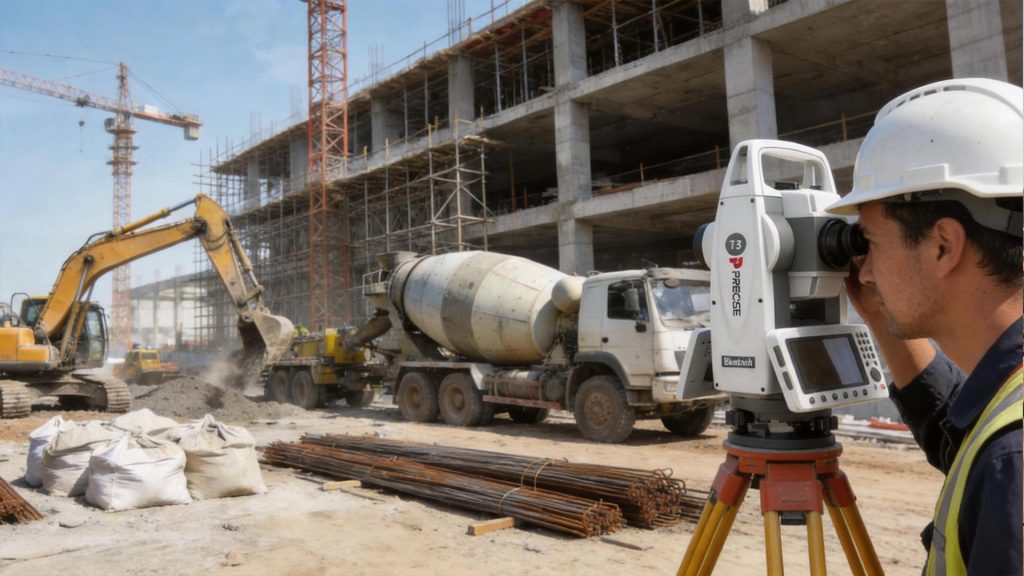
But in real-world construction environments, several factors can interfere with efficiency.
Obstructed Lines of Sight
Structural elements, machinery, temporary installations, or materials on site can interrupt measurement paths.
This may force operators to stop, reposition, or recheck points more frequently.
Limited Working Space
Tight areas restrict instrument setup and operator movement.
When there is not enough space to place the instrument ideally, crews need a more flexible workflow to keep layout work moving.
Variable Lighting Conditions
Strong sunlight, shadows, or low-light environments can affect screen visibility and field interaction.
When operators need more time to read, confirm, or adjust tasks, the entire workflow slows down.
Frequent Environmental Changes
Construction sites are dynamic.
Equipment, materials, temporary structures, and workers may change the working environment throughout the day.
These challenges often force operators to:
- Reposition equipment more often
- Recheck measurements repeatedly
- Slow down decision-making
- Restart parts of the workflow
- Spend more time adapting than executing
The result is not just reduced speed.
It is increased workflow fragmentation.
A More Adaptive Workflow Logic
Maintaining total station efficiency in complex environments requires a shift in approach.
Instead of trying to force ideal conditions, crews need a workflow that is adaptive and resilient.
A more practical approach is built on three principles:
1. Reduce Dependence on Perfect Setup Conditions
In complex job sites, waiting for the perfect setup position can slow down the entire task.
A more efficient workflow should allow crews to continue working with sufficient visibility and practical setup conditions.
2. Improve Operational Flexibility
Operators need to adjust quickly when site conditions change.
A flexible workflow reduces unnecessary interruptions and helps maintain progress even when the environment is not ideal.
3. Maintain Clarity Under Constraints
Even in limited visibility, tight spaces, or changing site conditions, operators still need to understand the task clearly.
Clear interaction and consistent data handling help reduce hesitation during execution.
This turns surveying from a “stop-and-adjust” process into a more continuous workflow.
Key Execution Steps for Complex Environments
1. Optimize Setup for Flexibility, Not Perfection
In constrained environments, spending too much time searching for the “perfect” setup position can delay the entire workflow.
Instead, crews should focus on practical setup choices that support continuous work.
A more efficient setup strategy includes:
- Choosing positions that provide sufficient visibility, not necessarily maximum visibility
- Prioritizing operational continuity over ideal geometry
- Considering the layout sequence before placing the instrument
- Avoiding setup locations that may quickly become blocked by site activity
This helps reduce setup time and keeps the work moving.
2. Minimize Repositioning Through Workflow Planning
Frequent repositioning is one of the biggest sources of efficiency loss in complex construction environments.
Every repositioning may involve:
- Moving the instrument
- Rechecking the setup
- Reconfirming target visibility
- Rebuilding workflow continuity
To reduce unnecessary repositioning, crews can:
- Plan layout sequences before starting
- Group nearby points into logical workflows
- Prioritize points based on accessibility
- Avoid unnecessary back-and-forth movement
- Consider obstruction zones before execution
Efficient planning often saves more time than faster measurement alone.
3. Maintain Clear Interaction in Limited Visibility
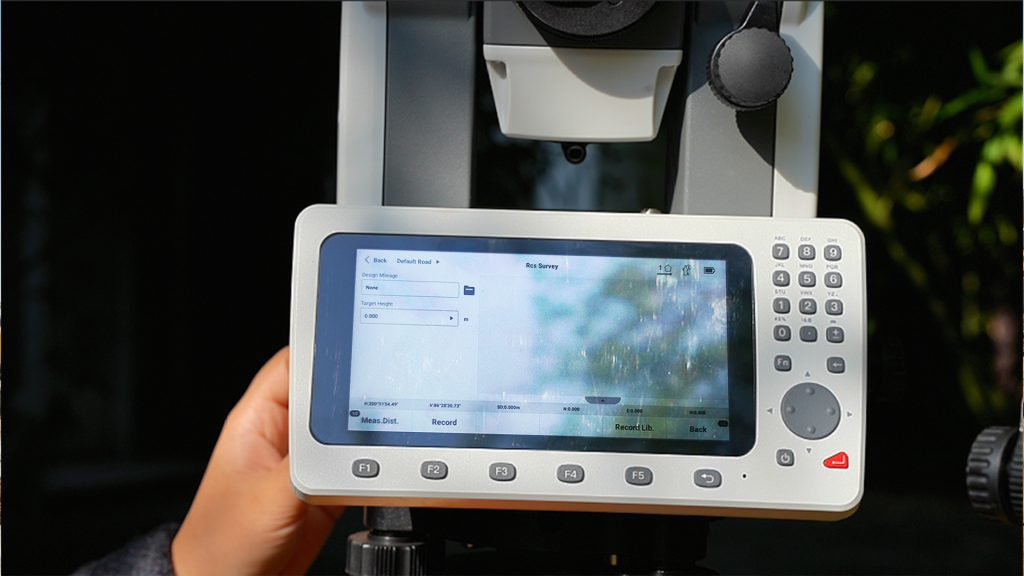
In environments with strong sunlight, shadows, or poor lighting, screen readability becomes critical.
If operators cannot clearly see the interface, even simple tasks may take longer.
A more efficient field workflow depends on:
- High-visibility display performance
- Clear interface structure
- Direct interaction logic
- Easy access to project data
- Simple point selection and confirmation
When the system is easier to read and interact with, operators can stay focused on the task instead of struggling with the interface.
This helps reduce hesitation and improves workflow consistency.
4. Adapt to Space Constraints Without Slowing Down
In tight areas, movement is limited and equipment positioning may be restricted.
This is common in:
- Building interiors
- Narrow corridors
- Dense structural areas
- Sites with temporary barriers
- Areas with stacked materials or machinery
A more efficient workflow should allow crews to make faster adjustments without complex recalibration or excessive external equipment.
This helps operators maintain progress even when space is limited.
The goal is not to make the site perfect.
The goal is to keep the workflow practical and stable under real conditions.
5. Maintain Workflow Continuity Under Changing Conditions
Construction environments change constantly.
A workflow that requires frequent restarting can quickly lose efficiency.
To maintain continuity, crews should avoid processes that depend too heavily on fixed, ideal conditions.
A more continuous workflow should support:
- Stable data handling across changes
- Consistent operation logic
- Faster adjustment when visibility or access changes
- Fewer repeated setup steps
- Reduced dependence on disconnected tools
Continuity is key to preventing small delays from accumulating over time.
What Affects Efficiency in Challenging Conditions
Even with an adaptive workflow, several factors can influence total station efficiency in the field.
Site Density and Obstruction Level
More obstacles usually require more flexible setup and workflow planning.
The denser the environment, the more important it becomes to reduce unnecessary repositioning.
Operator Awareness and Planning
Anticipating constraints before starting can significantly improve efficiency.
Experienced operators often save time by planning the layout sequence around real site conditions.
Equipment Usability
In complex conditions, interface clarity and responsiveness become even more important.
When the equipment is easier to use, operators can make faster decisions under pressure.
Environmental Stability
Frequent changes increase workflow disruption.
Moving machinery, temporary installations, and changing access routes can all affect layout efficiency.
Recognizing these factors helps crews adjust expectations and optimize execution on site.
Why This Workflow Fits Real Construction Scenarios
Modern construction sites are rarely ideal.
Surveying workflows must reflect that reality.
The PRECISE T3 Total Station is designed to support practical field operation in complex construction environments.
Key workflow advantages include:
- Android-based operating system
Enables flexible interaction and easier adaptation to different scenarios. - Integrated interface and control
Reduces reliance on external tools in constrained environments. - Practical field-oriented design
Focuses on maintaining efficiency under real job-site conditions, not only ideal setups. - Clearer operation logic
Helps operators keep tasks understandable even when visibility, space, or site conditions are limited.
This makes it easier for crews to maintain performance when conditions are less than optimal.
Instead of repeatedly stopping, adjusting, and restarting, operators can work with a more adaptive and continuous workflow.
Conclusion
Efficiency in construction surveying is not achieved by eliminating challenges.
It is achieved by working effectively despite them.
By optimizing setup strategy, reducing repositioning, and maintaining workflow clarity, crews can:
- Stay productive in obstructed environments
- Reduce delays caused by environmental constraints
- Maintain consistent output across varying site conditions
- Improve field confidence under pressure
- Keep layout work moving even when the site is not ideal
In complex construction environments, the most effective workflows are those that adapt without slowing down.