

Introduction
Single operator efficiency in precision farming is becoming a practical priority for farms that need to complete more work with fewer people.
This is especially true during long field hours, repeated passes, or tasks that demand constant steering attention. Even when equipment is technically capable, operator fatigue, head-turning, repeated corrections, and manual implement coordination can gradually reduce overall performance.
For farms facing labor pressure, or aiming to complete more work with fewer people, improving single-operator efficiency has become a practical priority.
Why Conventional Workflows Still Depend Too Much on the Operator
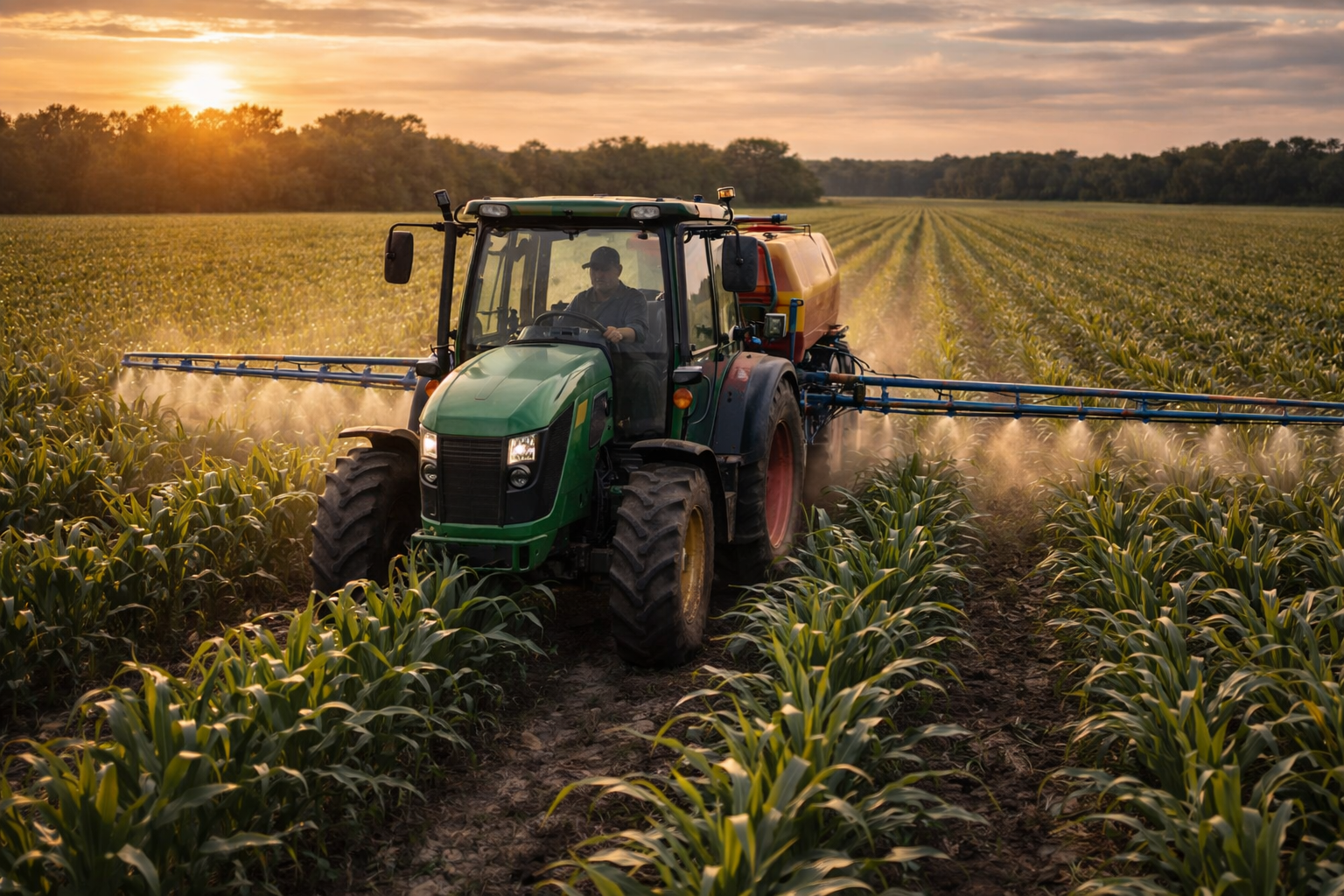
In a conventional field workflow, the operator is expected to do several things at once:
- Keep the vehicle aligned
- Monitor pass spacing
- Manage turns at the headland
- Watch implement status
- Correct overlap or skips manually
This creates a workflow that is heavily dependent on individual concentration.
The problem becomes more serious when operations extend into:
- Night work
- Large-acreage tasks
- Repetitive row-by-row operations
- Fields with uneven ground or irregular boundaries
In these conditions, even skilled operators experience fatigue. That fatigue does not always cause obvious mistakes, but it often reduces consistency, slows pace, and increases mental load.
A Better Workflow Logic
A more efficient approach is not simply to ask the operator to work harder. It is to redesign the workflow so that the operator no longer has to control every micro-decision manually.
This means shifting from:
“The operator performs every adjustment”
to
“The system handles repeatable guidance and control tasks”
The goal is to let one operator supervise the job rather than manually carry every part of it.
This is the real value of integrated precision farming automation: it reduces workload while helping field performance stay stable.
Key Execution Steps
1. Stabilize Guidance First
Single-operator efficiency starts with reducing steering workload.
A stable guidance workflow should:
- Maintain accurate path tracking
- Reduce the need for repeated steering corrections
- Keep pass spacing consistent over long runs
When steering is automated, the operator can focus more on field conditions, implement behavior, and job progress instead of constantly correcting direction.
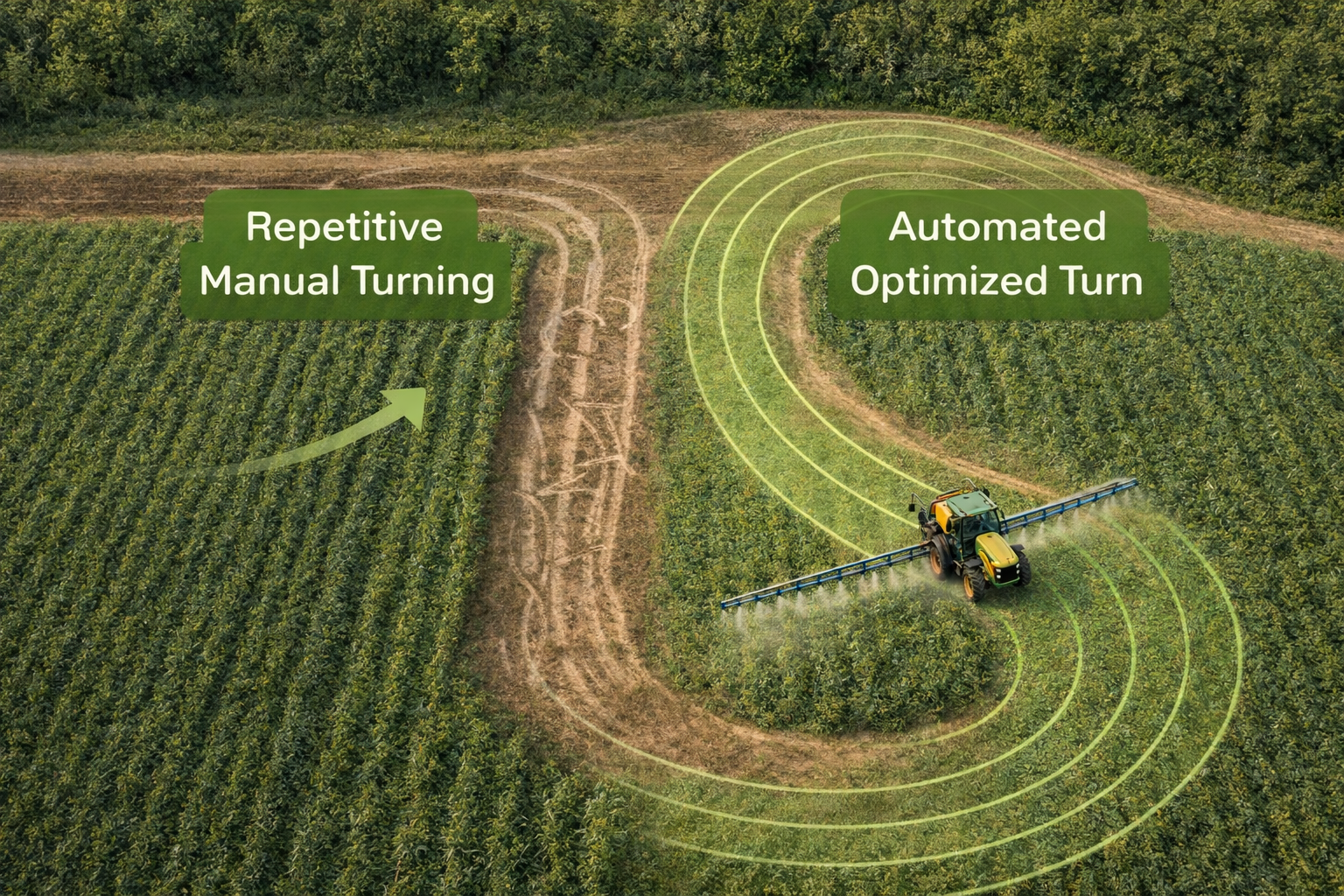
2. Reduce Repetitive Manual Actions During Turns
Headland turns are one of the most tiring parts of repetitive fieldwork.
Without automation, the operator must repeatedly:
- Judge timing
- Control steering
- Re-enter the next pass accurately
Over a full day, this repetition adds significant mental and physical load.
A more efficient workflow uses automated turning support to reduce repetitive steering tasks and improve consistency at every pass transition.
3. Centralize Implement Control
Efficiency drops when the cab workflow is fragmented across multiple control interfaces.
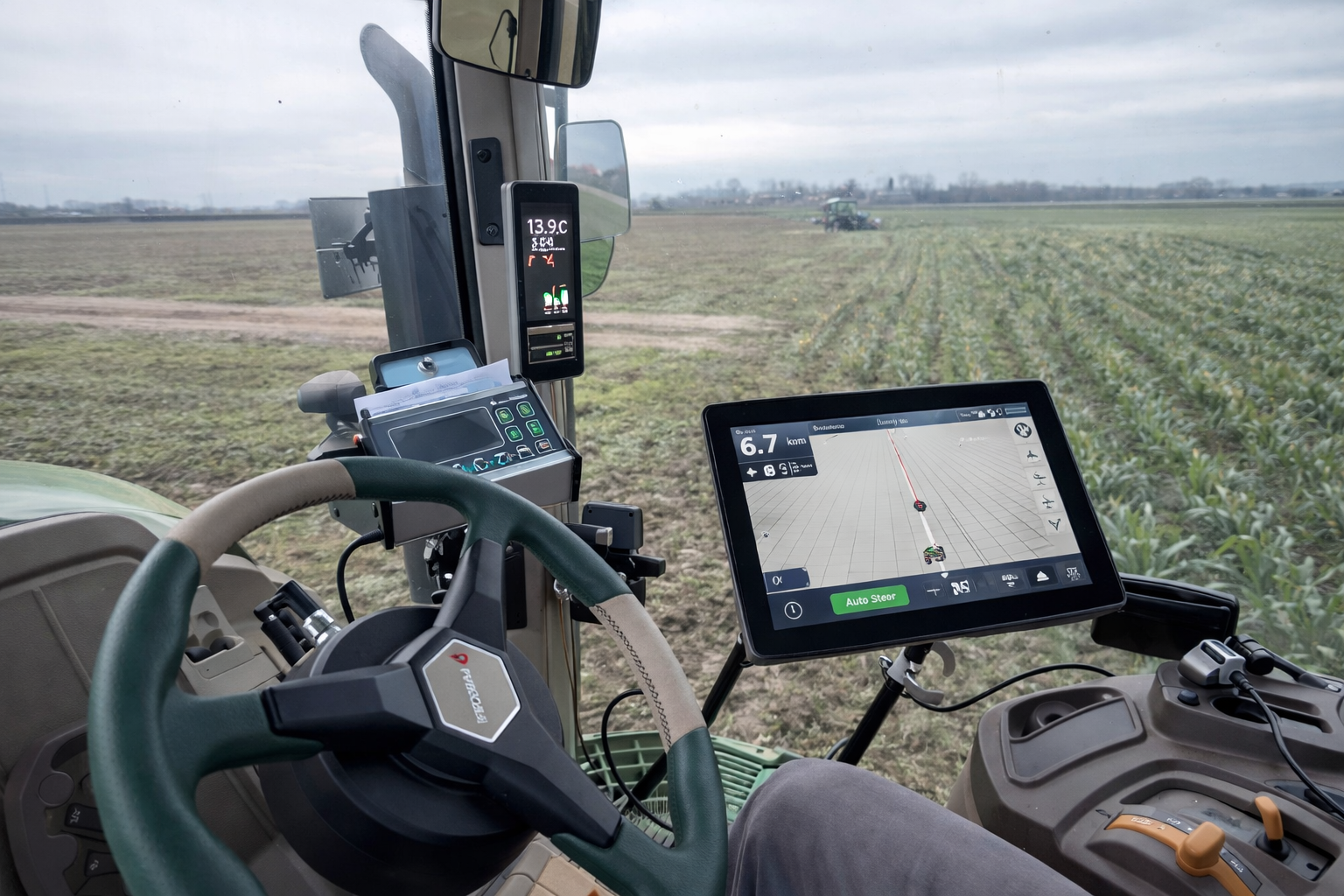
A single-operator setup works better when the operator can manage steering and implement-related functions from one unified control environment.
This reduces:
- Interface switching
- Extra control boxes in the cab
- Delays caused by manual section adjustments
In practical terms, this means fewer interruptions and less distraction during operation.
4. Maintain Performance in Low-Visibility or Long-Hour Conditions
Single-operator efficiency is not only about speed. It is also about maintaining quality over time.
Night work, dust, or long working hours make manual guidance more demanding. In these situations, automation helps preserve consistency even when visibility or operator energy declines.
A well-structured workflow should support:
- Accurate operation after dark
- Stable pass-to-pass control
- Reduced need for constant visual alignment
This is where operator comfort directly affects output quality.
5. Keep the Operator in a Supervisory Role
The most effective precision workflow is not one where the operator is overloaded with constant control tasks.
It is one where the operator can:
- Observe machine behavior
- Monitor field conditions
- Check implement performance
- Intervene only when necessary
That shift, from controller to supervisor, is what enables one person to manage more work with less fatigue.
What Affects the Results
Improving single-operator efficiency depends on more than automation alone.
Several factors still matter:
Positioning stability
Reliable GNSS and RTK performance are essential for repeatable automated operation.
Machine compatibility and setup quality
Poor installation or mismatched settings reduce workflow smoothness.
Field complexity
Irregular terrain, tight boundaries, or obstacles increase task difficulty.
Operator familiarity
Even user-friendly systems still require basic workflow discipline and correct setup.
Automation reduces workload, but consistent results still depend on a stable operating environment.
Why This Workflow Fits Modern Farming Operations
As farms work to improve output per operator, workflow integration becomes more important than isolated features.
The PRECISE A Pro is designed around that kind of integrated field logic. Its product positioning highlights ±2.5 cm pass-to-pass accuracy, Smart U-turn, ISOBUS support, terrain compensation, and an operating speed range of 0.1–26 km/h. The system is intended to reduce skips and overlaps, support night work, and improve comfort by reducing the need for constant head-turning.
That matters because single-operator efficiency is not created by one feature alone. It comes from combining guidance accuracy, automated turning, and simplified implement control into one smoother operating workflow.
A Pro’s integration of auto steering, Smart U-turn, and ISOBUS control aligns directly with that need.
Conclusion
Improving single-operator efficiency is not just about finishing faster. It is about reducing unnecessary manual effort so that performance stays consistent across the full job.
By shifting repetitive control tasks into a more automated workflow:
- Steering workload is reduced
- Operator fatigue decreases
- Long-hour consistency improves
- One operator can manage more field work with greater stability
In precision farming, efficiency is no longer only a machine question. It is also a workflow design question, and that is exactly where modern automation creates value.