
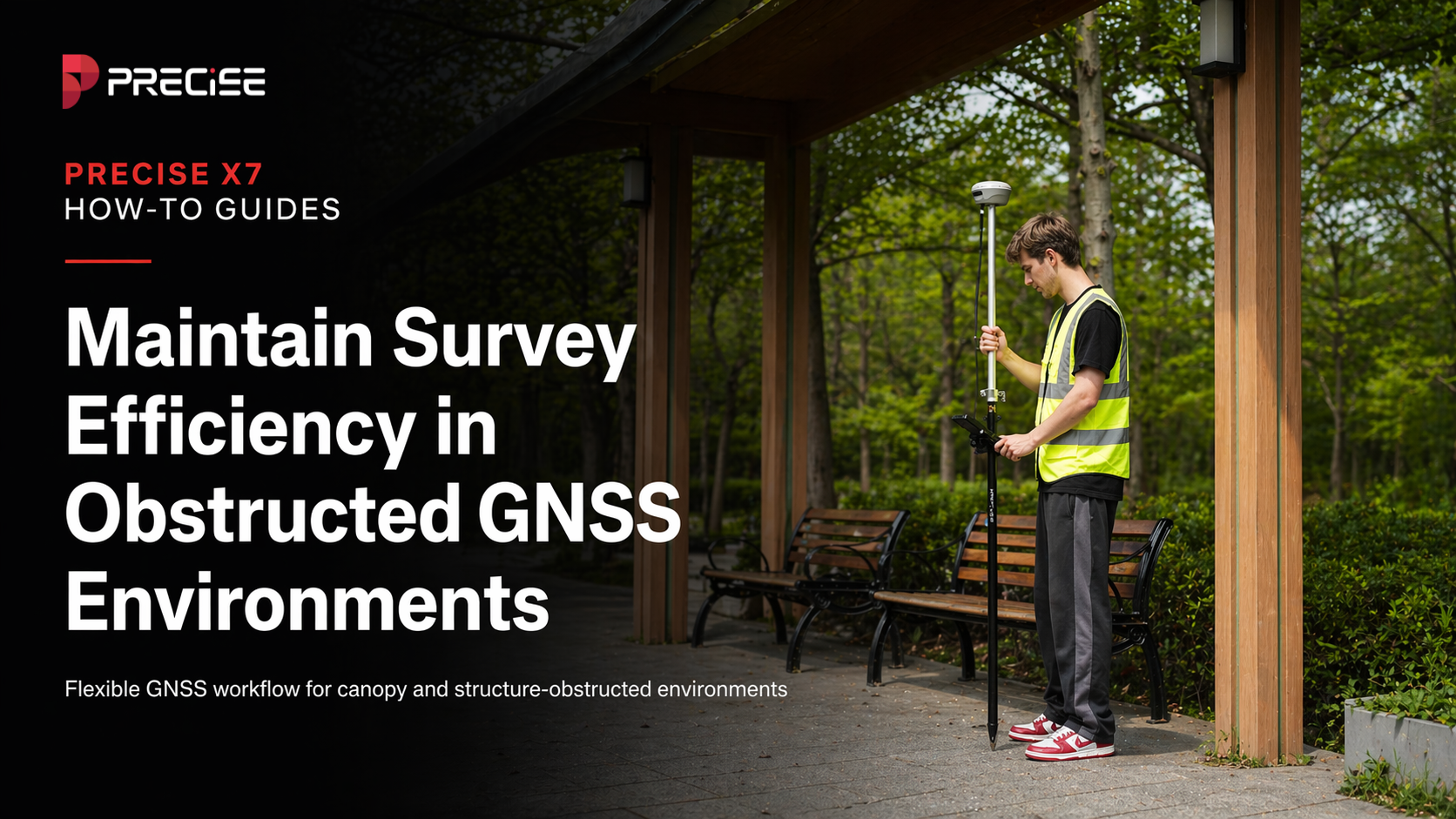
Survey efficiency in obstructed GNSS environments often depends less on ideal signal conditions and more on how well the workflow adapts to interruption, uncertainty, and limited visibility.
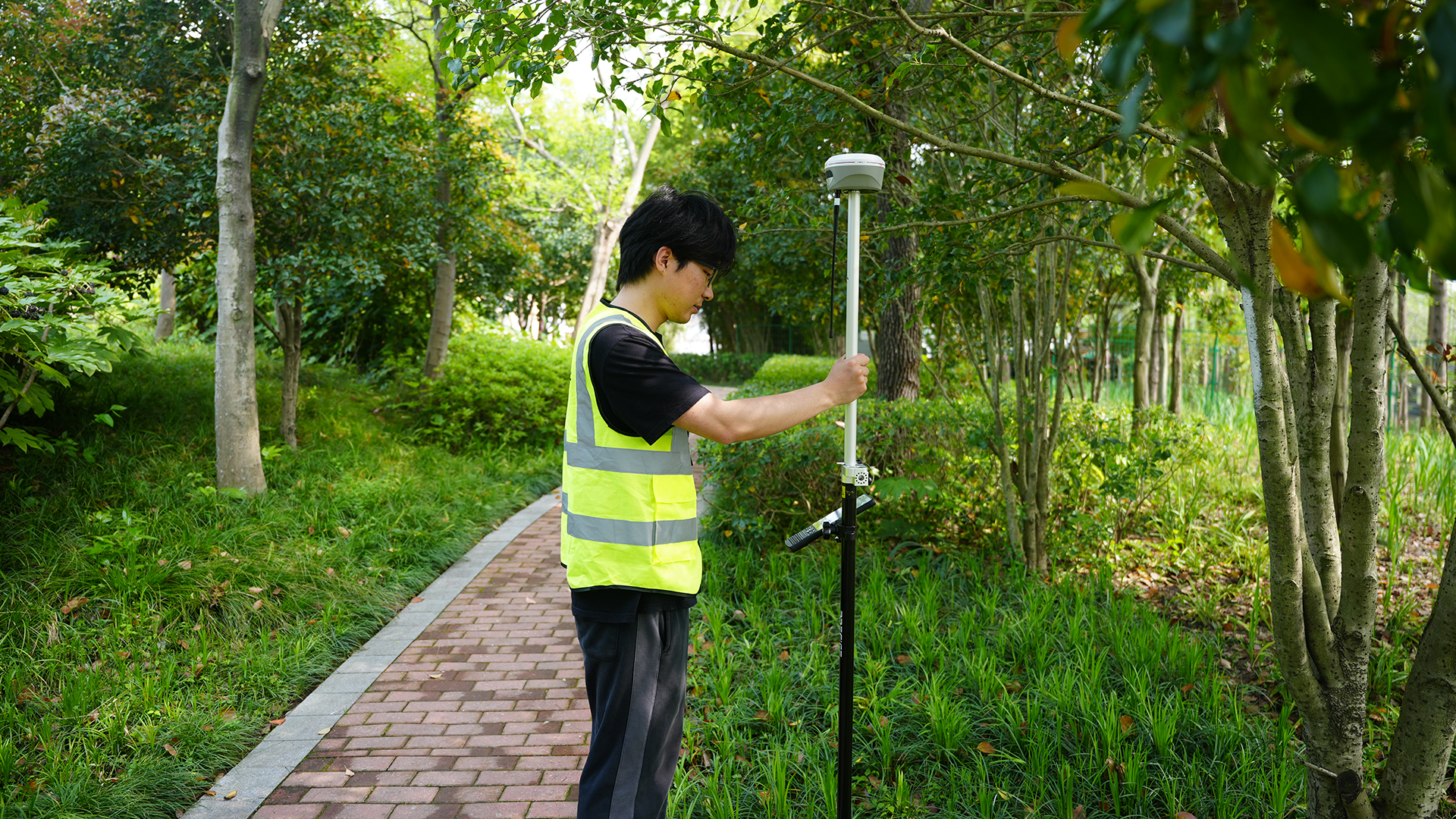
While open-sky conditions allow for smooth and predictable workflows, many real-world surveying projects take place in environments where signal quality is compromised. These conditions are common in areas under tree canopy, near buildings or large structures, in urban corridors with limited sky visibility, inside partially enclosed construction zones, or around reflective surfaces that can cause signal interference.
In these situations, the workflow often slows down not because the task itself is more complex, but because signal instability interrupts measurement continuity.
This article explains how to maintain survey efficiency in obstructed GNSS environments by adjusting workflow strategies rather than relying solely on signal conditions.
Why Obstructed Environments Reduce Productivity
In ideal conditions, GNSS surveying is continuous and predictable. In obstructed environments, that continuity begins to break down.
Common issues include:
- Unstable positioning or delayed convergence
- Frequent interruptions in workflow
- Repeated measurement of the same point
- Hesitation caused by inconsistent feedback
- Loss of working rhythm
The result is not simply slower measurement. It is fragmented workflow.
When surveyors are forced to stop, wait, recheck, or reposition repeatedly, overall productivity drops quickly. That is why working under obstruction is not only a signal problem. It is also a workflow management problem.
A More Effective Approach: Stabilize the Workflow, Not Just the Signal
Improving efficiency in obstructed environments is not always about improving signal conditions, because those conditions are often fixed by the site itself.
Instead, the workflow should focus on:
- Reducing dependency on perfect positioning
- Maintaining continuity of movement
- Minimizing unnecessary rework
- Adapting measurement methods to real site conditions
An integrated workflow makes it possible to stay productive even when GNSS conditions are less than ideal.
With a system such as the PRECISE X7, this can be supported through a combination of:
- Stable positioning strategies
- Visual interpretation support
- Flexible measurement approaches
- Tilt-supported operation
The goal is not to eliminate obstruction. The goal is to work efficiently despite it.
Step-by-Step Workflow for Obstructed GNSS Environments
Step 1: Identify Signal-Limited Zones Early
Before starting measurement, first observe where signal limitations are most likely to occur.
This includes:
- Areas with poor sky visibility
- Potential sources of obstruction such as trees, walls, or machinery
- Transitional zones where conditions change between open and covered areas
Working reactively in these spaces often leads to delays. Planning the sequence in advance improves workflow continuity.
Step 2: Prioritize Stable Positions for Critical Points
Not all points require the same level of positioning stability.
For key control or reference points:
- Choose locations with better signal conditions whenever possible
- Avoid rushing directly into obstructed zones
- Establish reliable reference measurements early in the workflow
This reduces the need for later correction or repeated checking.
Step 3: Use Flexible Measurement Methods Where Needed
In obstructed areas, forcing direct occupation is not always the most efficient option.
A better approach is to:
- Avoid direct occupation when conditions are poor
- Use alternative measurement methods when visibility allows
- Maintain productivity without waiting for ideal signal conditions
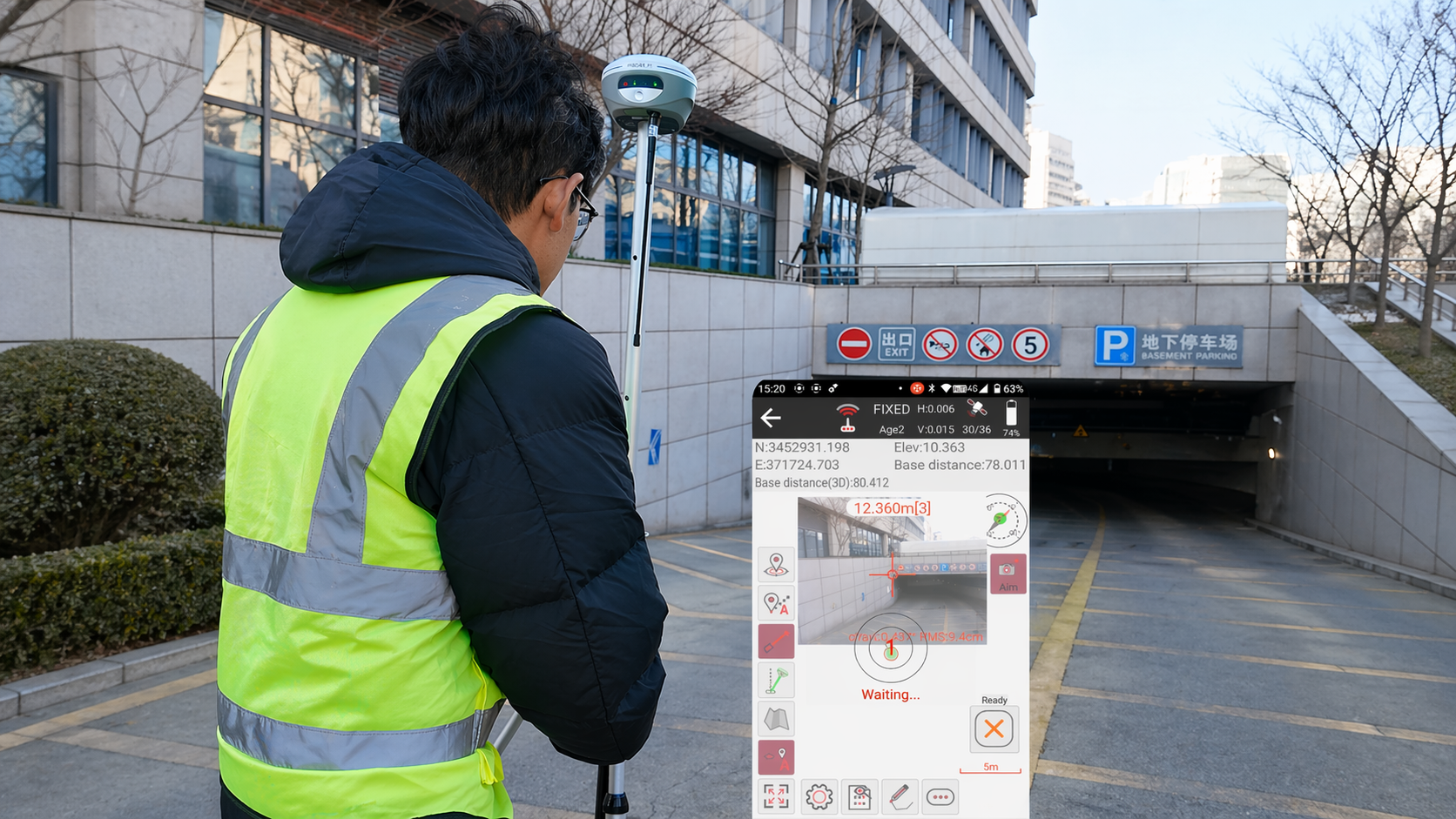
Laser-assisted measurement becomes especially useful when direct access is inefficient, GNSS conditions fluctuate, or movement is restricted by the site.
Step 4: Reduce Repetition Through Visual Understanding
Repeated measurement is one of the biggest hidden time losses in obstructed environments.
To reduce this:
- Use visual context to confirm target location
- Avoid re-measuring points because of uncertainty
- Make sure the correct point is identified before finalizing the result
Visual interpretation helps maintain confidence even when signal feedback is less consistent.
Step 5: Maintain Continuous Movement
Frequent stops and restarts are a major source of delay.
To keep the workflow efficient:
- Group nearby points into logical sequences
- Minimize unnecessary backtracking
- Keep movement fluid between measurements
Efficiency comes from rhythm, not just speed.
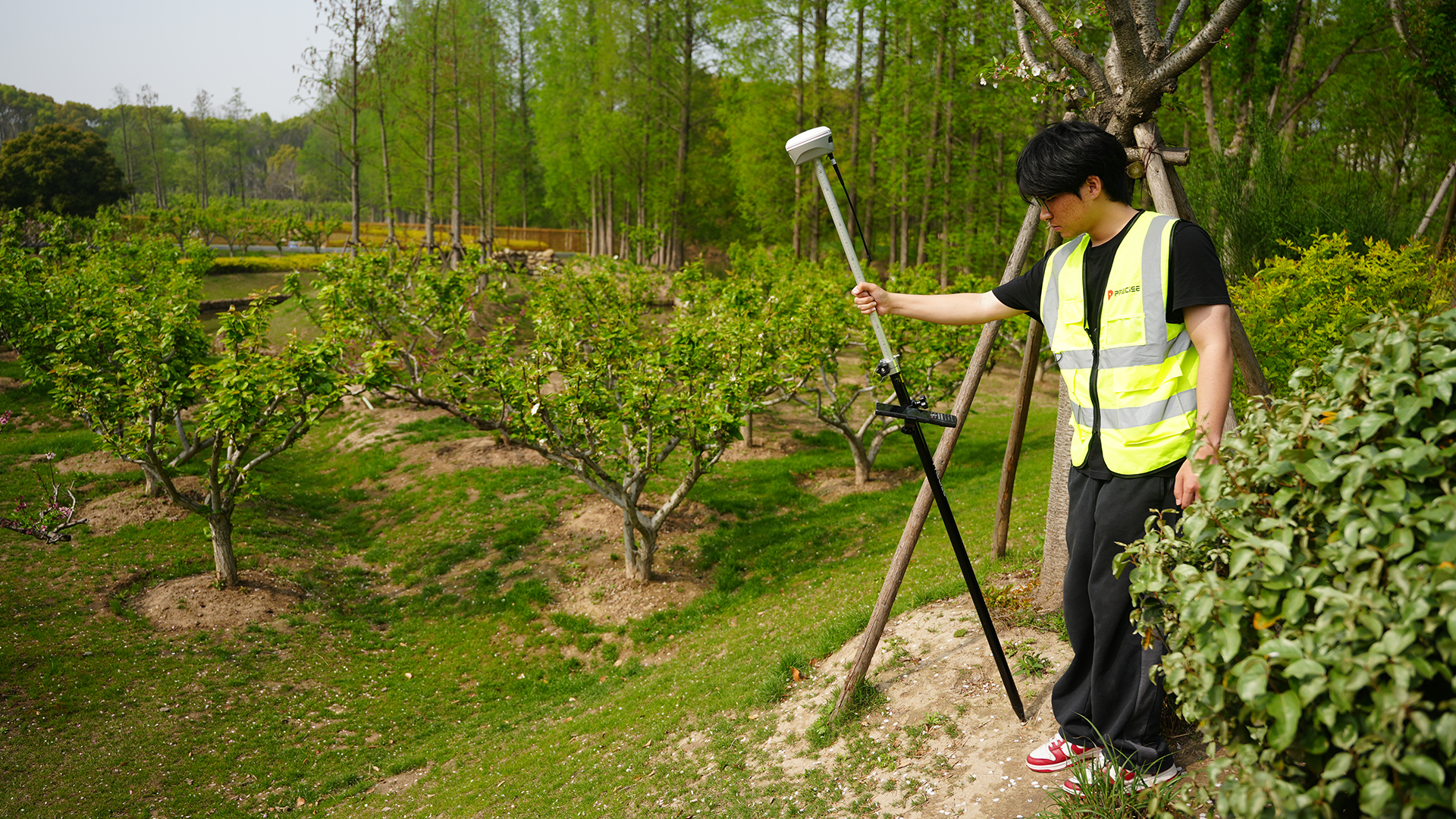
Step 6: Use Tilt Flexibility to Avoid Repositioning
In obstructed environments, ideal pole positioning is not always practical.
Small adjustments can otherwise require full repositioning, which slows down the workflow.
Tilt-supported surveying allows operators to:
- Acquire points faster
- Reduce dependence on perfect vertical alignment
- Work more smoothly in tight or uneven areas
This is especially valuable under tree canopy or near large structures.
What Affects Performance in Obstructed Conditions
Even with an optimized workflow, performance still depends on several practical factors.
These include:
- Signal variability: Fluctuating conditions require an adaptive workflow
- Environment density: More obstruction increases operational complexity
- Measurement method choice: Using the wrong method creates unnecessary delays
- Operator decision-making: Workflow awareness remains critical
Understanding these factors helps maintain more consistent efficiency across changing site conditions.
When This Workflow Is Most Valuable
This workflow is particularly effective in:
- Forested or semi-covered areas
- Urban construction environments
- Infrastructure corridors
- Sites with mixed open and obstructed zones
- Projects that require continuous movement across varying conditions
In these scenarios, adapting the workflow often has a greater impact than trying to improve signal conditions alone.
Conclusion
Obstructed GNSS environments are a normal part of modern surveying.
Trying to eliminate them is often impractical. A more effective approach is to maintain workflow efficiency despite imperfect conditions.
By combining stable positioning strategies, flexible measurement methods, visual interpretation, and continuous movement, surveyors can:
- Reduce unnecessary delays
- Avoid repeated work
- Maintain productivity across variable environments
In challenging conditions, efficiency is not achieved by waiting for better signals. It is achieved by working smarter within the conditions that already exist.