

Stakeout efficiency on busy construction sites often depends less on positioning alone and more on how quickly surveyors can interpret complex surroundings.
On paper, the process seems straightforward: follow the guidance, move to the point, and confirm the position. In reality, busy construction sites rarely offer ideal working conditions. Surveyors often need to work in environments filled with temporary structures, changing layouts, machinery, stacked materials, moving personnel, repeated structural elements, and limited working space.
Under these conditions, stakeout becomes less about pure accuracy and more about maintaining efficiency in a complex and constantly changing environment.
This article explains how to improve stakeout efficiency on busy construction sites by optimizing workflow rather than relying only on positioning performance.

Why Stakeout Slows Down in Complex Environments
In open environments, stakeout is mainly a positioning task. On busy construction sites, it becomes an interpretation task.
The most common causes of slowdown include:
- Difficulty identifying the correct physical target
- Repeated checking of direction and distance
- Hesitation caused by visual confusion
- Interruptions created by obstacles or on-site movement
- Frequent repositioning to double-check the target location
These issues are not always caused by GNSS accuracy. In many cases, they come from the way the operator interacts with the surrounding environment.
As site complexity increases, the gap between coordinate guidance and real-world understanding becomes the main bottleneck in workflow efficiency.
A More Effective Approach: Reduce Interpretation Time
Improving stakeout efficiency is not simply about moving faster. It is about making decisions faster and with more confidence.
An optimized stakeout workflow should:
- Reduce the need to mentally translate coordinates into physical space
- Improve clarity when identifying the target location
- Minimize repeated confirmation steps
- Maintain continuous movement between stakeout points
This is where combining visual guidance, flexible positioning, and efficient movement becomes especially valuable.
With an integrated workflow such as that enabled by the PRECISE X7, surveyors can:
- Use visual stakeout to understand point location more quickly
- Avoid unnecessary directional corrections
- Maintain smoother movement across multiple stakeout tasks
- Adapt their position without losing efficiency
The key is not to use more features. The key is to apply the right workflow for complex environments.
Step-by-Step Workflow for Efficient Stakeout
Step 1: Start from a Readable Position
Before moving toward the point, choose a starting position that makes the environment easier to interpret.
A good starting position should:
- Provide a clear view of the surrounding area
- Avoid visually blocked or congested zones
- Make it easier to understand the relationship between your position and the target point
A clear starting position reduces confusion later in the process and supports smoother movement.
Step 2: Establish Stable Positioning Before Movement
Do not begin stakeout before the system is fully ready.
Before moving:
- Confirm stable GNSS status
- Ensure the controller and device connection is reliable
- Avoid walking while the system is still stabilizing
Unstable positioning often leads to unnecessary corrections, hesitation, and wasted time.
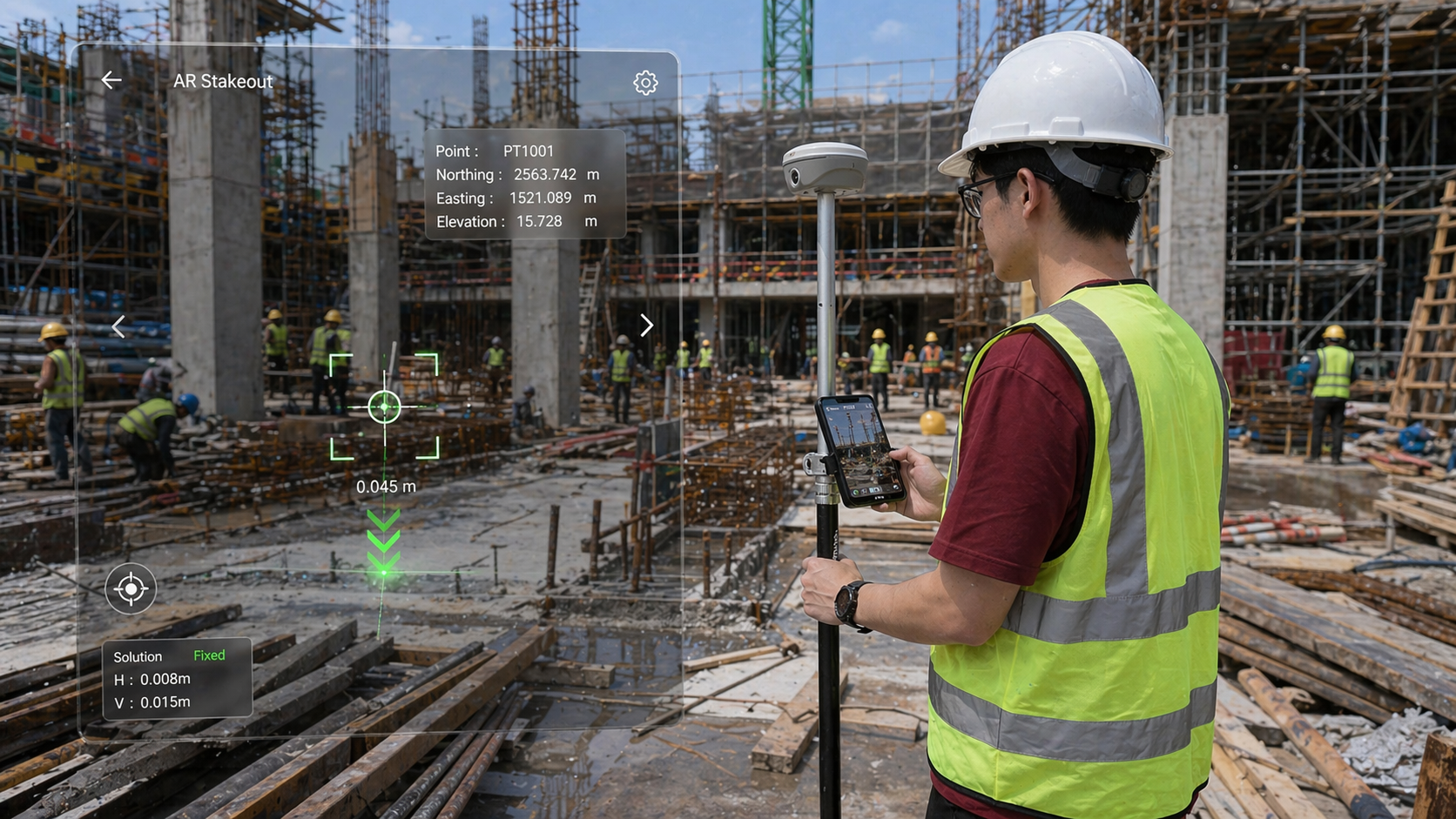
Step 3: Use Visual Guidance to Reduce Orientation Time
Instead of relying only on numeric direction and distance, use visual guidance to understand the target in context.
Visual stakeout helps the operator:
- See where the point sits relative to surrounding structures
- Align movement with visible reference elements
- Reduce repeated directional adjustments
This is especially effective in environments with repeated structures, partial obstruction, or high visual noise.
Step 4: Move Continuously, Not Incrementally
One common inefficiency in stakeout is stop-and-check movement.
A more efficient method is to:
- Move smoothly and continuously toward the target
- Avoid stopping too frequently for micro-adjustments
- Trust the workflow once positioning is stable
Stakeout becomes more efficient when movement is fluid rather than fragmented.

Step 5: Minimize Repositioning
Frequent repositioning is one of the biggest hidden time losses on busy sites.
To reduce it:
- Use visual context instead of over-correcting
- Avoid unnecessary detours unless visibility is completely blocked
- Maintain a consistent working direction across multiple points
A planned working path is usually more efficient than reacting point by point.
Step 6: Adapt Position Without Losing Accuracy
On active construction sites, ideal positioning is not always possible. Obstacles, limited access, and changing site conditions often make a direct approach difficult.
Tilt-supported surveying allows operators to:
- Maintain productivity in constrained areas
- Avoid repositioning only to achieve perfect alignment
- Continue working without breaking workflow
This flexibility is essential for maintaining efficiency in real site conditions.
What Affects Stakeout Efficiency
Even with an optimized workflow, performance still depends on several practical factors.
These include:
- Site density: More objects and activity increase interpretation difficulty
- Visual clarity: Poor visibility often causes hesitation
- Workflow discipline: Inconsistent methods reduce efficiency
- Operator experience: Familiarity with visual workflows improves speed and confidence
Understanding these factors helps survey teams maintain more consistent performance across different project environments.
When This Workflow Makes the Biggest Difference
This workflow is especially useful in:
- Dense construction environments
- Urban infrastructure projects
- Indoor-outdoor transitional areas
- Sites with temporary structures
- Repetitive layout tasks across large working areas
In these situations, reducing interpretation time often has a greater impact on productivity than improving raw positioning speed alone.
Conclusion
Stakeout efficiency is not defined by how quickly a point can be reached. It is defined by how quickly the correct decision can be made.
On busy construction sites, the main challenge is not positioning accuracy alone. It is clarity in a complex environment.
By reducing interpretation time, maintaining workflow continuity, and adapting movement to real site conditions, surveyors can significantly improve productivity without increasing effort.
In complex stakeout environments, the most effective workflow is the one that removes hesitation. Because in stakeout work, confidence is often the biggest driver of speed.