
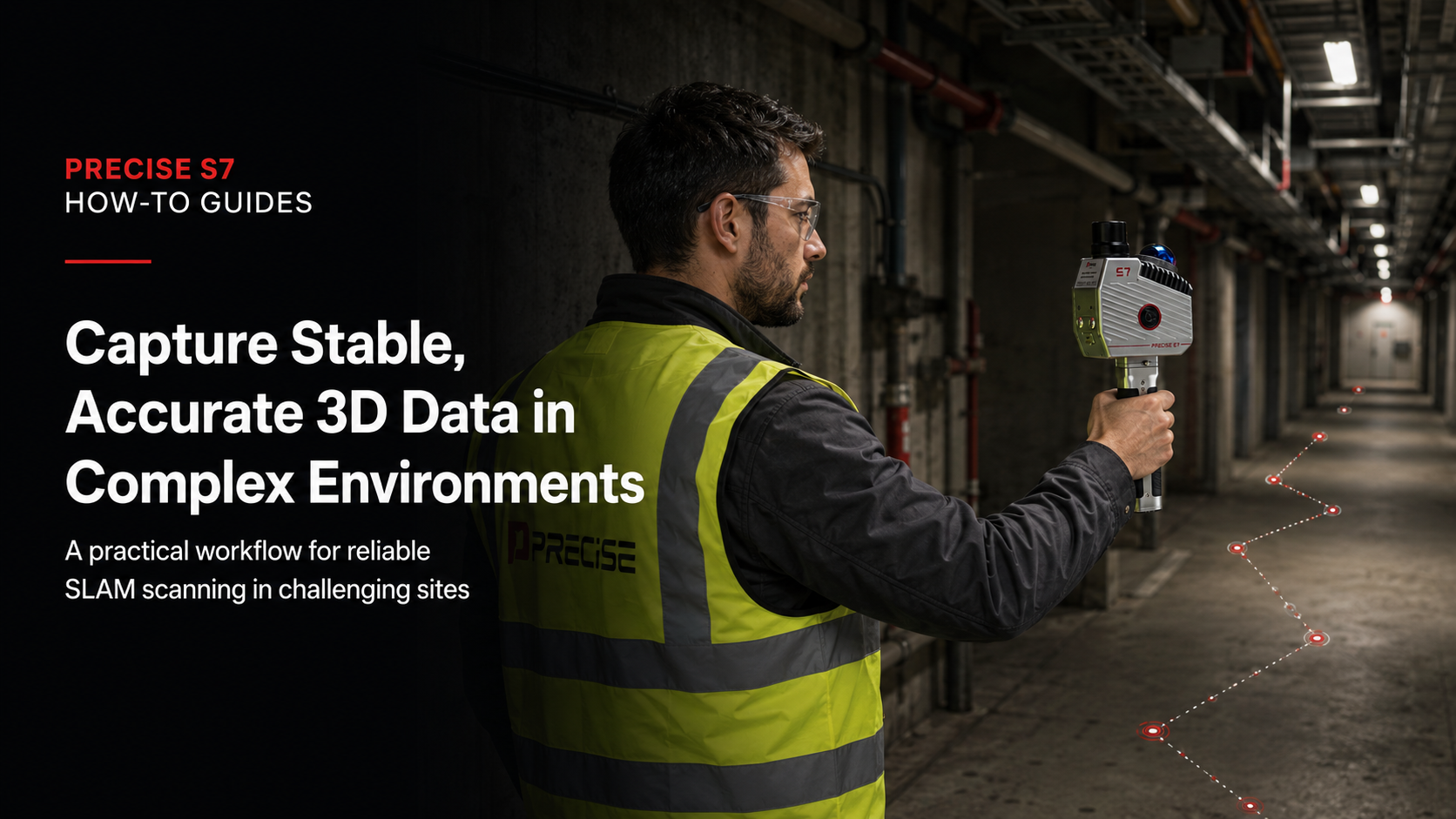
Learn how SLAM scanning in complex environments helps capture stable, accurate 3D data with better trajectory planning, controlled movement, and multi-sensor fusion. Surveyors, engineers, and geospatial professionals often need to work in spaces where GNSS signals are weak, structures are repetitive, lighting conditions are inconsistent, and movement paths are limited.
These challenges are especially common in indoor industrial facilities, underground tunnels, dense urban areas, forested environments, and partially obstructed project sites.
In these conditions, the key challenge is not only collecting data. It is maintaining trajectory stability, data consistency, and reliable scan quality throughout the entire workflow.
This guide explains how to approach complex SLAM scanning tasks more effectively, focusing on practical workflow logic rather than basic device operation. It also shows how multi-sensor SLAM systems such as the PRECISE S7 can help improve data reliability in demanding field environments.
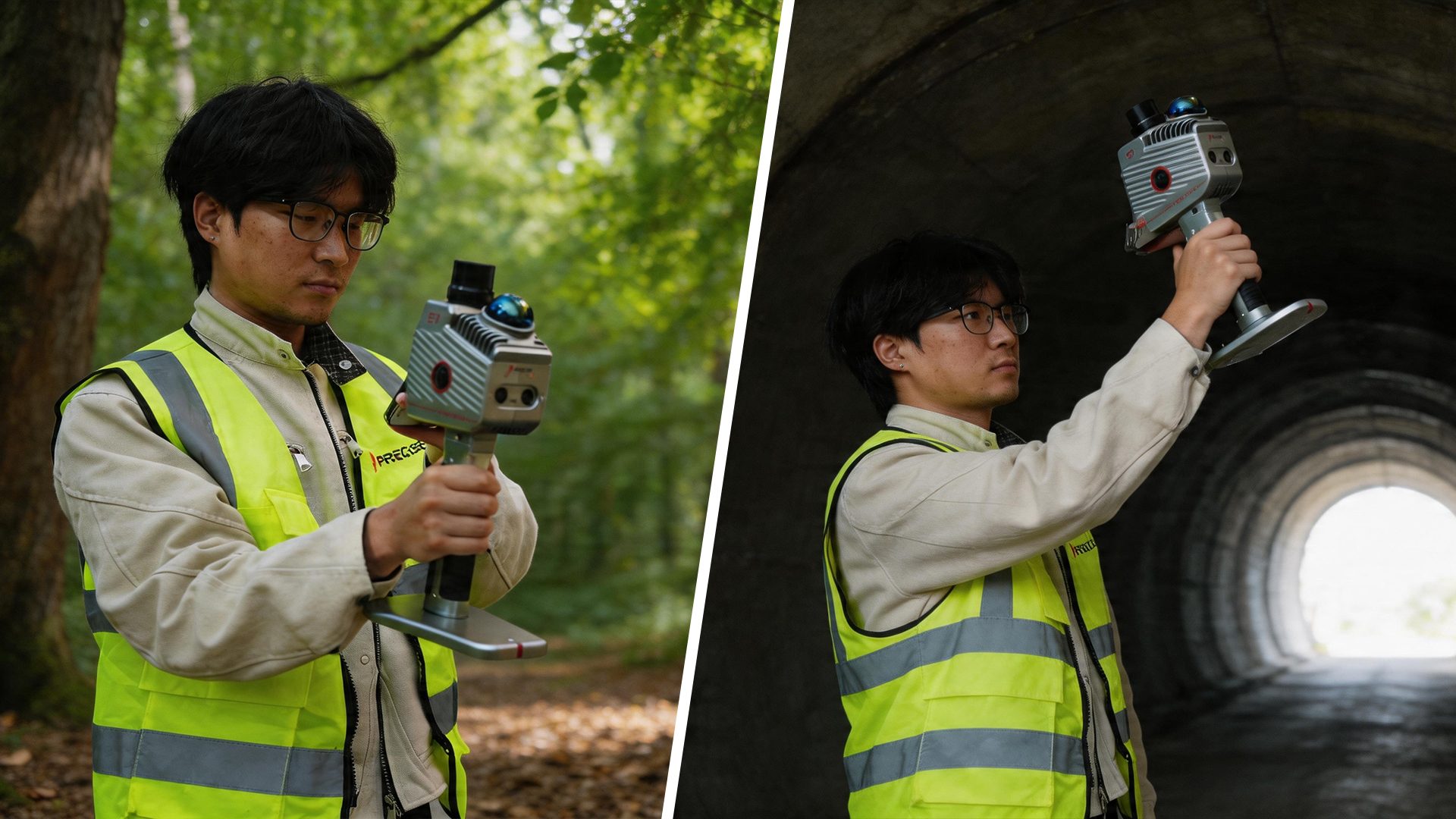
Why Conventional Scanning Approaches Break Down
Traditional 3D data capture workflows often rely on either static scanning or mobile scanning.
Static scanning can deliver high accuracy at each scan position, but it often requires time-consuming setup, multiple stations, and later alignment work. In complex or large environments, this can slow down field operations and increase the workload during post-processing.
Mobile scanning improves coverage efficiency, but systems without strong sensor fusion may face problems such as trajectory drift, tracking loss in repetitive environments, and reduced consistency in geometry or color data.
In complex environments, these limitations can lead to:
- Incomplete datasets
- Misaligned point clouds
- Longer post-processing time
- Higher risk of field rework
- Less reliable project deliverables
For this reason, a stable and well-planned scanning workflow is just as important as the scanning device itself.
A Better Workflow Logic for Complex SLAM Scanning
Effective SLAM scanning is not only about moving quickly through a site. It is about moving in a way that supports stable tracking and consistent data capture.
A better workflow should prioritize three things:
1. Trajectory stability over speed
Fast scanning is useful only when the trajectory remains reliable. In complex environments, controlled movement usually produces better results than rushing through the site.
2. Environmental awareness over blind coverage
Operators should understand where tracking may become difficult, such as long corridors, repetitive surfaces, open areas, or spaces with few visual features.
3. Sensor synergy over single-source data reliance
Modern SLAM systems combine LiDAR, vision, and IMU data to support more stable tracking when one signal source becomes less reliable.
The goal is not simply to scan faster. The real goal is to preserve data integrity from the beginning to the end of the scanning path.
Key Execution Steps for Reliable SLAM Data Capture
1. Plan a Continuous and Loop-Friendly Path
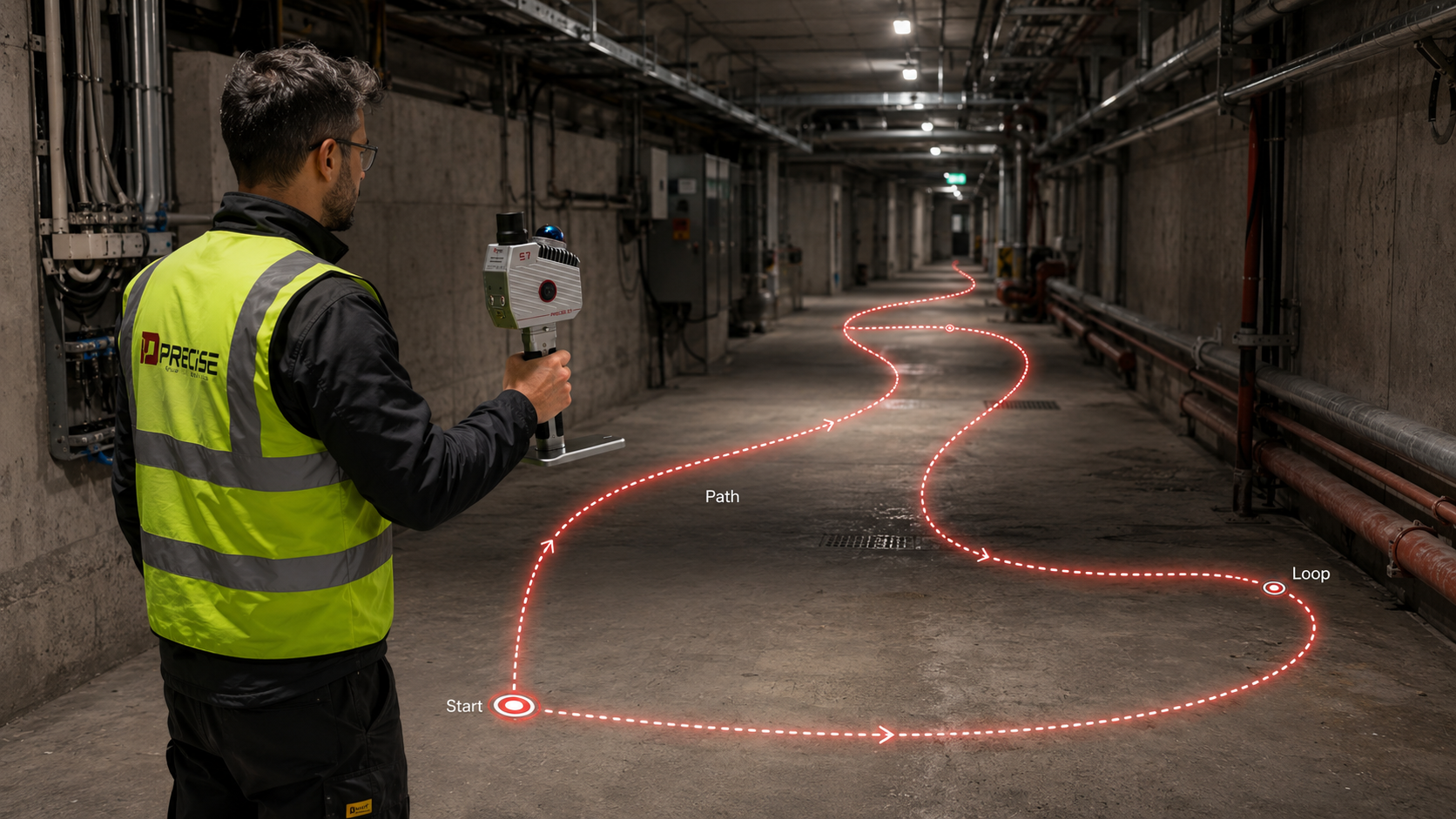
Before scanning, plan a path that allows the operator to return to known or previously scanned areas. This is especially important in environments where the scanning route is long, narrow, or visually repetitive.
Avoid long straight paths without enough reference features whenever possible. Instead, create a route that supports loop closure and gives the SLAM system more opportunities to correct accumulated drift.
Why it matters:
Loop closure helps reduce trajectory drift and improves the global consistency of the final point cloud.
2. Maintain Smooth and Controlled Movement
During scanning, walk at a consistent pace and avoid sudden rotations, sharp stops, or unnecessary shaking. The device should remain stable throughout the scanning process.
Smooth motion helps the system maintain better continuity between LiDAR, visual, and IMU data.
Why it matters:
SLAM algorithms depend on predictable movement. Erratic motion can reduce trajectory accuracy and make the final dataset less reliable.
3. Use Environmental Features to Support Tracking
In feature-poor environments such as tunnels, corridors, warehouses, or open industrial areas, operators should intentionally include more identifiable features in the scanning path.
Useful reference features may include:
- Corners
- Intersections
- Equipment
- Structural changes
- Doors, columns, or fixed objects
Why it matters:
Visual SLAM benefits from recognizable environmental features. Repetitive or empty surfaces can make tracking more difficult and increase the risk of ambiguity.
4. Balance Coverage and Redundancy
Reliable SLAM scanning does not mean scanning the same area repeatedly without purpose. It also does not mean moving too quickly through important zones.
A good workflow should balance coverage and useful redundancy.
For key areas, scan from more than one angle when possible. Maintain consistent coverage density and make sure important structures are captured clearly.
Why it matters:
Balanced redundancy improves data completeness while avoiding unnecessary file size, wasted time, or inefficient scanning routes.
5. Monitor Data in Real Time When Available
If the system supports real-time preview or trajectory monitoring, operators should use it during scanning.
Real-time feedback can help identify:
- Missing areas
- Trajectory interruptions
- Possible drift
- Incomplete coverage
- Areas that may need immediate rescanning
Why it matters:
Finding problems during fieldwork is much easier than discovering them after returning to the office. Real-time monitoring helps reduce rework and improves project efficiency.
What Affects SLAM Scanning Results?
Even with a strong workflow, final scan quality can still be affected by several factors.
Environmental Factors
Lighting conditions, reflective surfaces, narrow spaces, moving people, vehicles, or temporary objects can all influence scan quality.
Motion Factors
Walking speed, device handling, turning behavior, and operator consistency can directly affect trajectory reliability.
System Factors
Sensor synchronization, algorithm robustness, LiDAR performance, visual tracking capability, and data fusion quality all play important roles in the final result.
Understanding these factors helps field teams make better decisions during scanning instead of relying only on post-processing corrections.
Why Multi-Sensor SLAM Systems Improve Results
A multi-sensor SLAM system combines different types of data to support more reliable scanning.
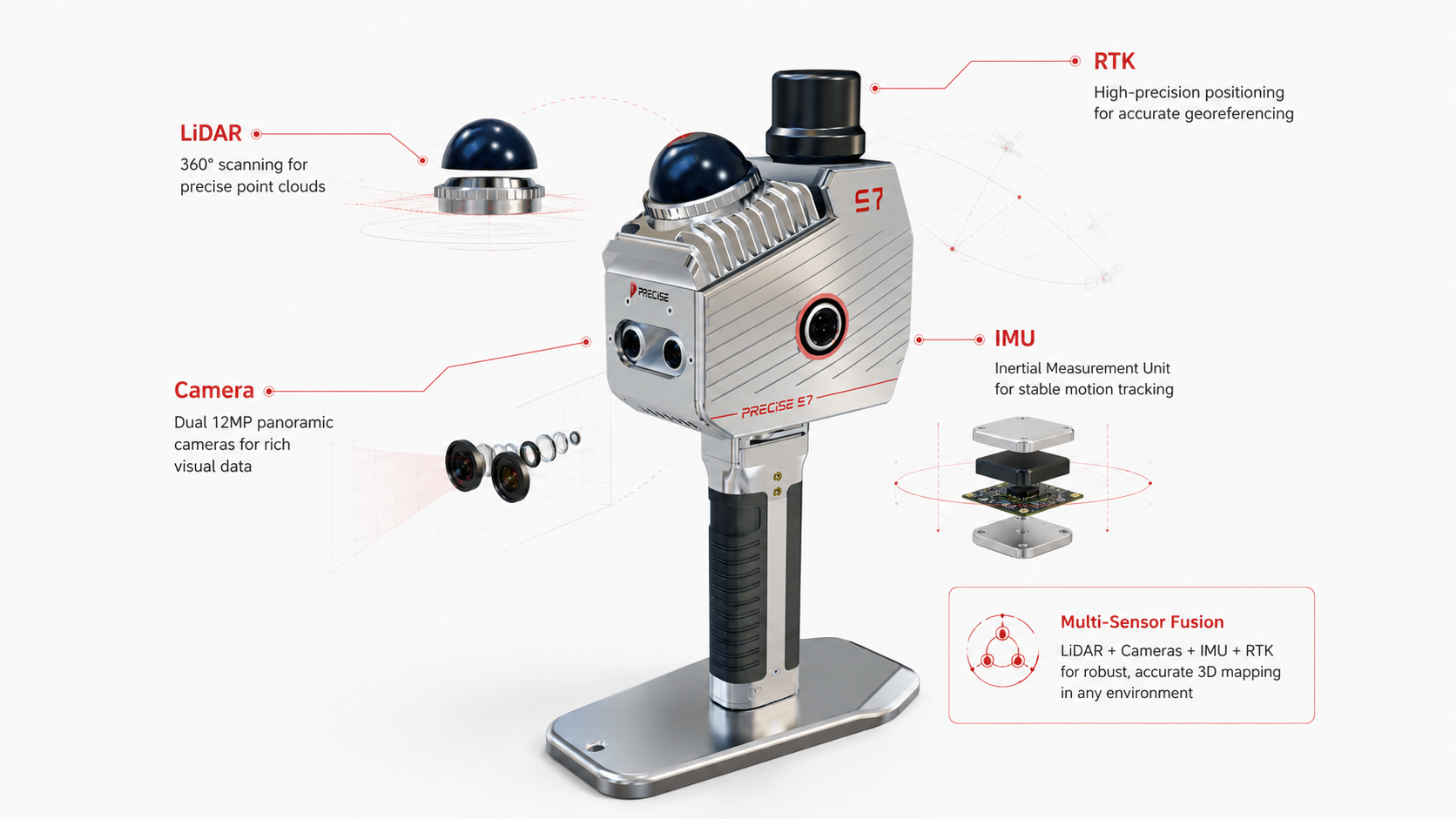
LiDAR provides geometric information. Vision systems help with texture, color, and feature tracking. IMU data supports motion continuity and helps maintain trajectory stability during movement.
The PRECISE S7 is designed around this multi-sensor fusion logic. By integrating LiDAR, panoramic imaging, visual SLAM cameras, and motion sensors, it supports more stable data capture in complex field environments.
With this type of integrated workflow, operators can:
- Improve trajectory stability in GNSS-denied environments
- Capture both geometry and visual context
- Reduce dependence on perfect field conditions
- Improve point cloud consistency
- Reduce the risk of field rework
For survey teams working in tunnels, industrial sites, indoor spaces, complex buildings, or obstructed environments, this can make the scanning process more practical and dependable.
Conclusion
In complex environments, successful 3D data capture depends on more than hardware specifications. It also depends on how the scanning workflow is planned and executed.
A stable trajectory, smooth movement, loop-friendly path planning, and environment-aware scanning strategy can significantly improve the quality of SLAM-based data capture.
By combining these workflow principles with a multi-sensor SLAM system such as the PRECISE S7, survey teams can achieve more reliable datasets, reduce field rework, and improve project turnaround efficiency.
For teams that need fast, stable, and color-rich 3D data capture in challenging environments, the PRECISE S7 provides a practical solution for professional SLAM scanning workflows.