

GNSS base setup time can quickly become a major productivity bottleneck when survey crews move between multiple sites in a single day.
It is movement.
Survey crews working across multiple sites in a single day often face the same repeating cycle:
- Arrive on site
- Set up the base station
- Configure the system
- Start surveying
- Pack up and move again
Individually, each setup may only take 10 to 20 minutes.
But when this process is repeated across several locations, the lost time can quickly add up to hours of reduced productivity.
For teams working on construction layout, utility surveys, topographic surveys, or distributed field projects, reducing setup time is one of the most direct ways to improve daily efficiency.
This guide explains how to streamline GNSS base station deployment when working across multiple sites, and how survey teams can eliminate unnecessary delays in the field.

Why Frequent Setup Becomes a Bottleneck
Traditional GNSS workflows are often designed around single-site operations.
They usually assume:
- One stable base location
- Long working duration
- Minimal relocation
- Sufficient time for configuration and checking
However, many real surveying projects are different.
Field crews often need to deal with:
- Short-duration tasks at each site
- Frequent relocation between locations
- Limited setup space
- Time pressure between jobs
- Changing field environments
In these conditions, small inefficiencies become more noticeable.
Common sources of delay include:
- Repeating manual configuration steps
- Rechecking communication settings
- Adjusting equipment multiple times
- Waiting for RTK reinitialization
- Repacking and unpacking equipment repeatedly
The issue is not just repetition.
It is the lack of a repeatable and fast deployment workflow.
When every setup feels like a new process, field productivity slows down.
A Better Workflow: Standardize and Minimize Every Step
To reduce setup time, the goal is not to rush.
The goal is to simplify and standardize.
An efficient multi-site GNSS workflow should help crews:
- Minimize manual input
- Reduce setup variability
- Enable fast transitions between locations
- Maintain stable RTK performance after relocation
- Reduce the chance of operator error
Instead of treating each site as a completely new setup, crews should use a consistent deployment pattern that can be repeated quickly and reliably.
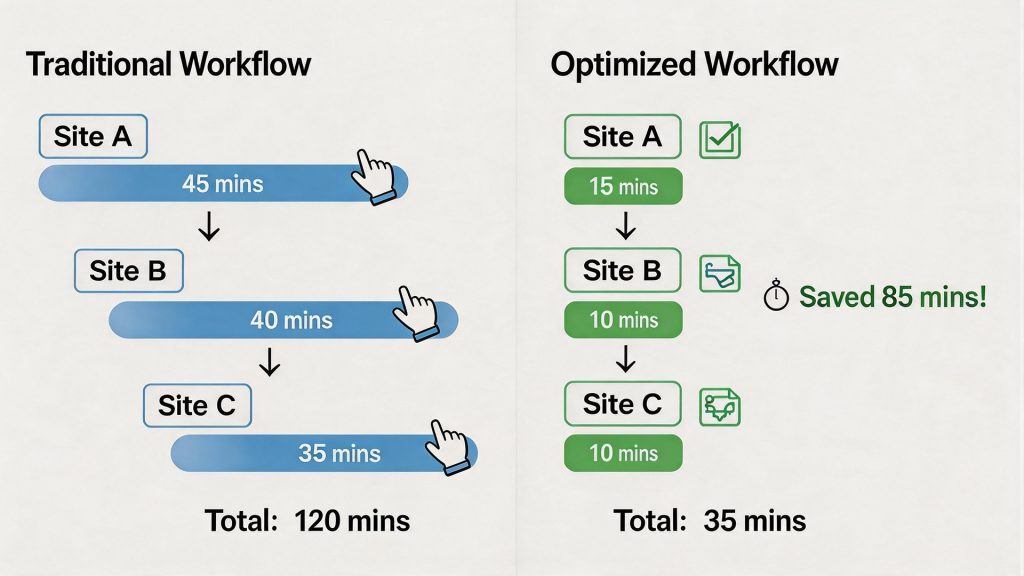
A standardized workflow helps survey teams move from arrival to operation with fewer decisions, fewer adjustments, and less downtime.
Key Steps to Reduce Setup Time Across Multiple Sites
Step 1: Pre-Configure the Base and Rover Before Leaving the First Site
Time is often lost before the crew even arrives at the next location.
If the base and rover need to be reconfigured from the beginning every time, setup becomes slow and inconsistent.
Before moving to the next site, crews should:
- Save communication settings
- Confirm radio frequency or network mode
- Predefine working profiles
- Ensure the base and rover are already paired
- Check battery status before relocation
- Confirm that required accessories are ready for the next setup
This allows the next deployment to begin with minimal adjustments.
A well-prepared system helps crews start faster, especially when several sites need to be completed within the same day.
Step 2: Use Consistent Setup Criteria for Every Location
One common reason setup takes too long is that crews rethink the same decisions at every site.
To reduce hesitation, teams should standardize key setup criteria.
These may include:
- Preferred tripod height
- Antenna orientation
- Base placement rules
- Minimum open-sky requirements
- Distance from obstructions or reflective surfaces
- Communication path considerations
For example, crews can follow a simple base placement rule:
Choose a stable location with clear sky visibility, minimal obstruction, and a practical communication path to the working area.
A consistent setup standard helps operators make faster decisions without compromising reliability.
Step 3: Simplify Base Deployment Steps
Every additional setup step increases both time and error risk.
This is especially important when crews are working under time pressure or moving between multiple locations.
An efficient base deployment workflow should:
- Require minimal manual configuration
- Enable fast startup
- Support quick switching between working modes
- Reduce cable connections and external modules
- Make system status easy to confirm
The simpler the deployment process, the easier it is for crews to repeat the workflow consistently.
Reducing setup complexity directly improves field efficiency, especially in projects where the base station needs to be moved several times per day.
Step 4: Optimize the RTK Initialization Workflow
RTK reinitialization is often a hidden delay in multi-site surveying.
Even if the equipment is set up quickly, unstable initialization can slow down the start of actual measurement work.
To improve RTK initialization efficiency, crews should:
- Start initialization in a location with clear satellite visibility
- Avoid heavy obstruction from buildings, trees, or terrain
- Keep the base and rover communication link stable during startup
- Confirm correction data is being received before beginning measurement
- Avoid unnecessary movement during the initial fixing process
A clean initialization reduces the need for retries, adjustments, and repeated checks.
For multi-site projects, every minute saved during initialization contributes to higher daily productivity.
Step 5: Minimize Equipment Handling and Movement
Frequent unpacking, assembling, disassembling, and repacking can slow down field crews.
Mobility is not only about equipment weight.
It is also about reducing friction during every transition.
Where possible, crews should:
- Keep components assembled during short moves
- Use lightweight and portable equipment
- Reduce unnecessary cable connections
- Organize accessories for quick access
- Avoid repeated packing of components that will be used again soon
- Check that the tripod, receiver, controller, and power accessories are ready before leaving each site
A more mobile setup allows crews to move between locations with fewer interruptions.
This is especially useful for short-duration tasks where setup time may take almost as long as the measurement work itself.

What Typically Slows Down Multi-Site Survey Workflows?
Even experienced survey teams can lose time when moving between sites.
Common workflow bottlenecks include:
- Inconsistent setup habits between operators
- Repeated configuration changes
- Poor communication link setup
- Unstable base placement requiring adjustment
- Long RTK reinitialization time
- Too many separate accessories or external modules
- Unclear responsibility during packing and relocation
These issues may seem small at first.
But across multiple sites, they compound quickly.
A delay of only a few minutes at each location can become a significant productivity loss by the end of the day.
Why This Workflow Matters for Field Productivity
In multi-site projects, efficiency is cumulative.
Saving just 10 minutes per setup across 5 sites per day means almost one extra hour of productive time.
That extra time can directly affect:
- Project timelines
- Daily task completion
- Crew workload
- Operational costs
- Customer satisfaction
- Overall field productivity
For survey teams, reducing setup time does not mean cutting corners.
It means removing unnecessary steps from the workflow.
A faster and more repeatable GNSS base setup helps crews spend less time preparing and more time collecting reliable data.
How PRECISE Base2 Supports Faster Multi-Site Deployment
Portable GNSS base solutions are especially valuable in multi-site workflows.
PRECISE Base2 is designed to support efficient RTK field deployment, helping crews move more smoothly between locations.
For teams working across multiple sites, Base2 can help by supporting:
- Faster base station deployment
- Simplified field setup
- Stable base-to-rover communication
- More efficient transitions between sites
- Practical operation in changing field environments
By reducing setup friction and supporting a more repeatable workflow, PRECISE Base2 helps survey teams improve daily productivity without sacrificing RTK reliability.
This makes it well suited for construction layout, utility surveys, distributed site work, and other field tasks that require frequent movement.
Conclusion
Reducing setup time is not about working faster.
It is about working smarter.
By focusing on pre-configuration, standardized setup decisions, simplified deployment, efficient initialization, and reduced equipment handling, survey teams can significantly improve productivity across multiple sites.
In practice, the most efficient crews are not the ones who rush.
They are the ones who eliminate unnecessary steps.
A repeatable GNSS base deployment workflow helps field teams move between sites more confidently, reduce downtime, and maintain reliable RTK performance throughout the day.