

A GNSS base station does not underperform only because of hardware limitations.
In many cases, the problem is that the setup method does not match the job.
The same base station may work efficiently on one project but feel slow or unstable on another. A compact urban layout task, a long corridor survey, and a multi-site construction project do not place the same demands on deployment, coverage, mobility, communication, or operation time.
That is why choosing the right GNSS base setup method matters.
This guide explains how to evaluate different base deployment strategies by project type, and how to choose a setup approach that supports stable RTK performance, efficient field workflow, and fewer interruptions.

Why One Setup Method Does Not Fit Every Job
A common mistake in RTK fieldwork is applying the same setup routine to every project.
In theory, the workflow seems simple:
- Place the base station
- Initialize the system
- Start broadcasting corrections
- Begin rover work
But in real surveying projects, site conditions can vary significantly.
Key differences may include:
- Working area size
- Terrain openness
- Relocation frequency
- Communication environment
- Operation duration
- Interference risk
- Power requirements
A setup that works well for a static, all-day control task may be unnecessarily slow for a short multi-site project.
Likewise, a fast deployment method may not be the best option for wide-area work where long-distance correction stability is critical.
The real question is not only:
“How do I set up the base?”
It should be:
“What kind of base setup best fits this specific job?”
A Better Decision Logic: Match the Setup to the Workflow
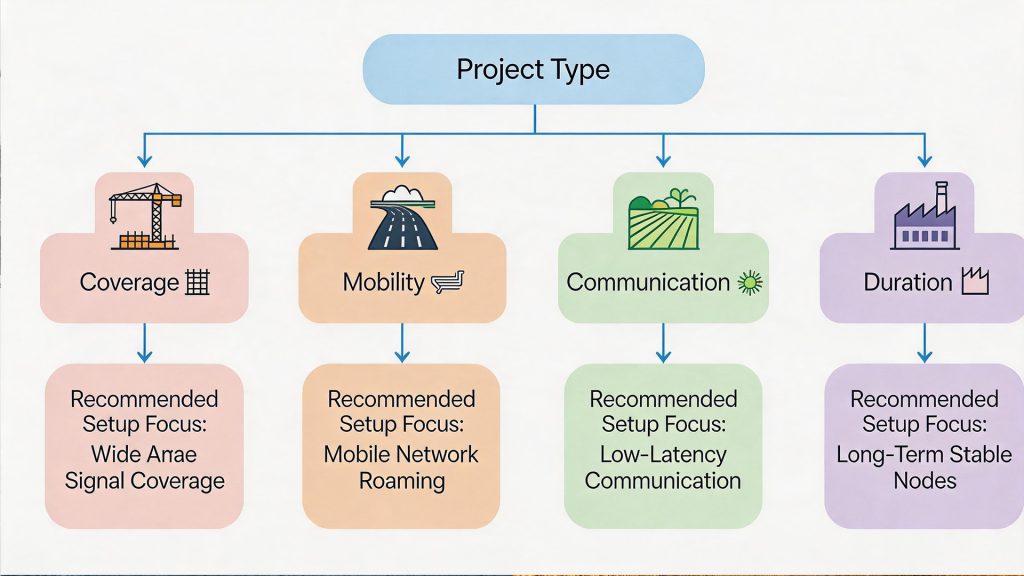
Instead of treating GNSS base deployment as one fixed procedure, survey teams should evaluate the setup method through four practical criteria:
- Coverage requirement
- Mobility requirement
- Communication condition
- Operation duration
These factors often shape the best deployment method more than operator habit does.
A well-matched setup method helps crews:
- Reach field readiness faster
- Maintain more stable RTK corrections
- Avoid unnecessary reconfiguration
- Reduce workflow interruptions
- Improve productivity across the entire task
The goal is not to use the same base setup every time.
The goal is to choose the setup logic that best supports the work being done.
Project Type 1: Single-Site, Long-Duration Work
Examples include:
- Construction control on one site
- Topographic survey in a defined area
- Long-duration base occupation
- Site monitoring or repeated checks in one working zone
In this type of project, the priority is usually stability over relocation speed.
The base station may need to remain in one position for several hours, so the setup should focus on long-term reliability.
Recommended setup focus:
- Choose the most open and stable position available
- Optimize antenna visibility
- Keep a clear communication path between base and rover
- Confirm power availability for the full working duration
- Reduce the need for later repositioning
- Protect the base from vibration, impact, or accidental movement
This setup method is best when:
- The site is fixed
- The crew will remain in one operating area
- The base is expected to support continuous work for hours
- Repositioning would interrupt the workflow
For single-site, long-duration work, a base station with integrated architecture, stable correction broadcasting, and reliable power performance can help reduce setup complexity while maintaining consistent RTK operation.
PRECISE Base2 is designed for this kind of practical field workflow, supporting long-duration RTK base operation with an integrated form factor and all-day field usability.
Project Type 2: Large-Area or Long-Distance Fieldwork
Examples include:
- Road and corridor surveying
- Farmland mapping across wide areas
- Linear infrastructure projects
- Pipeline or utility route surveys
- Large open-area topographic work
In these projects, the key factor is not only setup speed.
It is correction stability over distance.
As the rover moves farther from the base, communication quality becomes more important. Terrain, vegetation, buildings, radio interference, and antenna height can all affect correction delivery.
Recommended setup focus:
- Maximize transmission efficiency toward the working area
- Avoid terrain blockage between base and rover
- Prioritize strong radio performance and clean communication channels
- Elevate the antenna where practical
- Verify whether the communication mode suits the project scale
- Monitor RTK status across the working range
This setup method is most effective when:
- The rover may move far from the base
- The working area is wide or linear
- Terrain is mixed or partially obstructed
- Communication quality is a major risk factor
- Stable correction delivery is more important than quick relocation
For large-area or long-distance fieldwork, radio capability and link reliability become central.
PRECISE Base2 is positioned as a long-range portable GNSS base station, supporting stable base-to-rover communication for field projects where correction coverage matters.
Project Type 3: Multi-Site, High-Mobility Operations
Examples include:
- Distributed construction layout tasks
- Utility surveys across separated points
- Daily survey work involving repeated relocation
- Short-duration jobs across several sites
- Fast-turnaround field checks
In these projects, the most important factor is deployment efficiency.
The crew may not spend a full day at one site. Instead, they may need to set up, complete a task, pack up, move, and repeat the process several times.
If every setup requires repeated configuration, cable connection, pairing, and checking, small delays quickly accumulate.
Recommended setup focus:
- Minimize manual configuration
- Standardize the setup sequence for every move
- Reduce external modules, cables, and connection steps
- Shorten the transition from transport to RTK readiness
- Keep base and rover settings consistent when possible
- Make equipment handling as simple as possible
This method works best when:
- Multiple locations must be covered in one day
- Crews need fast redeployment
- Setup repetition becomes a productivity bottleneck
- Portability and workflow simplicity are more important than fixed-site operation
This is where portability matters beyond simple device weight.
A compact, integrated GNSS base setup can help reduce the friction of repeated relocation. PRECISE Base2 supports this type of high-mobility workflow by combining base station functionality, communication capability, and field-ready design in a more streamlined platform.
Project Type 4: Harsh or Interference-Prone Environments
Examples include:
- Dusty industrial zones
- Mixed urban environments
- Sites with nearby metal structures
- Uneven terrain with vibration or impact risk
- Areas with partial signal obstruction
- Construction sites with changing site conditions
In these projects, the best setup method is one that prioritizes operational resilience.
The base station must not only initialize successfully. It must remain stable when the environment is not ideal.
Recommended setup focus:
- Select a physically secure mounting position
- Reduce exposure to impact and vibration
- Avoid reflective surfaces and heavy obstruction where possible
- Monitor interference risk before finalizing communication settings
- Confirm radio or network performance before full operation
- Ensure the base can remain stable throughout the task
This setup logic is important when:
- Equipment reliability affects workflow continuity
- The environment introduces radio noise or physical risk
- Rework or interruption would be costly
- Crews need dependable performance in less controlled conditions
For harsh or interference-prone environments, durability and communication stability become as important as positioning performance.
PRECISE Base2 is designed as a field-ready GNSS base solution, supporting practical RTK workflows in outdoor environments where reliability, durability, and simplified deployment matter.
How to Decide More Quickly in the Field
A practical way to choose the right GNSS base setup method is to ask four questions before deployment.
1. How large is the effective working area?
If coverage is the main issue, prioritize communication reach, antenna placement, and base position.
For large or linear projects, a slightly better base position can make a major difference in correction stability.
2. How often will the crew relocate?
If relocation is frequent, prioritize simplified deployment and integrated design.
For multi-site work, a faster and more repeatable setup process can improve daily productivity more than a technically perfect but slow deployment method.
3. What is the biggest risk: distance, interference, or time loss?
Different projects have different risks.
- If distance is the main risk, focus on communication coverage
- If interference is the main risk, focus on channel quality and environment awareness
- If time loss is the main risk, focus on fast redeployment
- If long operation is the main risk, focus on power and physical stability
This helps crews choose a setup method based on actual field priorities.
4. How long must the base operate without interruption?
Long sessions require confidence in power endurance, mounting stability, and communication consistency.
Short sessions require fast setup, easy transition, and minimal configuration.
Understanding the expected operation time helps crews avoid both under-preparing and overcomplicating the setup.
Why This Matters for Modern Survey Teams
Surveying workflows are becoming more varied, not more uniform.
Teams are expected to work across:
- Compact urban jobs
- Large rural areas
- Fast-turnaround construction tasks
- Long-distance corridor projects
- Distributed utility surveys
- Demanding industrial sites
That means the value of a GNSS base station is no longer defined only by raw specification.
It is also defined by how well it adapts to different deployment needs.
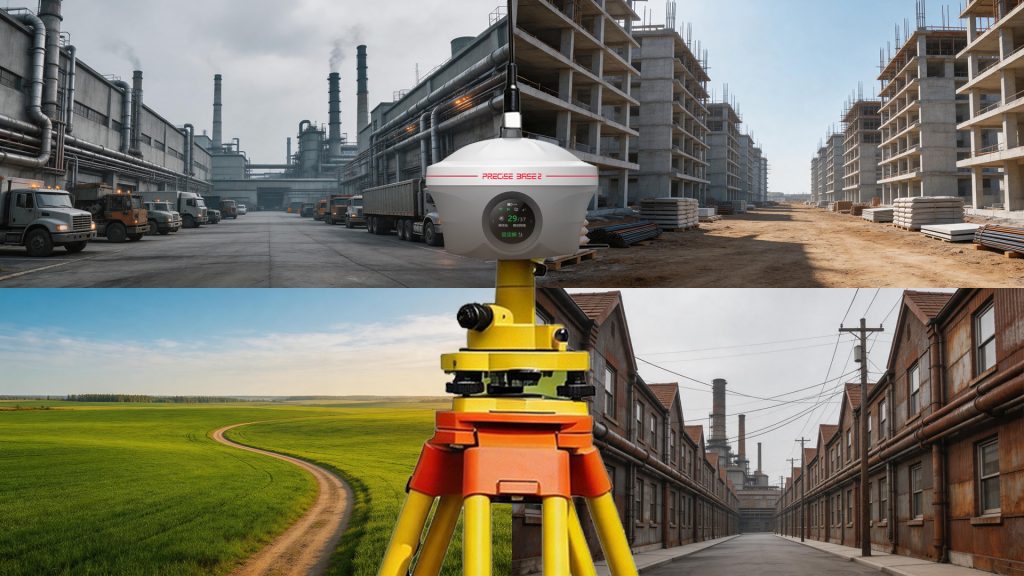
A portable integrated unit like PRECISE Base2 is relevant in this context because it combines mobility, communication capability, integrated architecture, and field-ready durability in one platform.
For survey teams, this means fewer unnecessary setup steps, faster decision-making in the field, and more predictable RTK performance across different project types.
Conclusion
The right GNSS base setup method depends on the job, not on routine.
For fixed long-duration work, prioritize stability.
For large-area tasks, prioritize communication coverage.
For multi-site workflows, prioritize fast redeployment.
For harsh environments, prioritize durability and interference resistance.
When the setup method matches the project type, RTK work becomes more predictable, efficient, and reliable.
In practice, better results do not come only from having a capable base station.
They come from deploying it in the way the job actually requires.