
Rework is one of the most underestimated sources of inefficiency in construction layout.
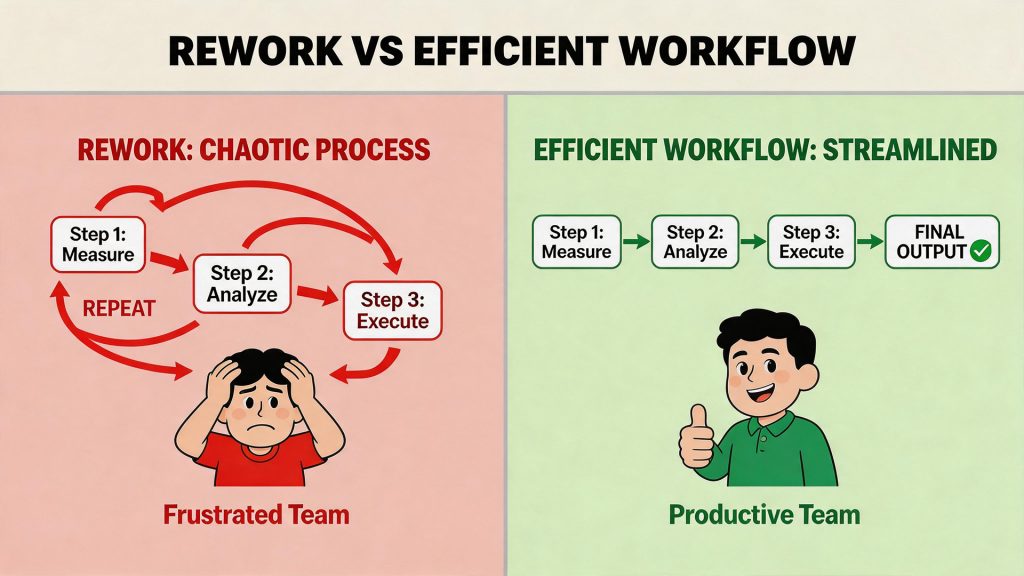
It rarely comes from major mistakes. More often, it builds up through small, repeated issues: points that need to be checked twice, layout positions that require confirmation, or slight misalignments that trigger re-measurement.
Over time, these small inefficiencies slow down the entire crew.
For survey teams, improving layout efficiency is not only about working faster. It is about reducing the need to do the same work again.
That is why a more practical total station workflow matters in daily construction layout.
Why Rework Happens More Often Than Expected
In real job sites, rework is rarely caused by one single factor. It is usually the result of workflow gaps that appear during setup, measurement, verification, or data handling.
Common causes include:
- Unclear point positioning during layout
- Interrupted workflows between measurement and verification
- Manual data handling errors
- Inconsistent operation between team members
- Delayed confirmation after point placement
These problems are especially common in:
- Dense construction environments
- Multi-team coordination projects
- Sites with frequent task switching
- Areas with limited setup space
- Layout tasks that require repeated confirmation
In these conditions, even accurate measurements can still lead to inefficient outcomes if the workflow itself is not clear and continuous.
The result is simple: the crew spends more time checking, correcting, and repeating work.
A Better Approach: Reduce Uncertainty, Not Just Measure Faster
When teams try to improve construction layout efficiency, they often focus first on speed.
However, speed alone does not always reduce rework.
A faster measurement process can still create repeated work if the operator is unsure about point positioning, if the verification step is delayed, or if different team members follow different operating habits.
A more effective strategy is to reduce uncertainty during layout.
This means:
- Making point positioning clearer at the moment of measurement
- Keeping the workflow continuous from setup to verification
- Reducing interpretation gaps between operator and data
- Keeping data handling simple and consistent
- Helping different operators follow the same process
When uncertainty is reduced, the need for rework naturally decreases.
A practical total station workflow should not only help the operator measure points. It should help the whole team complete layout tasks with fewer interruptions, fewer doubts, and fewer repeated steps.
Step 1: Establish a Consistent Layout Reference System
Before starting layout, survey teams should make sure that all reference points are clearly defined and shared.
A stable reference system helps prevent confusion later in the process.
To improve consistency:
- Use unified coordinate systems across teams
- Avoid switching reference bases during the same task
- Keep point naming conventions simple and consistent
- Confirm control points before layout begins
- Make sure all operators understand the same reference logic
This step may seem basic, but it has a major impact on reducing rework.
When reference systems are unclear, layout errors may not appear immediately. They often become visible later during verification, installation, or cross-checking with other teams.
By establishing a clear reference system at the beginning, survey teams can reduce confusion and prevent repeated confirmation work later.
Step 2: Improve Visibility of Target Points
One of the main causes of rework in construction layout is hesitation during point positioning.
If the operator cannot clearly identify the target location, the layout process becomes slower and less confident.
To improve target visibility:
- Ensure the operator can clearly identify the target point
- Maintain a clear line of sight whenever possible
- Reduce reliance on abstract coordinate interpretation
- Use a logical point sequence to guide movement
- Keep the layout area as visually clear as possible
Better visibility leads to faster and more confident placement.
This is especially important in dense construction environments, where obstacles, temporary structures, materials, and moving workers may affect line of sight.
When target points are easier to understand and confirm, the operator can reduce hesitation and complete layout tasks with greater confidence.
Step 3: Maintain a Continuous Measurement-to-Verification Flow
Rework often happens when verification is separated too far from measurement.
For example, if a team completes many layout points first and only verifies them later, small deviations may accumulate before they are discovered. At that stage, correction becomes more time-consuming.
A better approach is to keep measurement and checking as part of one continuous process.
Practical methods include:
- Confirming points immediately after layout
- Avoiding delayed verification when possible
- Keeping measurement and checking within the same workflow
- Identifying deviations before moving too far ahead
- Reducing the need to return to previously completed areas
This helps catch small issues before they become larger workflow problems.
For construction layout, a continuous measurement-to-verification flow can significantly reduce repeated movement, repeated setup, and repeated communication between teams.
Step 4: Simplify On-Site Data Handling
Complex data workflows increase the risk of mistakes.
When operators frequently export, import, rename, transfer, or manually input data during fieldwork, each step creates another opportunity for errors.
To simplify on-site data handling:
- Avoid frequent exporting and re-importing during fieldwork
- Keep operations within a single system where possible
- Reduce manual input steps
- Maintain a clear structure for layout point names
- Organize project data before starting the task
A simpler data process means fewer opportunities for mistakes.
It also helps operators stay focused on layout work instead of switching between tools, files, or interfaces.
For daily construction layout, this is especially important because tasks often change quickly. A smooth data workflow helps the team respond faster without losing consistency.
Step 5: Standardize Operator Workflow
Different operators may have different habits.
In some situations, this flexibility can be useful. But in construction layout, inconsistent operation can increase rework risk, especially when multiple people work on the same project or continue each other’s tasks.
To improve consistency:
- Define a standard workflow for layout tasks
- Make sure all team members follow the same process
- Use consistent point naming and checking methods
- Reduce reliance on personal habits
- Keep operation steps simple and repeatable
A standardized workflow helps teams produce more consistent results.
It also makes training easier, reduces communication gaps, and helps new operators quickly understand how the task should be completed.
For projects with multiple teams, this consistency is one of the most important factors in reducing repeated work.
What Affects Layout Accuracy and Rework Risk?
Even with a good workflow, several real-world factors can increase rework risk.
These include:
- Site congestion and obstructions
- Frequent switching between layout zones
- Limited working space for instrument setup
- Operator fatigue during long working hours
- Poor visibility or changing lighting conditions
- Coordination between different construction teams
- Time pressure during fast-moving site work
This is why layout efficiency should not be judged only under ideal conditions.
A practical workflow must remain stable when the site becomes crowded, when task priorities change, or when the operator needs to move between different areas throughout the day.
The more stable the workflow is under these conditions, the lower the risk of repeated work.
Why Practical Total Station Design Helps Reduce Rework
Reducing rework is not only about workflow planning. It is also influenced by how well the equipment supports that workflow.
A practical total station design, such as the PRECISE T3 Lite, focuses on everyday field productivity rather than unnecessary complexity.
In construction layout, this can help teams achieve:
- Easier operation, reducing interpretation errors
- Faster setup, minimizing interruptions between tasks
- Flexible deployment in changing site conditions
- Smoother measurement and data handling
- More consistent operation across different users
These factors help reduce hesitation, improve clarity, and lower the likelihood of repeated work.
For daily layout tasks, this practical value is often more important than extreme specifications. What matters most is whether the instrument helps the operator work clearly, consistently, and efficiently on real job sites.

Practical Value of PRECISE T3 Lite in Construction Layout
The PRECISE T3 Lite is suitable for survey teams that need a lightweight and practical total station for everyday layout tasks.
It is especially useful in scenarios such as:
- Building layout
- Interior and exterior construction measurement
- Dense or compact job sites
- Short-duration layout tasks
- Multi-point checking and verification
- Projects requiring frequent setup and movement
By supporting a more practical workflow, T3 Lite helps survey teams reduce unnecessary repeated steps and keep layout work moving smoothly.
For teams that want to improve productivity without adding complexity, a lightweight total station workflow can be a valuable solution.
Conclusion
Rework is not always obvious, but its impact on construction layout productivity is significant.
Instead of trying to eliminate errors after they occur, a more effective approach is to reduce uncertainty before repeated work becomes necessary.
Survey teams can do this by focusing on:
- Clear reference systems
- Better target visibility
- Continuous measurement-to-verification workflows
- Simpler on-site data handling
- Standardized operator processes
A lightweight and practical total station, combined with a clear workflow, can help reduce rework and improve overall efficiency in daily construction layout.
For real job sites, productivity is not only about measuring faster.
It is about measuring with fewer interruptions, fewer doubts, and fewer repeated steps.