
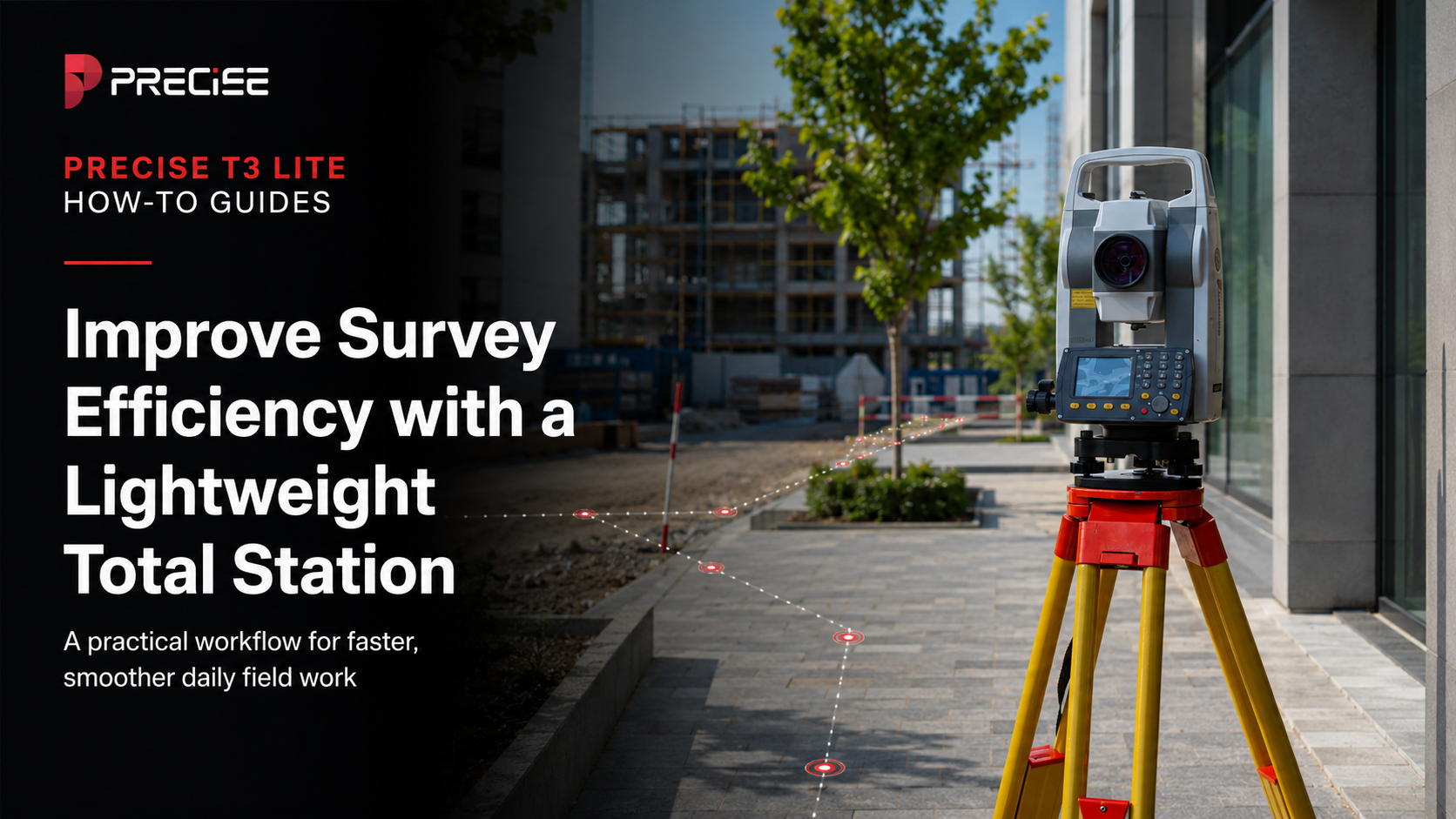
In daily surveying and construction tasks, improving survey efficiency is not always about using more complex equipment. In many real field scenarios, productivity depends more on setup speed, workflow continuity, and how smoothly surveyors can move between tasks.
For small to mid-scale projects, temporary job sites, or fast-paced construction environments, surveyors often need a practical balance between accuracy, portability, and ease of operation.
This is where a lightweight total station workflow becomes especially valuable.
Rather than focusing only on maximum performance specifications, a practical workflow helps surveyors reduce unnecessary steps, maintain consistent operation, and complete everyday tasks more efficiently.
Why Conventional Workflows Slow Down Daily Survey Tasks
On paper, total stations are already efficient surveying instruments. However, in real field conditions, efficiency is often reduced by workflow interruptions rather than measurement capability itself.
Common issues include:
- Frequent repositioning on dynamic or crowded sites
- Slow data handling when switching between tasks
- Complex operation logic that interrupts field rhythm
- Limited flexibility when handling multiple small tasks in sequence
These problems are especially common in:
- Urban construction layouts
- Interior measurement tasks
- Short-duration survey jobs
- Temporary or constrained working environments
- Projects with tight deadlines
In these scenarios, efficiency is not only about long-range measurement or extreme precision. It is more about keeping the workflow smooth, simple, and continuous.
A More Practical Workflow Approach
Instead of focusing only on measurement accuracy, survey teams can improve productivity by optimizing how work flows throughout the day.
A practical total station workflow should help surveyors:
- Reduce unnecessary setup time
- Simplify operation between different task types
- Maintain consistency across multiple measurements
- Move faster between points and targets
- Reduce interruptions caused by repeated configuration
This shifts the focus from:
“How powerful is the instrument?”
to:
“How smoothly can the job be completed?”
For daily field work, this difference matters. A tool that is easy to transport, quick to set up, and simple to operate can often deliver greater practical value than a more complex system that slows down the workflow.
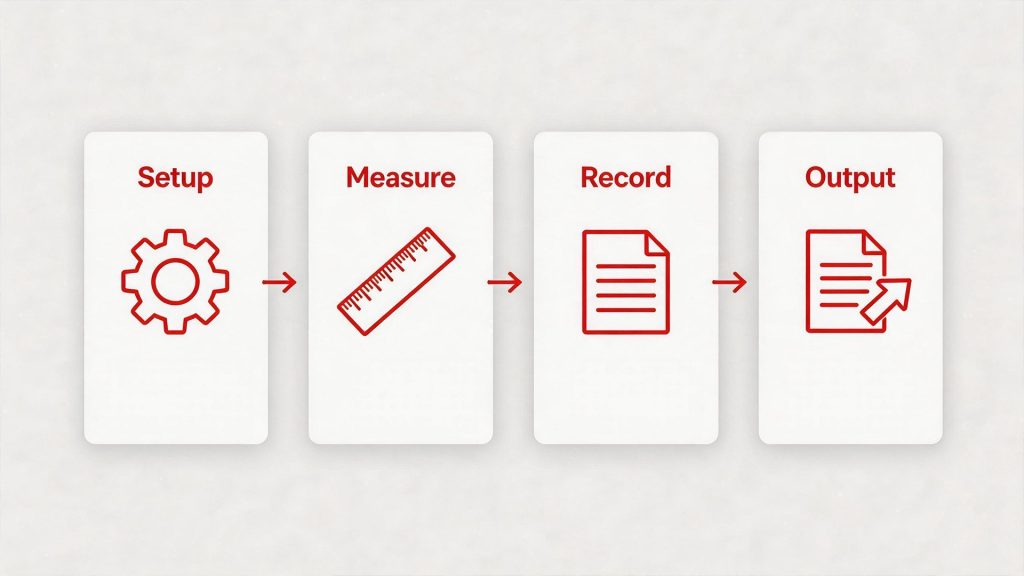
Step 1: Simplify Initial Setup
A large part of field efficiency is determined before the first measurement begins.
If the operator spends too much time configuring the instrument, adjusting parameters, or checking repeated settings, the whole workflow becomes slower from the start.
To improve setup efficiency:
- Use predefined project templates where possible
- Standardize coordinate systems across teams
- Reduce repeated parameter adjustments
- Keep commonly used settings consistent
- Prepare basic workflow requirements before entering the site
A consistent setup routine helps surveyors start faster and reduces the risk of errors caused by repeated manual configuration.
For daily jobs, this is especially important because surveyors may need to work across several small areas or complete multiple tasks within a limited time.
Step 2: Optimize the Point-to-Point Workflow
In many surveying tasks, time is not lost during measurement itself. It is lost while moving between points, repositioning the instrument, or adjusting the workflow repeatedly.
A more efficient point-to-point workflow should focus on reducing unnecessary movement.
Practical methods include:
- Planning measurement sequences before starting
- Grouping nearby targets into one workflow loop
- Avoiding unnecessary instrument repositioning
- Reducing back-and-forth movement across the site
- Arranging tasks according to site layout and access conditions
This improves the overall rhythm of the job.
When the operator can move through the site with a clear sequence, each measurement becomes part of a continuous workflow rather than a separate task.
Step 3: Keep Data Handling Continuous
Survey efficiency is also affected by how data is recorded, managed, and exported.
If the operator frequently switches between measurement, manual recording, data transfer, and file organization, fieldwork becomes fragmented.
To keep data handling continuous:
- Use systems that support on-device data processing
- Avoid unnecessary manual data transfers during fieldwork
- Maintain a clear point naming structure
- Classify points consistently during collection
- Keep project files organized from the beginning
A continuous data workflow helps the operator stay focused on the task instead of the interface.
This is particularly useful for jobs that require many small measurements, frequent point collection, or repeated layout checks.
Step 4: Reduce Operator Learning Friction
Even experienced surveyors can lose time when equipment is not intuitive.
If the operation logic is too complex, or if different tasks require completely different command sequences, productivity becomes inconsistent across teams.
To reduce learning friction:
- Use familiar interface systems where possible
- Keep operation steps consistent across different tasks
- Minimize reliance on complicated command sequences
- Make common functions easy to access
- Support faster onboarding for different operators
An intuitive workflow does not only help beginners. It also helps experienced users work more consistently under pressure.
In busy field environments, simple and familiar operation can make a major difference.
What Affects Real-World Survey Efficiency?
Even with a good workflow, actual field efficiency is influenced by many practical factors.
These may include:
- Site complexity
- Obstacles and limited working space
- Operator experience
- Lighting and visibility conditions
- Task switching frequency
- Time pressure on site
- The need to move between multiple job areas
This is why practical efficiency should not be judged only under ideal conditions.
A good daily workflow needs to remain stable when the site becomes crowded, when tasks change quickly, or when the operator needs to move frequently between different points.
Why Lightweight Total Stations Fit Everyday Jobs
For many daily surveying tasks, a lightweight total station provides a more balanced solution.
Devices like the PRECISE T3 Lite are designed around practical field productivity, not only technical specifications.
In real-world workflows, this can help surveyors achieve:
- Easier transport between multiple job points
- Faster setup in temporary or constrained environments
- More flexible operation across different task types
- Smoother transitions between measurement tasks
- Better adaptability for everyday surveying scenarios
Instead of optimizing only for extreme field conditions, this approach focuses on consistent efficiency across typical jobs.
And for most surveyors, this is where most time is actually spent.

Practical Value of PRECISE T3 Lite in Daily Field Work
The PRECISE T3 Lite is suitable for survey teams that need a lightweight, practical, and easy-to-use total station for daily work.
Its value is especially clear in scenarios such as:
- Small and mid-scale construction layout
- Interior measurement tasks
- Urban job sites with limited space
- Short-duration survey jobs
- Multi-point field tasks requiring frequent movement
- Projects where setup speed and workflow continuity matter
By supporting a more practical workflow, T3 Lite helps reduce unnecessary interruptions and makes daily surveying work more efficient.
For users who need a reliable instrument for everyday tasks, a lightweight total station can provide a strong balance between usability, portability, and productivity.
Conclusion
Improving survey efficiency is not always about upgrading to more complex equipment.
In many cases, it comes down to adopting a workflow that:
- Reduces unnecessary steps
- Keeps operation continuous
- Simplifies setup and data handling
- Matches the pace of real field conditions
- Helps surveyors stay productive across different tasks
A lightweight total station, combined with a practical workflow approach, can significantly improve productivity in everyday surveying scenarios.
For daily field work, consistency often matters more than peak performance.
That is why a practical, lightweight solution like the PRECISE T3 Lite can become a valuable tool for surveyors who need to work faster, move easier, and complete tasks with greater efficiency.