Not every surveying project requires the most advanced or most complex equipment.
In fact, many inefficiencies in daily fieldwork come from using tools that are either over-specified or poorly matched to the actual task.
Choosing the right total station is not about selecting the most powerful model. It is about finding a solution that fits your typical workflow, job conditions, and efficiency needs.
For daily survey tasks, the best equipment is often the one that helps surveyors work more consistently, set up faster, and complete common tasks with fewer unnecessary steps.
Why Choosing the Wrong Total Station Affects Productivity
A mismatch between equipment and real-world tasks often leads to hidden inefficiencies.
These problems may not appear as major errors, but they can slow down fieldwork throughout the day.
Common issues include:
- Spending more time on setup than actual measurement
- Slower workflows caused by unnecessary system complexity
- Increased operator errors due to difficult interfaces
- Reduced flexibility across different job types
- Inconsistent productivity between different users
Over time, these issues affect not only productivity, but also team consistency, project timelines, and overall field efficiency.
For example, a highly complex system may be powerful, but if operators need extra time to configure settings, switch modes, or complete basic tasks, the workflow becomes slower than necessary.
For daily survey work, practical usability matters as much as technical capability.
A More Practical Way to Think About Equipment Selection
Instead of focusing only on specifications, survey teams should evaluate total stations based on how well they support everyday work.
A practical selection process should consider:
- How often the equipment will be used
- What types of environments it will operate in
- How complex the workflows need to be
- How easily different operators can use it
- Whether the system supports smooth data handling
- How well it adapts to changing job conditions
This shifts the focus from:
“What can the device do?”
to:
“How well does it support the job?”
For many teams, this is a more useful way to choose equipment.
A total station may have advanced specifications, but if those features are rarely used in daily work, they may not improve actual productivity. On the other hand, a practical and easy-to-use total station can help teams complete common tasks more smoothly and consistently.
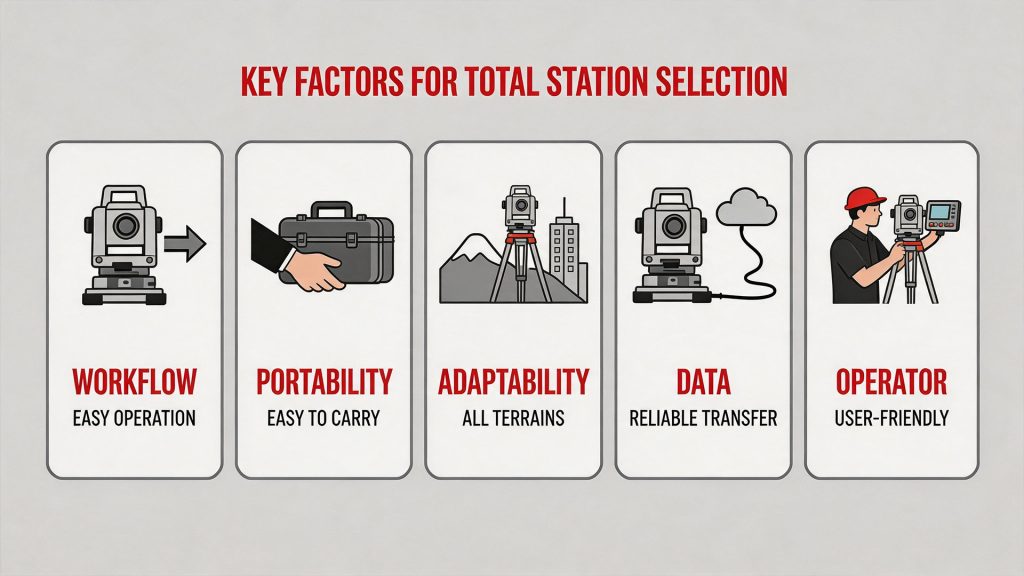
Key Factors to Consider When Choosing a Total Station
Choosing the right total station requires more than comparing specifications on paper.
Survey teams should consider how the instrument performs in real workflows, real environments, and real team conditions.
The following factors are especially important for daily survey tasks.
1. Workflow Simplicity
For daily tasks, ease of use is often more valuable than advanced features.
A total station should help operators complete common tasks quickly and consistently, without unnecessary complexity.
Key questions to consider include:
- Can the system be operated without complex training?
- Are common tasks quick to execute?
- Is the interface intuitive for different users?
- Are operation steps consistent across different tasks?
- Can operators avoid unnecessary mode switching?
Simpler workflows lead to more consistent productivity across teams.
This is especially important when multiple operators use the same equipment, or when survey teams need to complete several different tasks in one day.
A total station that is easy to understand and simple to operate can reduce hesitation, shorten the learning curve, and help maintain a smooth working rhythm.
2. Portability and Setup Efficiency
In many survey jobs, time is lost before measurement even begins.
Transporting the instrument, selecting a setup position, leveling the tripod, and preparing the workflow all take time. If the equipment is difficult to move or slow to set up, productivity decreases.
When evaluating portability and setup efficiency, consider:
- Is the instrument easy to transport between points?
- How fast can it be set up and ready to use?
- Does it adapt well to temporary or changing setups?
- Is it suitable for jobs that require frequent movement?
- Can it help reduce repeated setup-related delays?
Lightweight and practical designs are especially valuable in daily fieldwork.
For small to mid-scale projects, compact construction sites, indoor tasks, and short-duration jobs, portability can directly affect how efficiently the team works.
A total station that is easier to carry, position, and prepare can help surveyors move through tasks with fewer interruptions.
3. Adaptability to Different Environments
Survey conditions are rarely identical from one project to another.
A team may need to work in open outdoor areas one day, building-side construction environments the next, and indoor or obstructed spaces soon after.
That is why adaptability is an important factor when choosing a total station.
Important questions include:
- Can the equipment perform well in both indoor and outdoor environments?
- Does it handle obstructed or complex layouts effectively?
- Is it suitable for both short-range and medium-range tasks?
- Can it support construction layout, checking, and daily measurement tasks?
- Does it remain practical in confined or changing environments?
Flexibility ensures the equipment remains useful across projects.
For daily survey work, a practical total station should not be limited to one narrow application. It should help teams handle different job conditions without needing to change tools or workflows too often.
This adaptability can reduce downtime and make field operations easier to plan.
4. Data Workflow Integration
Efficient surveying is not only about measurement.
It also includes how data is recorded, processed, organized, and delivered.
If the measurement process is fast but data handling is slow, fragmented, or error-prone, the overall workflow still suffers.
When evaluating data workflow integration, consider:
- Can data be processed directly on the device?
- Is the workflow continuous from measurement to output?
- Does the system reduce reliance on external tools?
- Can point names and classifications be managed clearly?
- Does it reduce manual transfer or repeated data handling steps?
Integrated data workflows help minimize interruptions and errors.
They also help operators stay focused on the task instead of switching between devices, software, or file structures.
For daily survey tasks, this is especially useful because teams often need to complete multiple small jobs quickly and keep data organized throughout the day.
5. Operator Accessibility
Survey equipment should support not only experts, but the entire team.
If only a few highly experienced users can operate the instrument efficiently, the team becomes less flexible. Daily productivity may depend too much on individual operators.
A practical total station should improve operator accessibility.
Key questions include:
- Can new users learn it quickly?
- Does it reduce dependence on highly specialized operators?
- Is the workflow consistent across users?
- Can different team members follow the same process?
- Does the system reduce the chance of operation errors?
Accessibility improves scalability and team efficiency.
When more team members can use the instrument confidently, tasks can be assigned more flexibly. This helps teams respond better to changing schedules, urgent tasks, or multi-site workflows.
For daily survey work, consistent operation across users is often more valuable than advanced features that only a few operators can fully use.
When a Practical Total Station Becomes the Better Choice
For many survey teams, the majority of work consists of routine and repeatable tasks.
These may include:
- Routine layout tasks
- Small to medium-sized projects
- Building-side measurement
- Indoor and semi-indoor surveying
- Environments with varying constraints
- Frequent task switching
- Repeated checking and verification
- Short-range or medium-range measurement tasks
In these scenarios, a practical total station often delivers better results than a more complex system.
This is because daily productivity depends on how smoothly the instrument supports the workflow, not only on the highest possible specification.
A practical total station can help teams:
- Reduce unnecessary setup time
- Simplify operation steps
- Maintain workflow continuity
- Improve consistency across different users
- Adapt to different site conditions
- Reduce interruptions during fieldwork
For daily work, usable efficiency is often more important than maximum technical capability.
Why PRECISE T3 Lite Fits Daily Survey Tasks
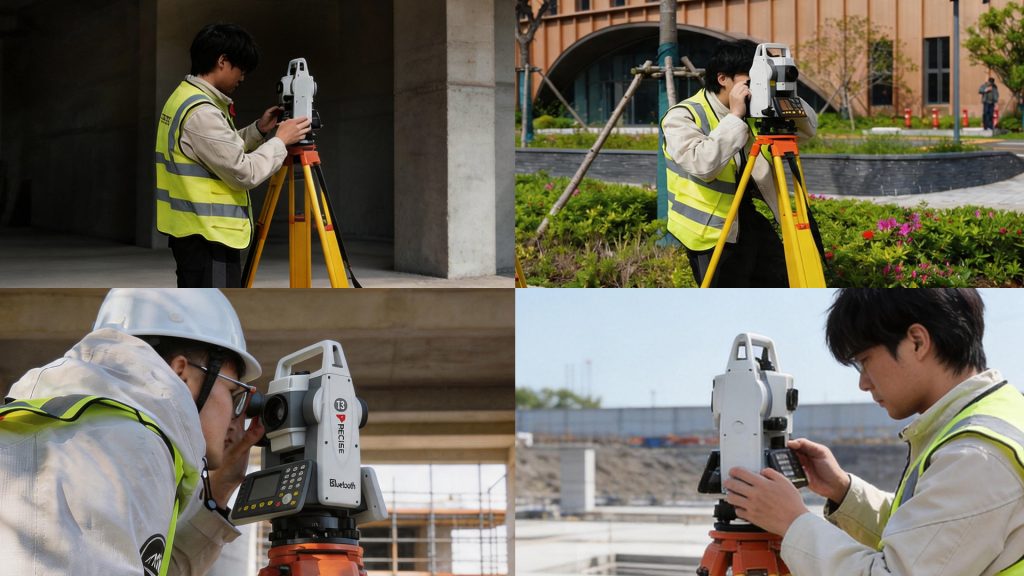
Devices like the PRECISE T3 Lite are designed with practical field productivity in mind.
Rather than focusing only on extreme specifications, T3 Lite supports the type of workflow that many survey teams need in everyday tasks.
Its value is especially relevant for teams that need:
- Ease of use
- Faster setup and movement
- Workflow consistency
- Adaptability to real-world conditions
- Balanced performance for daily tasks
- Practical operation across different users
In real fieldwork, this means the equipment can support smoother daily operation, especially in small to mid-scale projects, construction layout, indoor measurement, and environments where teams need to move efficiently between tasks.
For teams looking to improve productivity without adding unnecessary complexity, a practical total station like PRECISE T3 Lite can provide a more balanced solution.
Practical Value for Survey Teams
Choosing a total station is not only a technical decision. It is also a workflow decision.
The right instrument should help the team work more efficiently in the conditions they face most often.
For daily survey tasks, this usually means choosing equipment that supports:
- Fast preparation before measurement
- Smooth operation during the task
- Clear data handling after collection
- Flexible use across different environments
- Consistent performance across different operators
This type of practical value directly affects field productivity.
When the instrument matches the team’s real workflow, surveyors can spend less time dealing with equipment complexity and more time completing accurate, useful fieldwork.
Conclusion
Choosing the right total station is not about finding the most advanced solution.
It is about selecting the one that fits your work.
By focusing on:
- Workflow simplicity
- Setup efficiency
- Environmental adaptability
- Data integration
- Operator accessibility
survey teams can make better equipment decisions that improve productivity and reduce unnecessary complexity.
In the end, the best total station is the one that helps you work more efficiently every day, across the jobs and environments your team actually faces.
For daily survey tasks, a practical and lightweight solution such as the PRECISE T3 Lite can help teams maintain smoother workflows, reduce delays, and achieve more consistent results on every job.