
Introduction
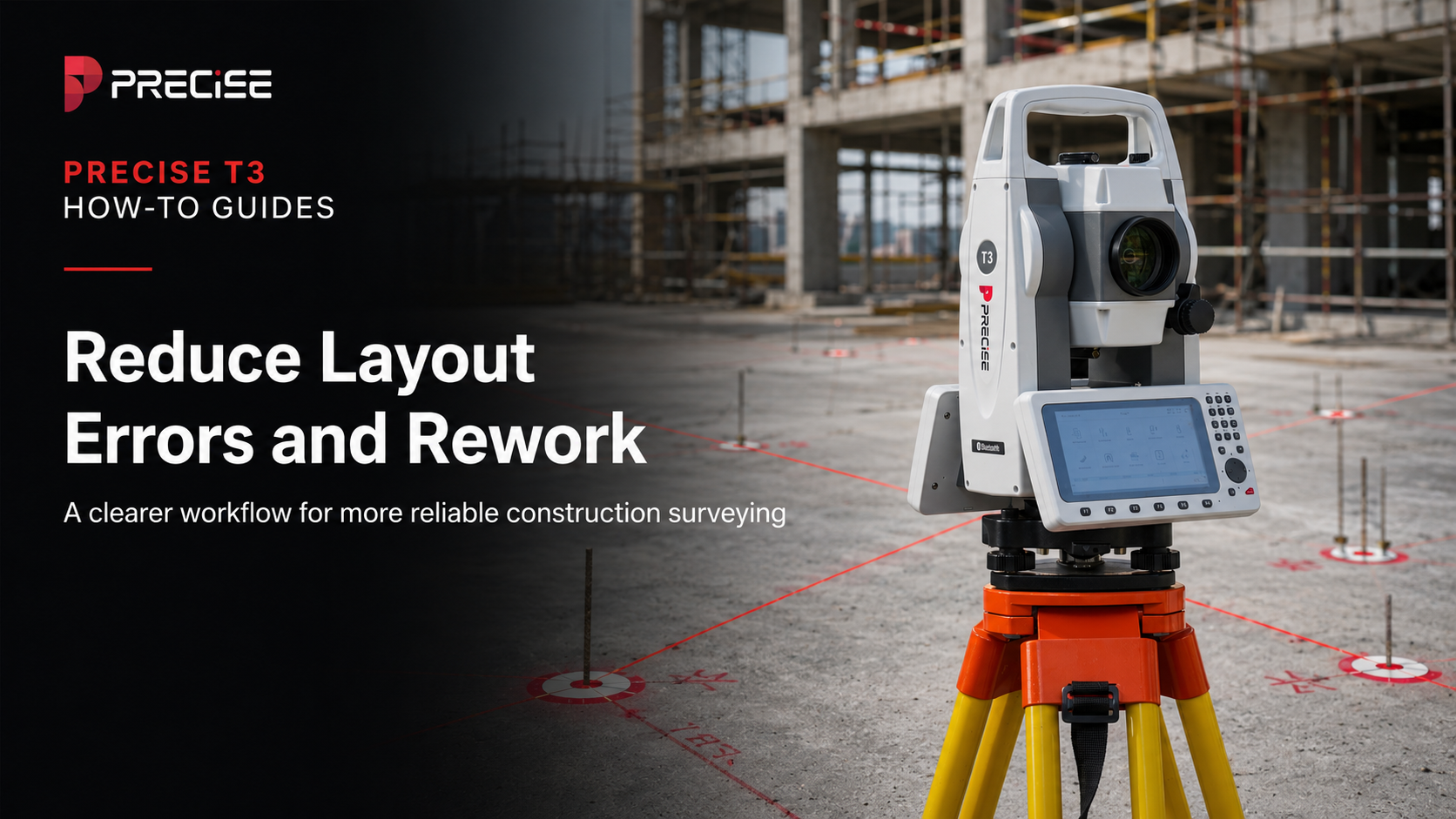
Reduce layout errors in construction surveying requires more than accurate measurement — it depends on clearer data handling, reliable point verification, and a consistent total station workflow.
In construction surveying, errors rarely come from measurement limitations alone. More often, they originate from workflow gaps — misinterpreted points, inconsistent data handling, or hesitation during layout execution.
Even small layout errors can lead to:
- Costly rework
- Project delays
- Misalignment between teams
This makes one question critical for field crews:
How can layout errors be reduced without slowing down the entire workflow?

Why Layout Errors Still Happen in Modern Job Sites
Despite advances in surveying equipment, layout errors remain common — especially in complex construction environments.
Typical causes include:
- Unclear point verification
Operators may hesitate or double-check excessively before confirming layout positions. - Fragmented data workflows
Switching between devices, software, or file formats increases the risk of mismatched coordinates. - Limited real-time feedback
Operators may not immediately confirm whether a point has been correctly interpreted. - Operational inconsistency across teams
Different operators may follow slightly different procedures, leading to variation in results.
These issues are not only about accuracy specifications.
They are about workflow clarity, execution confidence, and how reliably teams can complete layout work under real job-site pressure.
A More Reliable Layout Workflow Logic
Reducing layout errors requires more than careful operation.
It requires a workflow that improves clarity, consistency, and feedback throughout the entire layout process.
A more reliable approach is built on three principles:
1. Clear Point Visualization Before Execution
Operators should understand the target point before committing to layout.
Clear visualization helps reduce misinterpretation and improves confidence before field execution.
2. Consistent Data Handling Across the Workflow
Repeated conversions, manual re-entry, or fragmented file transfers can increase the risk of error.
Keeping data handling consistent helps crews reduce mismatched coordinates and outdated file usage.
3. Immediate Verification During Operation
The best time to identify a potential error is during execution — not after the work is completed.
Real-time feedback helps reduce uncertainty at the moment of layout.
This shifts construction layout from a “measure and confirm later” process to a “verify while executing” workflow.
Key Execution Steps to Reduce Layout Errors
1. Validate Data Before Entering the Field
Many layout errors originate before fieldwork begins.
Before starting construction layout, crews should check whether the project data is complete, consistent, and ready for field use.
To reduce risk:
- Ensure coordinate systems are consistent
- Check point naming and point structure
- Confirm that design data is aligned with site conditions
- Make sure the latest version of the layout file is being used
A well-prepared dataset reduces ambiguity during layout and helps operators start with greater confidence.
2. Use Direct On-Device Data Access
When data must be transferred across multiple devices, the risk of workflow error increases.
Common problems include:
- File format issues
- Version mismatch
- Incorrect coordinate files
- Manual transfer mistakes
- Operators using outdated data without realizing it
Using a system that allows direct data access and management on the device helps reduce these risks.
With an integrated workflow, crews can:
- Reduce data mismatch
- Improve confidence in point selection
- Eliminate unnecessary transfer steps
- Keep project information closer to the actual field operation
This makes the layout process more continuous and less dependent on fragmented tools.
3. Improve Point Interpretation in the Field
A key source of layout error is not measurement itself.
It is the misinterpretation of points.
In the field, operators need to quickly understand:
- Which point they are working on
- How that point relates to surrounding structures
- Whether the selected point matches the design intent
- Whether the next action is correct
Clear interface design and intuitive data display can reduce hesitation and improve decision speed.
When operators can interpret points more easily, they are less likely to make avoidable layout mistakes.

4. Enable Immediate Feedback During Layout
Errors often happen when verification is delayed.
If operators measure first and only check later, small mistakes may accumulate before they are discovered.
A more reliable workflow should provide feedback during layout execution.
This allows operators to confirm point alignment and position status in real time.
Immediate feedback helps reduce:
- Rework
- Re-measurement
- Repeated confirmation
- Accumulated small errors
- Uncertainty during layout execution
For construction crews working under time pressure, this is especially important.
It helps maintain both speed and control.
5. Standardize Workflow Across Teams
On multi-team construction sites, inconsistency is a major risk factor.
Even when equipment accuracy is reliable, different operating habits can still create variation in results.
To reduce this risk, crews should standardize the layout workflow as much as possible.
This includes:
- Using consistent project data structures
- Following similar point selection procedures
- Applying the same verification logic
- Reducing unnecessary manual steps
- Using systems with intuitive and standardized operation logic
Consistency improves overall reliability — not just individual performance.
When different operators can follow the same workflow more easily, the entire team can reduce error rates and improve layout efficiency.
What Affects Layout Accuracy and Error Rate
Even with improved workflows, several field factors can still influence layout results.
Data Quality and Structure
Poorly organized data increases interpretation errors.
Clear point names, consistent coordinate systems, and well-prepared files help reduce confusion before and during layout.
Operator Experience
Training still plays an important role, especially in complex construction layouts.
However, an intuitive workflow can reduce the burden on operators and help new users adapt more quickly.
Site Conditions
Obstructions, visibility, limited working space, and active construction movement can affect layout clarity.
A reliable workflow should help operators stay confident even when the site is not ideal.
Workflow Discipline
Skipping verification steps increases risk.
Even with efficient tools, crews still need a clear and repeatable workflow to maintain accuracy.
Recognizing these factors helps teams maintain better control over layout error rates.
Why This Workflow Fits Modern Construction Needs
Construction projects today demand both speed and precision — without compromise.
The PRECISE T3 Total Station supports this type of workflow by focusing on practical field needs rather than accuracy specifications alone.
Key workflow advantages include:
- Android-based open system
Simplifies data handling and helps reduce transfer errors. - Integrated operation environment
Minimizes the need for external devices and fragmented workflows. - Designed for clarity and efficiency
Helps operators interpret, select, and verify points with less hesitation. - Practical support for construction layout
Helps crews maintain consistency and confidence under job-site pressure.
This approach helps shift layout work from reactive correction to proactive accuracy control.
Instead of only finding mistakes after they happen, crews can reduce the chance of errors during execution.
Conclusion
Reducing layout errors is not about working slower or being overly cautious.
It is about building a workflow that makes correct execution easier from the start.
By improving data clarity, enabling real-time verification, and maintaining consistent processes, crews can:
- Reduce rework
- Improve confidence in layout decisions
- Maintain efficiency under pressure
- Reduce repeated checks and unnecessary corrections
- Support more consistent results across teams
In modern construction surveying, the most effective workflows are those that prevent errors before they happen.