
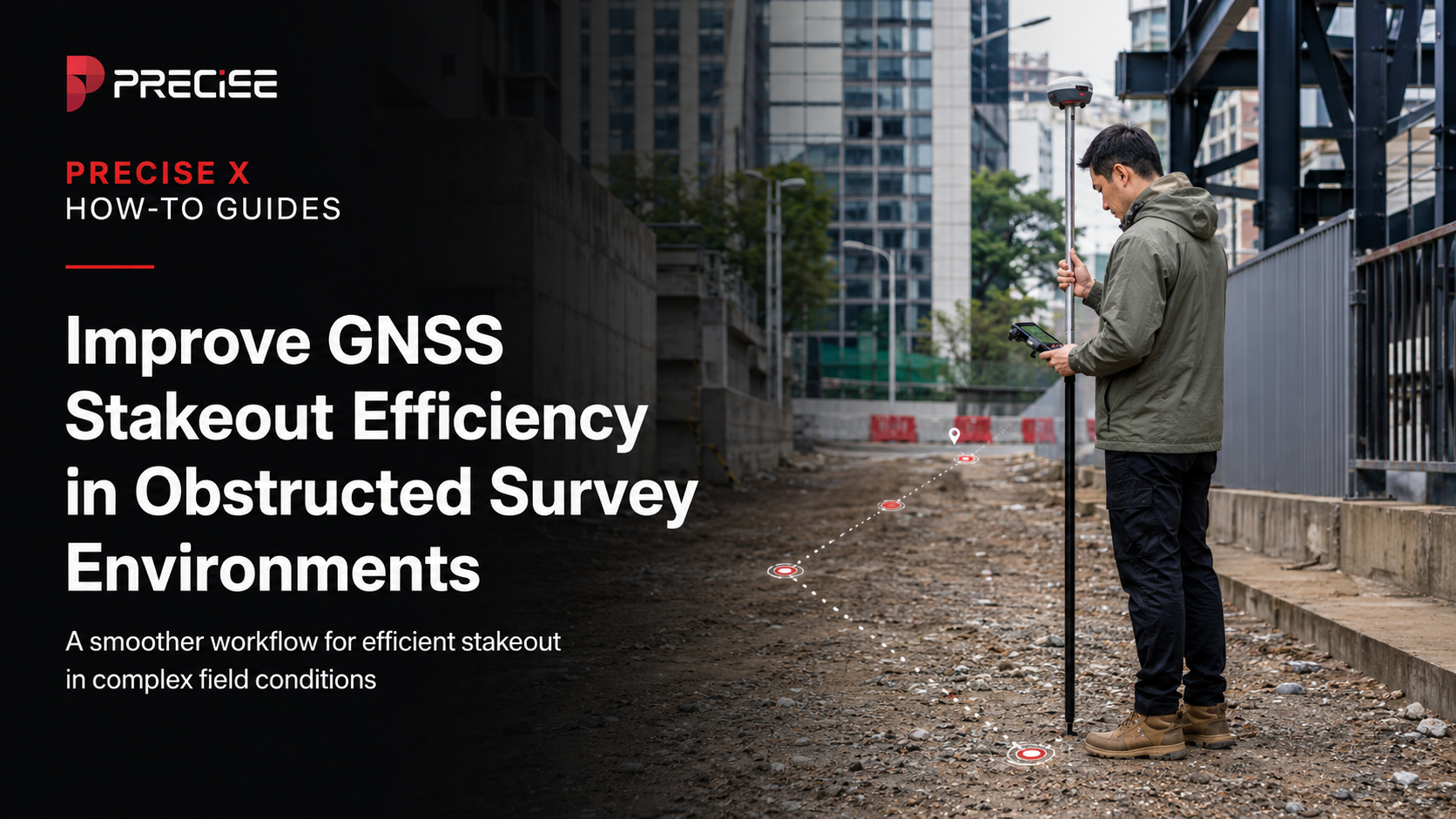
GNSS stakeout efficiency is especially important in obstructed survey environments, where signal interruptions, limited visibility, and repeated repositioning can slow down fieldwork.
You can replace the original first sentence with this version for better keyword relevance.
These conditions do not always make stakeout technically difficult. However, they can significantly slow down field workflows, increase hesitation during alignment, and raise the risk of cumulative layout errors.
Improving efficiency in obstructed GNSS stakeout environments is not simply about moving faster. It is about using a more practical workflow that reduces unnecessary movement, repeated checks, and uncertainty.

Why Conventional Stakeout Workflows Slow Down
Traditional GNSS stakeout workflows often rely on three basic assumptions:
- Clear satellite visibility
- Stable positioning without frequent interruptions
- Direct line-of-sight movement toward the target point
In obstructed survey environments, these assumptions often break down.
Buildings, structures, machinery, fences, vegetation, and uneven terrain can all affect the way surveyors approach a stakeout point. As a result, common inefficiencies may appear in daily fieldwork:
- Frequent re-initialization due to unstable GNSS signals
- Repeated repositioning to confirm direction and alignment
- Visual uncertainty when approaching the stakeout point
- Increased dependence on operator experience
Even experienced crews may spend more time confirming direction than actually completing the stakeout task.
A More Efficient Logic for GNSS Stakeout
A more efficient stakeout workflow should not rely only on traditional positioning feedback such as coordinates, distance, and direction.
Instead, it should combine three key elements:
- Stable positioning under partial obstruction
- Clear visual guidance during approach
- Reduced dependence on perfect vertical alignment
This approach changes stakeout from a repeated “check-and-adjust” process into a smoother and more intuitive movement toward the target point.
For complex survey jobs, this workflow logic can help reduce hesitation, improve field continuity, and make the stakeout process easier to control.
Step 1: Ensure Positioning Stability Before Movement
Before starting stakeout, the first priority is to confirm that the GNSS solution is stable.
In partially obstructed environments, the strongest signal is not always the most important factor. What matters more is whether the positioning result remains consistent enough to support reliable movement.
A stable fixed solution helps reduce downstream corrections and prevents unnecessary interruptions during the stakeout process.
Before moving toward the target point, surveyors should check:
- Whether the positioning status is stable
- Whether initialization has been completed properly
- Whether the surrounding environment may cause signal blockage or multipath interference
This preparation helps create a more reliable starting point for the entire workflow.
Step 2: Use Visual Guidance to Reduce Direction Uncertainty
In traditional GNSS stakeout, operators often rely heavily on numerical feedback, including distance, direction, and coordinate changes.
While this information is accurate and necessary, it may not always be intuitive in complex field environments.
Visual stakeout guidance allows the operator to understand direction more clearly during movement. Instead of repeatedly checking numbers and adjusting position, the operator can use visual cues to move toward the target point more naturally.
This can help reduce:
- Back-and-forth movement
- Overcorrection during approach
- Time spent rechecking orientation
- Confusion caused by obstacles or limited visibility
In dense or partially obstructed environments, visual guidance can significantly shorten the decision-making cycle and make the stakeout process more efficient.
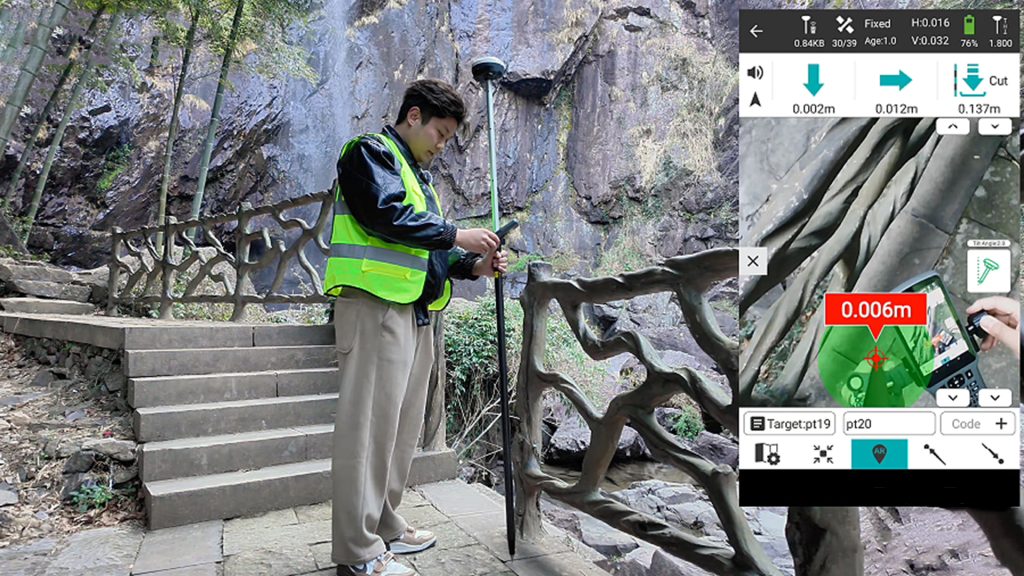
Step 3: Maintain Workflow Continuity with Tilt Compensation
Traditional stakeout often requires the pole to remain strictly vertical. In many real-world environments, this can force operators to stop, re-level, and adjust repeatedly.
When working near structures, road edges, fences, machinery, or uneven ground, maintaining perfect vertical alignment may interrupt the workflow and slow down the entire task.
Tilt-supported measurement allows operators to maintain greater flexibility during stakeout.
With IMU-based tilt compensation, surveyors can:
- Move more continuously toward the point
- Navigate around obstacles more easily
- Reduce repeated stopping and leveling
- Maintain workflow efficiency in confined or uneven areas
This is especially valuable when the stakeout point is difficult to approach directly or when the surrounding environment limits operator movement.
Step 4: Minimize Repositioning by Combining Feedback Methods
An efficient GNSS stakeout workflow should not depend on only one type of feedback.
A more practical approach combines:
- GNSS positioning
- Visual interpretation
- Operator movement logic
- Tilt-supported operation
By combining these elements, operators can maintain a smoother workflow and reduce the need to stop frequently for confirmation.
Instead of repeatedly repositioning, checking, and correcting, surveyors can move with more confidence and complete the task with fewer interruptions.
What Affects Stakeout Efficiency in Obstructed Areas
Even with an optimized workflow, several factors still influence stakeout performance in obstructed environments.
Key factors include:
- Satellite visibility conditions
- Multipath interference near buildings or structures
- Initialization stability
- Field environment complexity
- Operator familiarity with the workflow
In addition, visual guidance systems also require proper operating conditions, such as:
- Clear display visibility
- Stable device-camera synchronization
- Proper IMU initialization
- Smooth interaction between positioning and visual feedback
Ignoring these conditions can reduce the effectiveness of an otherwise advanced stakeout workflow.
For best results, surveyors should treat GNSS stakeout as a complete field process rather than a single positioning action.
Why This Workflow Fits Complex Survey Jobs
In environments where traditional GNSS workflows become inefficient, combining positioning stability, visual guidance, and tilt-supported operation creates a more adaptable stakeout system.
Devices like the PRECISE X are designed to support this type of practical field workflow by integrating:
- High-channel GNSS tracking for improved fix reliability
- Visual stakeout capabilities for more intuitive alignment
- IMU-based tilt compensation for flexible positioning
- A more efficient workflow for obstructed and complex survey environments
This combination helps crews maintain efficiency when conditions are less than ideal.
Instead of relying only on open-sky conditions or perfect vertical operation, surveyors can work with a more flexible system that supports smoother movement, fewer interruptions, and improved task flow.
Conclusion
Stakeout efficiency in obstructed environments is not only a matter of speed. It is a matter of workflow design.
By reducing dependence on perfect conditions and integrating positioning, visualization, and movement into a unified workflow, survey teams can complete stakeout tasks more smoothly and with fewer interruptions.
In practice, the most effective improvement often comes not from working harder, but from working with a better system.
With the right workflow and the right equipment, GNSS stakeout in complex environments can become more intuitive, more continuous, and more efficient.