

Scan indoor and GNSS-denied environments more efficiently by using SLAM workflows that support continuous data capture, stable trajectories, and reduced setup time.
In many real-world projects, surveyors and geospatial professionals need to work in environments where satellite signals are weak, unstable, or completely unavailable. These conditions are common in industrial plants, factories, underground tunnels, basements, large indoor facilities, and dense urban structures.
In these scenarios, traditional GNSS-based positioning becomes difficult to rely on. Initialization may fail, positioning may become unstable, and field workflows may be interrupted frequently.
For survey teams, this does not only affect convenience. It directly impacts scanning efficiency, data consistency, field time, and project delivery.
To maintain productivity and data quality in indoor or GNSS-denied environments, teams need a different approach — one that does not depend on GNSS as the primary positioning source.
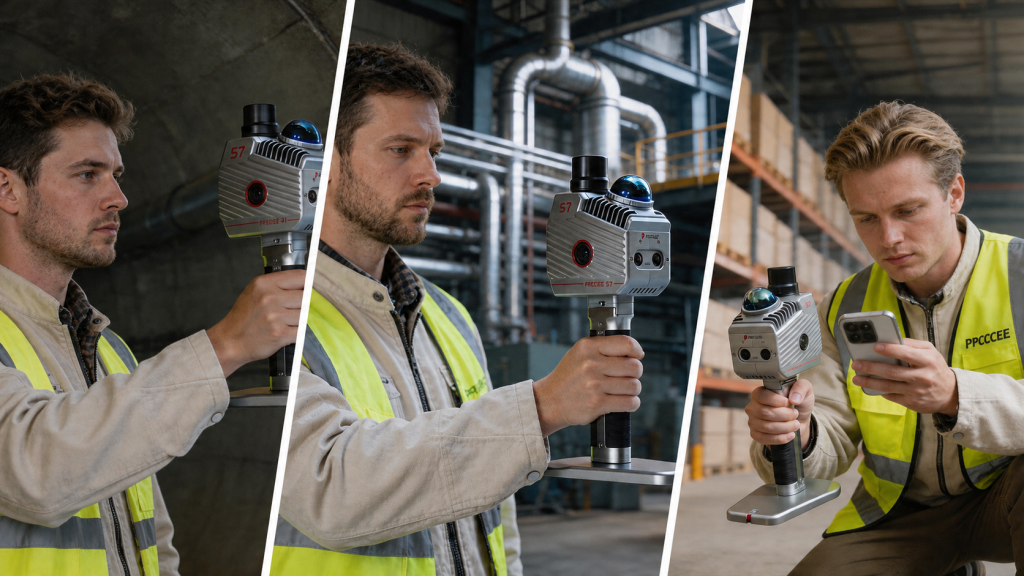
This guide explains how to scan indoor and GNSS-denied environments more efficiently using SLAM-based workflows, and how multi-sensor systems such as the PRECISE S7 support continuous and reliable data capture in challenging spaces.
Why Conventional Workflows Struggle Indoors
Traditional surveying workflows are often designed around open-sky positioning. GNSS receivers perform well when satellite signals are available and stable, but indoor and obstructed environments create very different conditions.
When GNSS signals are blocked or degraded, conventional workflows often become slower, more fragmented, and more difficult to manage.
1. GNSS Dependency Breaks Down
In indoor environments, underground spaces, or areas surrounded by dense structures, satellite signals may be weak, reflected, or completely unavailable.
When this happens, GNSS-based positioning can become unreliable. Operators may experience failed initialization, poor positioning stability, or interruptions in the measurement workflow.
This makes it difficult to maintain a continuous and efficient field process.
2. Setup Time Increases
To compensate for the lack of GNSS, teams often need to introduce additional control points, manual referencing, or repeated equipment setups.
While these methods can support accuracy, they also increase field preparation time and operational complexity.
For large indoor facilities, long corridors, factories, or underground spaces, repeated setup and alignment can significantly slow down the project.
3. Workflow Fragmentation Reduces Efficiency
In GNSS-denied projects, teams may need to switch between different tools and methods, such as GNSS equipment, total stations, manual measurements, control point workflows, and post-processing alignment.
This fragmented approach increases:
- Workflow complexity
- Operator workload
- Risk of human error
- Training requirements
- Field and office processing time
The more fragmented the workflow becomes, the harder it is to maintain consistent data quality across the entire project.
A More Efficient Approach: SLAM-Based Continuous Scanning
SLAM-based workflows offer a different way to capture spatial data in environments where GNSS is unavailable or unreliable.
Instead of relying on external positioning signals, SLAM systems use onboard sensors to estimate movement and build a map of the surrounding environment at the same time.
This allows operators to capture data continuously while moving through the space.
The key shift is from:
Point-based measurement
to
Continuous spatial capture
This approach is especially useful in environments where setup time must be minimized, coverage speed is important, and external positioning is difficult to maintain.
With the right workflow, SLAM scanning can help teams move through indoor and GNSS-denied environments more efficiently while still maintaining reliable trajectory tracking and consistent datasets.
Key Execution Steps for Indoor and GNSS-Denied Scanning
1. Start in a Structurally Clear Area
Before entering complex or narrow zones, begin scanning in an area with clear and identifiable features.
This may include spaces with visible walls, corners, columns, equipment, doors, or structural variation. A stable starting area gives the system a stronger reference for initial tracking.
Why it matters:
A clear starting environment helps establish a stable initial trajectory and reduces the risk of early-stage tracking instability.
2. Maintain Continuous Movement Without Interruptions
During scanning, keep movement smooth and continuous. Avoid frequent stops, sudden restarts, sharp turns, or unnecessary pauses.
SLAM systems work best when they receive continuous data from the environment and motion sensors. Interruptions can make trajectory estimation less stable, especially in complex indoor spaces.
Why it matters:
Continuous movement supports stable sensor fusion and helps maintain tracking reliability throughout the scan.
3. Prioritize Feature-Rich Paths
When planning the scanning route, choose paths that include useful environmental features.
These may include:
- Walls
- Corners
- Doorways
- Columns
- Machinery
- Pipes
- Equipment
- Structural changes
Avoid long featureless paths whenever possible, especially in empty corridors or open halls with repetitive surfaces.
Why it matters:
Visual and geometric features provide references for SLAM tracking, helping reduce drift and improve trajectory stability.
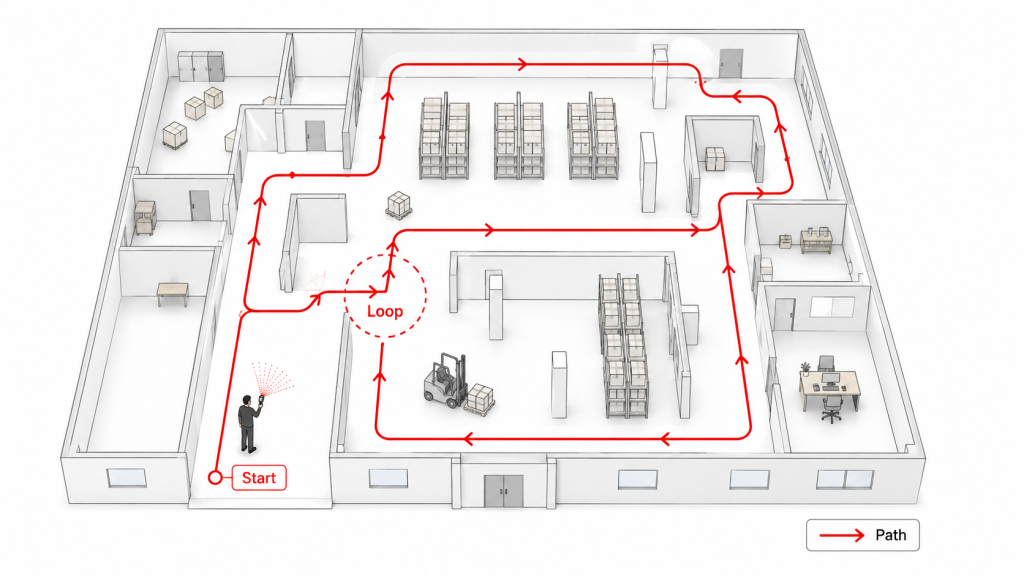
4. Use Loop Closures in Large Indoor Spaces
For larger indoor environments, design the scanning path so that it returns to previously scanned areas.
This may involve creating one large loop around the project area or several smaller loops within different sections of the site.
Loop closure allows the system to recognize known areas and correct accumulated positioning errors.
Why it matters:
Loop-based scanning paths help improve global dataset consistency and reduce the risk of long-distance drift.
5. Monitor Coverage and Adjust in Real Time
If the system supports real-time preview or coverage feedback, use it actively during scanning.
Operators should check for missing areas, weak coverage, or unstable sections while still on site. If a problem is found, critical zones can be rescanned immediately.
Why it matters:
Real-time adjustment helps reduce return visits, minimize rework, and improve project efficiency.
What Affects Efficiency in GNSS-Denied Environments?
Even with SLAM workflows, scanning efficiency can vary depending on the project environment and data requirements.
Environmental Complexity
Narrow corridors, underground passages, dense machinery, and cluttered industrial spaces may require more careful path planning than open halls or simple indoor spaces.
Complex environments often provide more features for tracking, but they may also restrict movement and visibility.
Movement Constraints
Access limitations, safety rules, restricted walkways, equipment zones, and active work areas can affect the scanning route.
Operators should plan paths that maintain both safety and data continuity.
Data Requirements
The required level of detail, accuracy expectations, and final deliverable type will influence the scanning speed and coverage strategy.
A basic documentation task may allow faster movement, while inspection, BIM, or engineering deliverables may require slower scanning and more consistent coverage.
Understanding these factors helps teams balance speed, accuracy, and data completeness more effectively.
Why SLAM Systems Like PRECISE S7 Are Better Suited for These Environments
Indoor and GNSS-denied environments require systems that can maintain positioning without relying on satellite signals.
The PRECISE S7 is designed for complex scanning conditions by integrating multiple sensors to support stable trajectory tracking and efficient data capture.
In the PRECISE S7, LiDAR captures precise geometric information, visual SLAM cameras support feature tracking, dual panoramic cameras provide full-scene visual context, and a high-frequency IMU supports motion continuity.
This multi-sensor approach helps the system maintain tracking when GNSS is unavailable and when the environment becomes more difficult to scan.
With this type of integrated SLAM workflow, operators can:
- Scan continuously without external positioning
- Maintain more stable trajectories in indoor spaces
- Reduce setup-heavy field processes
- Capture complex environments more efficiently
- Reduce workflow interruptions
- Complete projects faster with more consistent results
For industrial plants, factories, underground tunnels, basements, dense urban structures, and large indoor facilities, this can make 3D data capture more practical and dependable.

Conclusion
Indoor and GNSS-denied environments require a different scanning mindset.
Efficiency in these conditions does not come from repeated setups or isolated measurements. It comes from continuous workflows, feature-aware movement, stable trajectories, and real-time adjustment.
By adopting SLAM-based workflows, survey teams can work more efficiently in complex environments, reduce operational complexity, and deliver reliable 3D data without depending on GNSS.
When these workflow principles are combined with a multi-sensor system such as the PRECISE S7, indoor and GNSS-denied scanning becomes faster, more stable, and more practical for real-world project delivery.