
Setting up a GNSS base station may sound simple.
But in real field conditions, base deployment can quickly become a hidden bottleneck.
Survey crews may spend extra time finding a suitable position, checking signal quality, adjusting communication settings, or troubleshooting the connection between the base and rover. These delays may seem small during setup, but they can affect the efficiency of the entire RTK workflow.
For teams working on construction layout, topographic surveys, infrastructure mapping, or remote field projects, a poorly deployed base station can lead to unstable fixes, repeated checks, and unnecessary downtime.
This guide explains how to deploy a portable GNSS base station more effectively in real surveying environments, and what makes the difference between a stable setup and a problematic one.
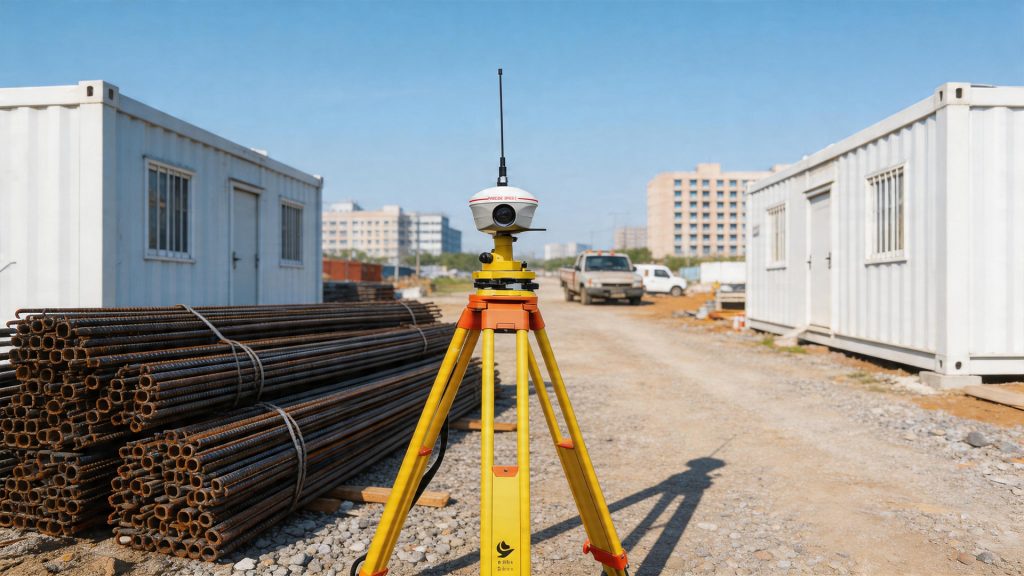
Why Conventional Base Station Setup Can Slow Down Fieldwork
Traditional base station workflows often assume ideal field conditions, such as:
- Open sky visibility
- Stable mounting points
- Minimal signal interference
- Simple radio communication
However, most job sites are not ideal.
Survey teams often face practical challenges such as:
- Limited space for tripod placement
- Signal obstruction from buildings, trees, or terrain
- Inconsistent radio link quality
- Time-consuming configuration steps
As a result, crews may need to reposition the base multiple times, recheck coordinates, or stop the workflow due to unstable communication.
In many cases, the problem is not only the environment.
It is also the lack of a streamlined base deployment workflow.
A Better Approach: Think in Stability, Not Just Setup
A GNSS base station should not be treated as a quick pre-task.
It should be treated as the foundation of the entire RTK workflow.
A reliable base setup depends on three key factors:
1. Position Stability
The base station must remain on a stable and consistent reference point throughout the operation.
Any movement, vibration, or unstable mounting condition may affect coordinate consistency and RTK reliability.
2. Signal Quality
Clear satellite tracking is essential for stable base performance.
Obstructions, reflective surfaces, nearby metal structures, and multipath environments can all reduce signal quality.
3. Communication Reliability
The base must provide continuous correction data to the rover.
If the communication link is weak or unstable, RTK initialization may slow down, fix rates may drop, and the field workflow may be interrupted.
When these three factors are optimized, survey teams can achieve:
- Faster RTK initialization
- More stable fix performance
- Fewer workflow interruptions
- More predictable field productivity
The goal is not simply to “set up a base.”
The goal is to build a stable reference workflow that supports continuous RTK operation.

Key Steps to Deploy a Portable GNSS Base Station Efficiently
Step 1: Choose a Position That Balances Visibility and Practicality
A common mistake is assuming that the highest point is always the best point.
In reality, a higher position is not useful if it is affected by obstructions, unstable ground, or unsafe placement.
When selecting a base position, prioritize:
- Clear sky visibility
- A wide open view of the sky
- Minimal nearby obstructions
- Distance from reflective surfaces and metal structures
- A safe and stable location for the full operation period
In constrained environments, a slightly lower but cleaner and more stable location is often better than a higher location with partial blockage.
A good base position should support both signal quality and practical field operation.
Step 2: Ensure Stable Mounting and Physical Security
Base station movement can directly affect coordinate consistency.
Even small movement during operation may reduce the reliability of the RTK workflow.
To improve physical stability:
- Use a stable tripod or fixed mounting point
- Avoid loose soil, unstable surfaces, or high-traffic areas
- Make sure all tripod legs and mounting connections are locked
- Keep the setup away from vibration sources where possible
- Confirm the base remains secure before initialization
Physical stability is especially important for long-duration projects or sites with heavy machinery, vehicle movement, or uneven ground.
A stable base station helps maintain a consistent reference point throughout the survey.
Step 3: Optimize Communication Between Base and Rover
Communication is one of the most important but often overlooked parts of base station deployment.
Even when the base position is good, poor communication can still cause RTK instability.
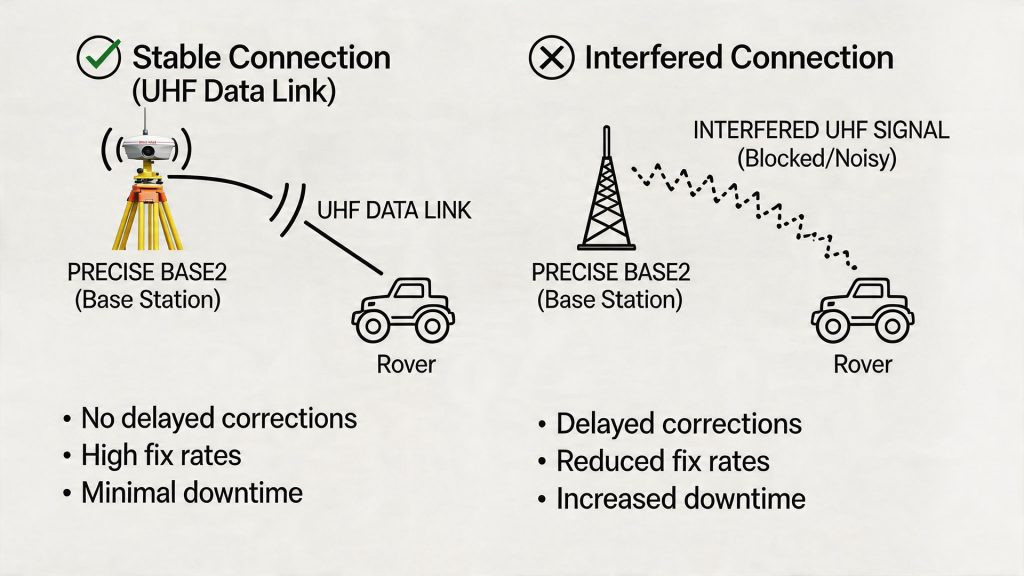
Depending on the project requirements, survey teams may use UHF radio or other communication methods for base-to-rover correction data.
To improve communication reliability:
- Confirm that the base and rover are using compatible settings
- Check frequency and communication parameters before work begins
- Avoid antenna blockage where possible
- Consider working distance between base and rover
- Monitor whether corrections remain stable during movement
A weak communication link may cause:
- Delayed correction data
- Lower RTK fix rates
- Frequent interruptions
- Increased downtime in the field
For efficient RTK surveying, communication should be checked before full deployment, not after problems appear.
Step 4: Simplify Initialization and Configuration
Complex setup processes increase the risk of mistakes.
This is especially true when crews need to move between multiple sites in one day or work under time pressure.
A more efficient base workflow should help crews:
- Reduce manual configuration steps
- Pair the base and rover quickly
- Switch between working modes more easily
- Start field operation with fewer repeated checks
The easier the base station is to configure, the faster crews can move from preparation to productive work.
For modern surveying teams, setup efficiency is not just about saving time at the beginning.
It also helps reduce errors and keeps the whole field workflow more consistent.
Step 5: Validate the Setup Before Full Survey Work
Before starting actual survey tasks, crews should take a short validation step.
This helps prevent larger problems later in the project.
Before full deployment, check:
- RTK fix status
- Coordinate consistency
- Correction data stability
- Communication performance over distance
- Power and connection status
A short validation process can prevent hours of rework.
It also helps the field team confirm that the base station is ready to support continuous operation.
What Affects GNSS Base Station Performance in the Field?
Even with a good deployment workflow, several external factors can influence base station performance.
These include:
- Satellite conditions
- Time of day and constellation availability
- Urban structures, trees, or terrain obstruction
- Multipath interference
- Distance between base and rover
- Radio communication environment
- Power stability during long operations
Ignoring these factors can lead to inconsistent field performance, even when the equipment itself is properly configured.
That is why reliable RTK surveying depends on both equipment capability and field deployment discipline.
Why This Workflow Matters for Modern Surveying Projects
Surveying projects are becoming faster, more mobile, and more complex.
Crews may need to work across different sites, changing environments, and varying communication conditions.
In this context, base station deployment should no longer be seen as a static setup step.
It should be part of a flexible and efficient field workflow.
A portable GNSS base station designed for real field conditions can help survey teams:
- Reduce setup complexity
- Improve deployment flexibility
- Support stable correction communication
- Move faster between sites
- Reduce unnecessary workflow interruptions
For example, PRECISE Base2 is designed to support practical RTK base workflows in the field, helping crews move from setup to operation with fewer interruptions and more predictable performance.
By simplifying base deployment and supporting stable RTK operation, Base2 helps make the entire survey workflow more efficient.
Conclusion
A GNSS base station is not just the starting point of an RTK survey.
It defines the stability of the entire field workflow.
By focusing on position selection, physical stability, communication reliability, and efficient configuration, survey teams can reduce delays and improve field productivity.
In real projects, the difference between a good base setup and a problematic one is not only the equipment.
It is also how the base station is deployed.
A stable, well-planned base workflow helps survey crews work faster, reduce interruptions, and maintain more reliable RTK performance in changing field conditions.