

RTK workflows rarely fail in ideal conditions.
They fail when the field environment becomes unpredictable.
Survey crews may need to work under signal obstruction, unstable communication, uneven terrain, or time pressure. In these situations, even a technically capable GNSS system can deliver inconsistent results if the workflow is not strong enough to handle real-world variability.
For modern survey teams, reliability is not only about accuracy.
It is about consistency under real field conditions.
This guide explains how to build a more reliable RTK workflow, especially when working in complex, changing, or imperfect environments.

Why RTK Workflows Break Down in Challenging Conditions
Most RTK workflows are built around ideal assumptions.
They often assume:
- Open sky visibility
- A stable base station location
- Uninterrupted communication
- Predictable field operation
- Enough time for setup and validation
But real surveying projects are rarely that simple.
Field crews often face:
- Partial sky obstruction in urban, forested, or industrial areas
- Changing working positions
- Uneven terrain
- Intermittent radio interference
- Limited setup space
- Pressure to complete tasks quickly
When these conditions appear, small weaknesses in the workflow become much more visible.
Common problems include:
- Longer RTK initialization times
- Unstable fixed status
- Unexpected drops to float solutions
- Repeated measurements
- Inconsistent confidence in positioning results
The issue is usually not a single failure point.
It is the lack of workflow resilience.
A reliable RTK workflow must be able to handle changing field conditions without breaking down.
A Better Approach: Build for Consistency, Not Perfection
A reliable RTK workflow is not built to perform perfectly once.
It is built to perform consistently across different field conditions.
This requires a shift in thinking.
Instead of focusing only on:
“maximum accuracy in ideal conditions”
survey teams should also focus on:
“stable performance across real environments.”
A resilient workflow helps ensure:
- Predictable RTK behavior
- Fewer interruptions
- Reduced need for reinitialization
- More consistent output quality
- Better confidence in field results
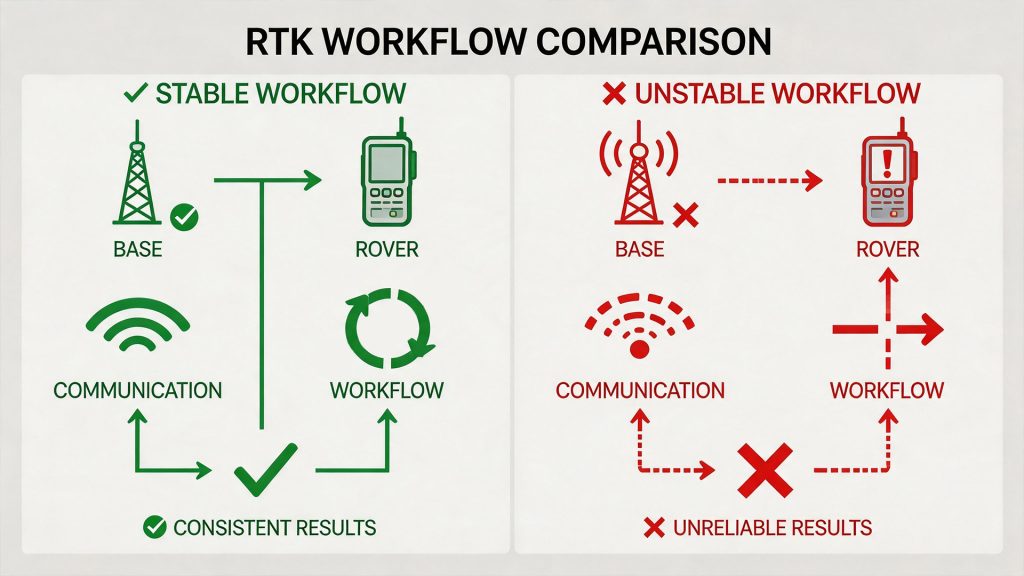
Instead of optimizing only one step, a reliable workflow strengthens the entire RTK chain:
Base Station → Communication Link → Rover → Operator → Environment
Each part affects final performance.
If one part becomes unstable, the whole workflow may be affected.
Key Steps to Build a More Reliable RTK Workflow
Step 1: Start with a Stable and Adaptable Base Setup
The base station defines the reference for the entire RTK workflow.
If the base setup is unstable, the rover workflow will be affected as well.
To improve reliability, survey crews should:
- Select a location that balances sky visibility and practical field operation
- Avoid high-interference areas where possible
- Keep the base away from reflective surfaces and heavy obstruction
- Ensure stable mounting on a tripod or fixed point
- Confirm that the base can operate continuously during the task
- Check power supply and connection stability before starting
In dynamic environments, the ability to adapt base placement quickly is often more valuable than finding a theoretically perfect position.
A practical base position should support both signal quality and workflow continuity.
Step 2: Maintain a Clean and Consistent Communication Link
Communication instability is one of the most common causes of RTK inconsistency.
Even when GNSS tracking is good, unstable correction delivery can lead to slower initialization, poor fix stability, or interruptions during measurement.
To improve communication reliability, crews should:
- Choose the appropriate communication mode based on field conditions
- Use UHF radio or network RTK according to project requirements
- Avoid interference-prone frequency ranges where possible
- Check communication quality before full operation
- Monitor correction data stability during the survey
- Reposition the base or antenna if repeated signal loss occurs
A stable correction stream is more important than maximum theoretical range.
For real fieldwork, the best communication setup is the one that remains reliable throughout the task.
Step 3: Standardize Field Workflow Across the Team
Inconsistent workflows between operators can introduce hidden variability.
Two crews using the same equipment may get different results if their setup habits, initialization checks, or validation steps are not aligned.
To reduce this risk, teams should define a standard operating workflow.
This can include:
- A consistent base setup sequence
- Standard communication settings and checking process
- Clear initialization steps
- Validation before full measurement
- Agreed rules for when to reposition or reinitialize
- Shared troubleshooting logic for unstable RTK status
Consistency in human operation is as important as consistency in hardware performance.
A standardized workflow helps reduce avoidable mistakes and makes results more predictable across different operators and sites.
Step 4: Control RTK Initialization Conditions
RTK initialization is sensitive to environmental conditions.
Starting initialization in a poor location may lead to longer wait times, unstable fixes, or repeated attempts.
To improve initialization reliability, crews should:
- Avoid initializing under heavy obstruction
- Start in a position with better sky visibility whenever possible
- Confirm stable communication before initialization
- Avoid unnecessary movement during the initial fixing process
- Allow sufficient time for the system to converge
- Verify fixed status before beginning critical measurements
Fast initialization is useful.
But reliable initialization is critical.
A few extra seconds spent starting under better conditions can prevent much longer delays later in the workflow.
Step 5: Monitor and Adjust Before Problems Escalate
Reliable RTK workflows include active monitoring.
Field conditions can change during operation. The rover may move into a more obstructed area, communication may weaken, or interference may appear unexpectedly.
During operation, crews should regularly check:
- RTK fixed status
- Correction data continuity
- Initialization behavior
- Signal quality indicators
- Patterns of instability in certain locations
- Communication performance over distance
If instability appears, crews should adjust early.
Possible actions include:
- Checking the communication link
- Moving away from heavy obstruction
- Repositioning the antenna or base
- Switching communication mode if needed
- Reinitializing under better conditions
- Validating questionable measurements before continuing
Waiting until results are clearly wrong often leads to rework.
Proactive monitoring helps crews keep the workflow stable before small issues become larger problems.
What Makes an RTK Workflow More Resilient?
A resilient RTK workflow is built on multiple layers.
These layers include:
Hardware Reliability
Stable GNSS tracking, strong receiver performance, and anti-interference capability help support reliable positioning in complex environments.
Communication Robustness
Consistent correction delivery is essential for maintaining RTK fixed status and reducing interruptions.
Operational Consistency
Standardized team practices help reduce human variability and make field performance more predictable.
Environmental Awareness
Crews need to understand how buildings, trees, terrain, radio noise, and working distance can affect RTK performance.
Power and Physical Stability
Longer tasks require stable power supply, secure mounting, and reduced risk of accidental movement or shutdown.
Weakness in any one layer can affect the entire workflow.
Reliability is not a single feature.
It is the result of system-level alignment.
Why This Matters in Real Survey Projects
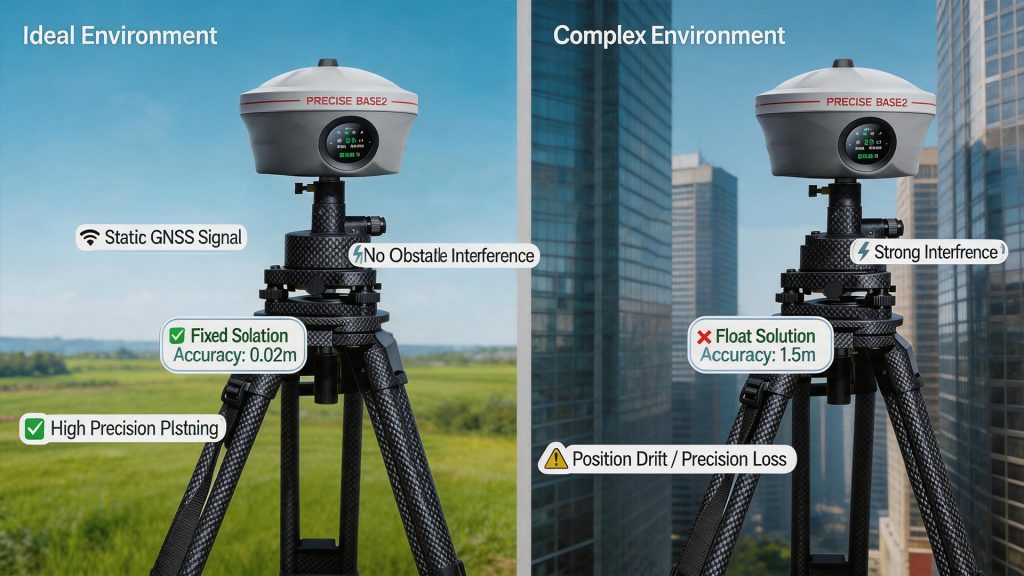
In challenging environments, unreliable RTK workflows can lead to:
- Repeated measurements
- Longer project time
- Lower confidence in results
- More interruptions in the field
- Higher operational cost
- Increased pressure on survey crews
On the other hand, a reliable workflow helps teams achieve:
- Smoother field operations
- More consistent accuracy
- Better time control
- Fewer unnecessary rechecks
- Higher team efficiency
- More predictable project delivery
This is especially important for projects where field conditions cannot be fully controlled.
They can only be managed.
That is why workflow reliability matters as much as equipment capability.
How PRECISE Base2 Supports a More Reliable RTK Workflow
Integrated GNSS base solutions like PRECISE Base2 are designed to support more predictable field operation.
For challenging field conditions, Base2 helps reduce workflow variables by combining:
- Stable multi-constellation GNSS tracking
- Flexible base-to-rover communication
- Integrated design with fewer external dependencies
- Portable deployment for changing field conditions
- Reliable power support for continuous operation
- A simpler base station workflow for field crews
By reducing setup complexity and supporting stable correction delivery, PRECISE Base2 helps survey teams build a more consistent RTK workflow across different environments.
For crews working in construction sites, urban edges, open fields, industrial areas, or distributed project locations, this can help improve field confidence and reduce avoidable interruptions.
Conclusion
Reliable RTK performance is not achieved by chance.
It is built through:
- Stable base deployment
- Consistent communication
- Standardized field workflows
- Controlled initialization
- Proactive monitoring
In challenging field conditions, the goal is not to eliminate all uncertainty.
The goal is to ensure that the workflow can handle uncertainty without breaking.
In practice, the most effective RTK workflows are not always the most complex ones.
They are the ones that remain stable when conditions are not ideal.