
Not all stakeout tasks fail for the same reason.
On some sites, the main challenge is obstruction. On others, it is limited access, difficult orientation, repeated corrections, or inefficient movement near boundaries. In practice, field efficiency depends not only on equipment performance, but also on whether the workflow matches the site condition.
This is why choosing the right GNSS stakeout workflow matters.
A method that works well in an open construction zone may become inefficient in a dense urban site. Likewise, a workflow that helps reduce final-point hesitation may not be enough when physical barriers restrict movement.
The most effective crews are not simply the fastest. They are the ones that adapt their workflow to the job.
Why One Stakeout Method Does Not Fit Every Site
Traditional GNSS stakeout workflows are often treated as if they were universally applicable.
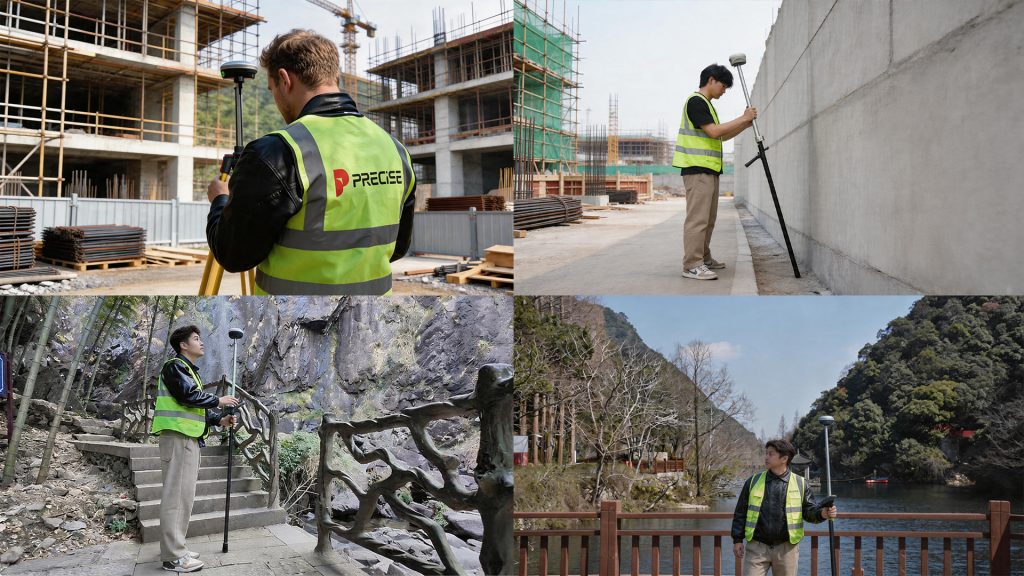
In reality, site conditions vary significantly. Different projects may present different challenges in satellite visibility, movement freedom, access conditions, and final-point confirmation.
Common site variables include:
- Satellite visibility
- Physical access to the target point
- Environmental complexity
- Operator movement freedom
- Final-point alignment difficulty
- Task volume and workflow repeatability
When crews use the same workflow everywhere, inefficiencies begin to appear.
Typical signs include:
- Excessive repositioning
- Repeated checks near the target point
- Slow movement in constrained areas
- Confusion during directional alignment
- Higher rework rates in complex layouts
The problem is not always the equipment. Very often, it is the mismatch between task conditions and task method.
A Better Decision Logic for Stakeout Workflows
Instead of asking, “What is the standard way to do stakeout?” a more useful question is:
“What is the most efficient workflow for this specific site condition?”
A better decision logic usually starts with four practical questions:
- Is access to the target point direct or restricted?
- Is the surrounding environment open or obstructed?
- Will the operator need continuous movement or repeated stops?
- Is the main challenge positioning accuracy, directional clarity, or workflow continuity?
These questions help teams choose a more suitable approach before inefficiency appears in the field.
By identifying the main workflow challenge early, survey teams can reduce unnecessary hesitation, choose the right working method, and improve overall field efficiency.
Step 1: Use a Stability-First Workflow in Partially Obstructed Areas
When working near buildings, structures, trees, or reflective surfaces, the first priority should be positioning consistency.
In these conditions, the workflow should emphasize:
- Stable GNSS initialization
- Reliable positioning under partial obstruction
- Reduced dependence on repeated resets
- Smoother movement under non-ideal visibility conditions
The goal is not to chase perfect conditions. It is to maintain reliable task flow under imperfect ones.
In partially obstructed environments, surveyors should first confirm that the GNSS solution is stable enough to support continuous operation. A stable workflow foundation helps reduce unnecessary interruptions later in the task.
This approach is especially useful in urban construction zones, industrial sites, or areas where satellite visibility changes during movement.
Step 2: Use a Clarity-First Workflow When Direction Becomes the Main Bottleneck
On many sites, the biggest delay is not measurement itself. It is the time spent understanding where to move.
When operators repeatedly stop to check azimuth, direction, or final alignment, the workflow should prioritize clearer directional understanding.
A clarity-first workflow should focus on:
- Intuitive directional guidance
- Less reliance on numerical interpretation
- Faster confirmation during approach
- Reduced hesitation near the target point
This is especially important in stakeout-heavy tasks where orientation time accumulates quickly across the day.
In practical fieldwork, even small pauses can become a major efficiency loss when repeated across many points. By improving how direction is communicated to the operator, survey teams can move more directly and complete stakeout tasks with greater confidence.
Visual stakeout guidance can be valuable in this scenario because it turns abstract direction into something easier to understand during movement.
Step 3: Use a Flexibility-First Workflow Near Boundaries and Obstacles
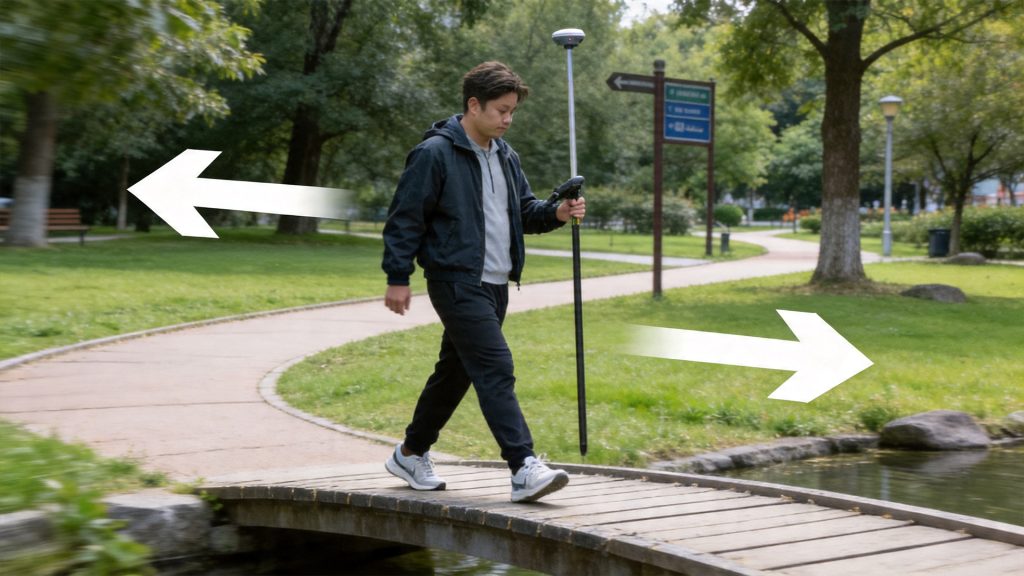
When the operator cannot move freely around the target point, rigid workflows become inefficient.
This is common when working near:
- Walls
- Fences
- Curbs
- Building edges
- Construction barriers
- Narrow corridors
- Restricted zones
In these conditions, the method should support:
- Operation from non-ideal positions
- Reduced dependence on strict vertical alignment
- Continuity even when direct access is limited
- Fewer repeated leveling and repositioning steps
This allows crews to complete stakeout tasks more efficiently in narrow, restricted, or boundary-sensitive environments.
A flexibility-first workflow is especially useful when the target point is close to an obstacle or when direct access would interrupt the operation. Instead of forcing perfect positioning conditions, operators can work from a more practical position and maintain workflow continuity.
Step 4: Use a Rework-Reduction Workflow in High-Volume Layout Jobs
On larger layout tasks, even small inefficiencies become expensive when repeated many times.
If the job involves many points, multiple crews, or tight timelines, the workflow should focus on repeatability and final confirmation.
A rework-reduction workflow should emphasize:
- Consistent task execution
- Fewer repeated checks
- Clearer final confirmation
- Better alignment confidence across operators
- Reduced variation between different crews
Here, efficiency comes from repeatability, not just speed.
In construction layout projects, repeated corrections can quickly increase labor time and reduce confidence in the final results. A more consistent workflow helps operators complete each point with fewer adjustments and less uncertainty.
This is especially valuable when multiple operators need to follow the same process across a large site.
What Site Conditions Should Crews Evaluate Before Starting?
Choosing the right workflow begins with reading the site correctly.
Before stakeout starts, teams should assess:
- Sky visibility: Is signal blockage likely?
- Access condition: Can the point be reached directly?
- Site density: Are there structures, fences, equipment, or edge conditions nearby?
- Movement pattern: Will the operator move continuously or stop frequently?
- Task volume: Is this a small verification job or a large layout operation?
- Main workflow risk: Is the biggest challenge obstruction, direction, access, or rework?
These factors influence not only productivity, but also how much mental effort the operator must spend during the task.
When the site is evaluated correctly, crews can select the workflow that best fits the actual condition instead of applying the same method everywhere.
This helps reduce unnecessary movement, repeated checking, and workflow interruptions.
Why Adaptive Workflows Matter in Real Projects
In real projects, efficiency rarely comes from a single feature.
It comes from how well different workflow needs are supported in one system.
This is where integrated surveying tools become valuable.
The PRECISE X supports more adaptive stakeout workflows by combining:
- Stable GNSS positioning for a reliable task foundation
- Visual stakeout capability for clearer directional understanding
- IMU-based tilt support for more flexible operation in constrained environments
- A practical workflow structure for different field conditions
This combination makes it easier to adjust workflow logic according to site conditions, rather than forcing the same method onto every task.
For open areas, the workflow may focus on speed and continuity.
For obstructed areas, it may focus on stability.
For boundary-heavy sites, it may focus on flexibility.
For high-volume layout jobs, it may focus on repeatability and rework reduction.
By supporting multiple workflow needs, PRECISE X helps crews maintain efficiency across different survey environments.

Conclusion
The right stakeout workflow depends on the job, the site, and the field condition.
Open areas, obstructed environments, boundary-heavy sites, and high-volume layout tasks all create different workflow demands. Teams that recognize these differences early can reduce hesitation, lower rework, and improve efficiency without changing the core objective of the task.
In GNSS surveying, productivity is not only about precision. It is also about choosing the method that fits the situation.
With a more adaptive GNSS stakeout workflow, survey teams can work more confidently, respond better to site conditions, and complete field tasks with fewer interruptions.