
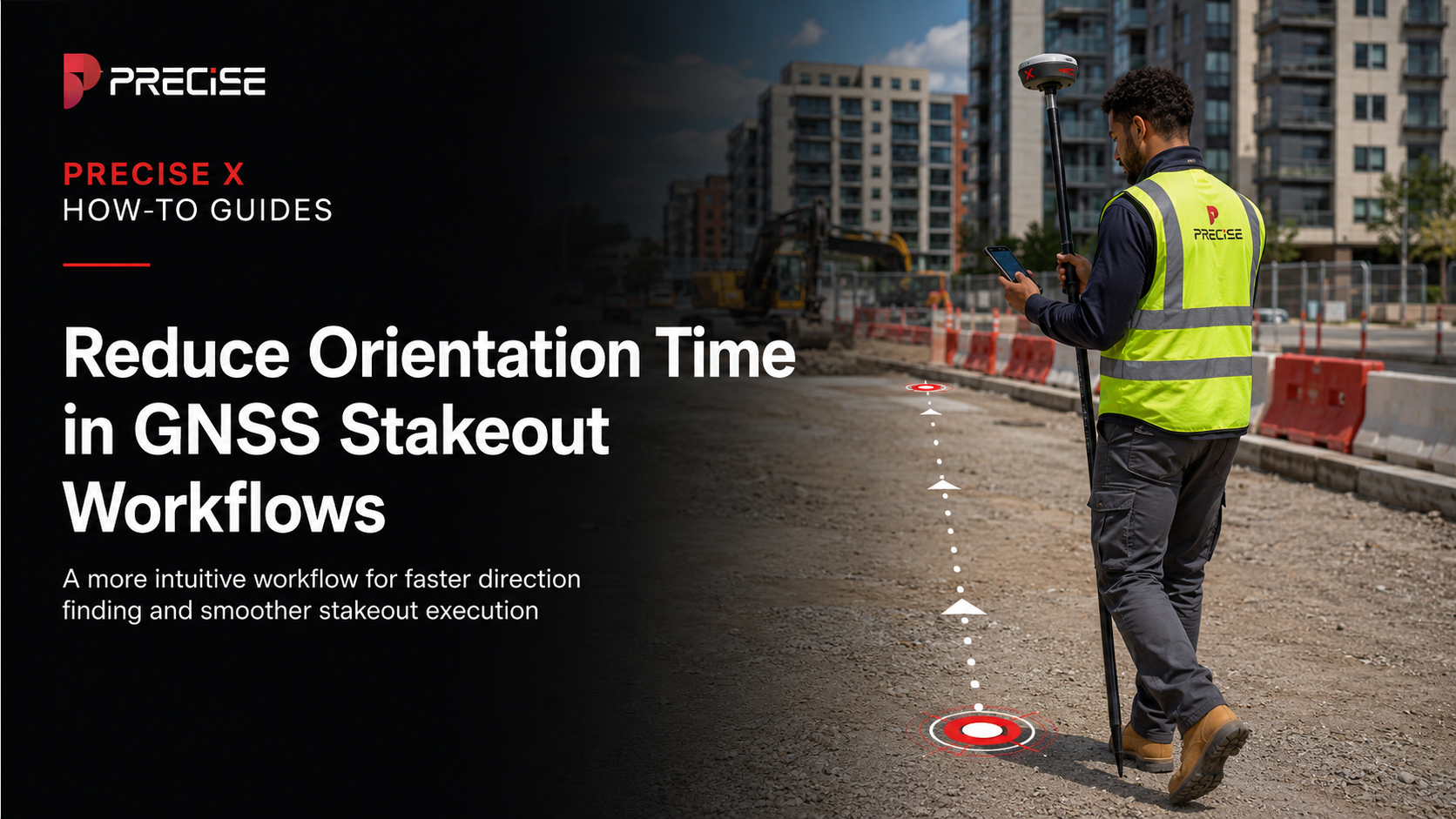
Reducing orientation time in GNSS stakeout is essential when operators spend too much time interpreting direction, rechecking position, and adjusting their path before reaching the target point.
Before reaching the target point, operators often pause, adjust, recheck, and reorient themselves multiple times. These moments may seem small individually, but across a full day of work, they can add up significantly.
Reducing orientation time is not about moving faster. It is about reducing uncertainty during movement, so that every step brings the operator closer to the target with greater confidence.
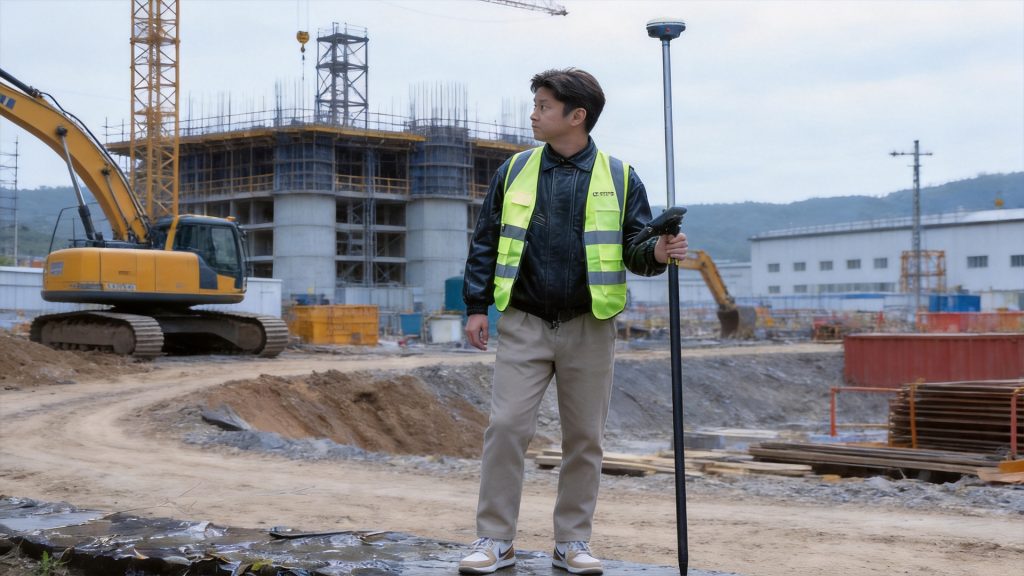
Why Orientation Time Becomes a Bottleneck
Traditional GNSS stakeout workflows rely heavily on numerical feedback, such as distance, azimuth, and coordinate differences.
While this information is accurate and necessary, it is not always the most intuitive form of guidance in real field conditions.
Numerical feedback can create several workflow limitations:
- It requires constant interpretation
- It increases cognitive load during movement
- It can be less intuitive in complex environments
- It often leads to hesitation near the final point
As a result, operators may frequently:
- Stop to recheck direction
- Adjust their path multiple times
- Overshoot the target point
- Circle around the target before final placement
- Spend extra time confirming the correct movement direction
This not only slows down stakeout work, but also increases the likelihood of small errors or repeated adjustments.
A More Intuitive Stakeout Workflow
To reduce orientation time, the workflow needs to shift from interpretation-based navigation to perception-based navigation.
Instead of asking the operator to constantly interpret numbers and convert them into movement decisions, a more intuitive workflow provides clearer directional understanding during the approach.
An improved GNSS stakeout workflow should focus on:
- Providing intuitive directional understanding
- Reducing reliance on abstract numerical data
- Maintaining continuous movement toward the target
This allows operators to spend less time thinking about direction and more time executing the task.
For daily stakeout work, this change can significantly improve workflow smoothness and reduce hesitation in the field.
Step 1: Establish Clear Direction Before Movement
Before starting the approach, the operator should first establish a clear understanding of the target direction.
This step helps reduce uncertainty at the beginning of the workflow and prevents unnecessary movement in the wrong direction.
Clear direction before movement can help reduce:
- Initial hesitation
- Incorrect movement paths
- Early-stage repositioning
- Repeated checks before approaching the target
A clear starting direction sets the tone for the entire stakeout workflow.
When the operator knows where to move from the beginning, the workflow becomes more direct and easier to control.
Step 2: Use Visual Feedback to Guide Movement
Visual guidance transforms abstract direction into something immediately understandable.
Instead of relying only on distance values, azimuth changes, or coordinate differences, visual stakeout feedback helps operators understand how to move in relation to the target point.
With intuitive directional cues, operators can:
- Move more directly toward the target
- Avoid unnecessary detours
- Reduce reliance on constant numerical checking
- Adjust movement direction more naturally
- Shorten the time spent deciding where to go
This significantly reduces orientation time during the approach.
In complex environments, visual feedback can also help operators make faster decisions when obstacles, boundaries, or uneven terrain limit movement options.

Step 3: Maintain Continuous Movement Without Frequent Stops
Frequent stopping is one of the main reasons orientation time increases during stakeout.
Each stop forces the operator to recheck direction, confirm current position, and decide how to move again. Over time, this creates a fragmented workflow.
A smoother stakeout workflow allows operators to:
- Adjust direction dynamically while moving
- Avoid full resets during minor deviations
- Maintain momentum toward the target
- Reduce unnecessary pauses and repeated checks
- Keep the workflow more continuous from start to finish
Continuous movement reduces both time and cognitive load.
When the operator can keep moving while making small directional corrections, the stakeout process becomes faster, more intuitive, and less tiring.
Step 4: Reduce Final Alignment Hesitation
The last few centimeters often take the longest.
Near the target point, operators tend to slow down, recheck position multiple times, and make small but repeated adjustments. This final-stage hesitation can become a major source of inefficiency, especially when many points need to be staked out in one day.
Common final alignment issues include:
- Excessive slowing down near the target
- Repeated position checks
- Small back-and-forth corrections
- Uncertainty before final marking
- Lack of confidence in the final placement
Combining positioning data with intuitive feedback allows for:
- Faster confirmation
- Greater confidence in final placement
- Fewer micro-adjustments
- A smoother transition from approach to marking
This helps reduce unnecessary rework and makes the final stage of stakeout more efficient.
What Affects Orientation Efficiency
Several real-world factors influence how quickly operators can orient themselves during GNSS stakeout.
Important factors include:
- Complexity of the surrounding environment
- Visibility of reference points
- Stability of GNSS positioning
- Operator experience and familiarity
- Obstructions near the movement path
- Site conditions such as walls, structures, vegetation, or uneven ground
Workflows that depend only on numerical data are often more sensitive to these variables.
When the environment becomes complex, operators need to spend more time interpreting data and translating it into movement. This increases hesitation and slows down the workflow.
Introducing intuitive visual guidance can reduce dependency on ideal conditions and help operators maintain better direction awareness in real field environments.
Why This Workflow Improves Real Productivity
Orientation is not only a technical issue. It is also a workflow issue.
By improving how operators understand direction, overall productivity can be increased without changing accuracy levels.
Systems like the PRECISE X support this approach by integrating:
- Stable GNSS positioning for reliable reference
- Visual stakeout capabilities for intuitive direction
- IMU-based flexibility for uninterrupted movement
- A more continuous workflow for practical field operation
This combination allows operators to navigate toward target points more naturally, reducing hesitation and improving task flow.
Instead of spending extra time interpreting direction, operators can focus on completing the task smoothly and confidently.
Conclusion
In stakeout workflows, time is not only lost during measurement. It is also lost during decision-making.
Reducing orientation time means reducing uncertainty, simplifying movement, and improving how direction is communicated to the operator.
In practice, the most efficient workflows are not always the ones with the most data. They are the ones that are easiest to follow.
With a more intuitive GNSS stakeout workflow, survey teams can reduce hesitation, improve field efficiency, and complete more points with greater confidence.