
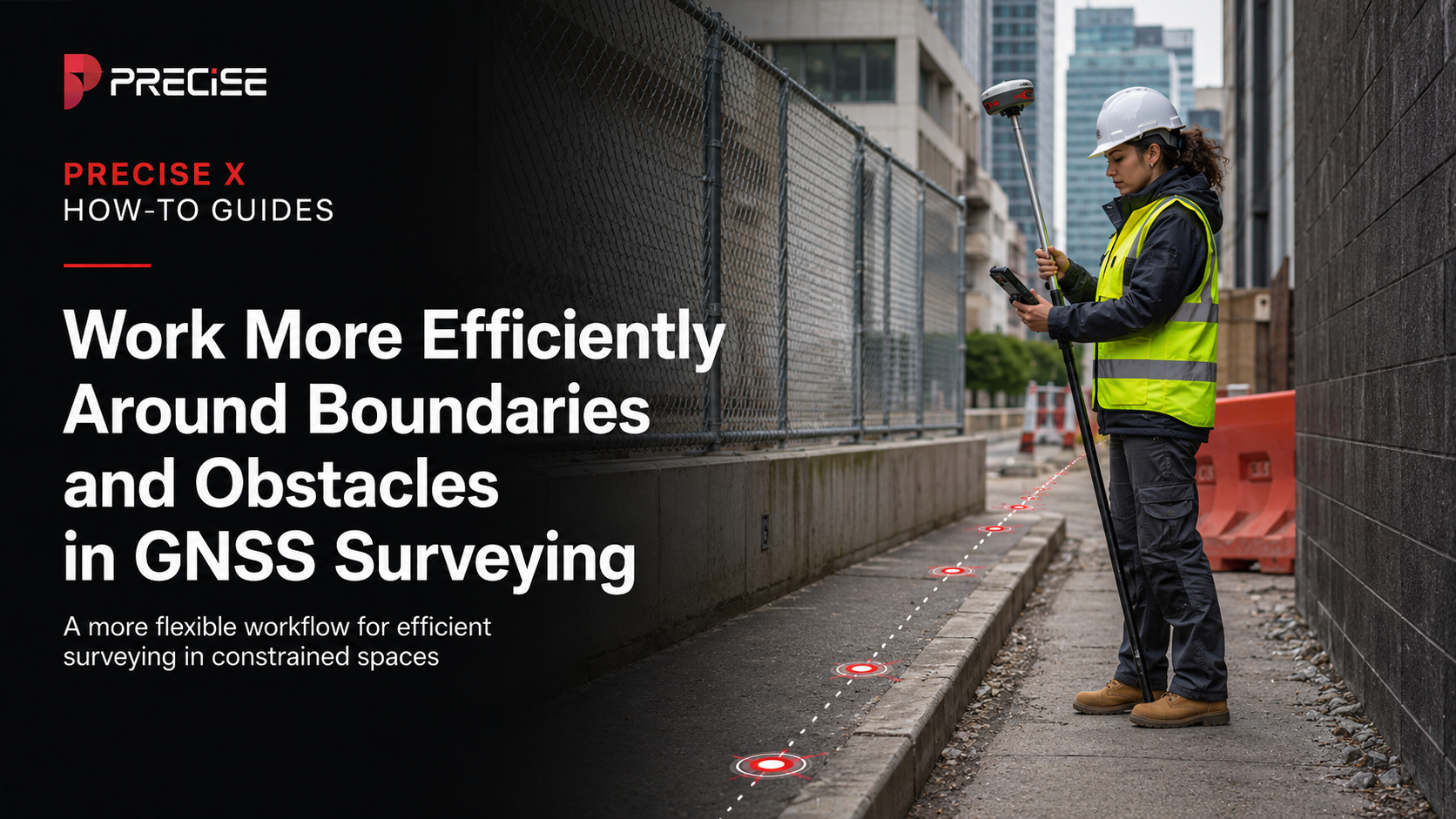
GNSS surveying around boundaries and obstacles often becomes inefficient when operators face restricted movement, limited access, and repeated repositioning.
Whether working along property lines, near building edges, or around physical barriers, operators often face restricted movement, limited positioning options, and constant workflow interruptions.
These conditions do not always reduce accuracy. However, they can significantly slow down operations, increase positioning uncertainty, and make measurement or stakeout tasks more difficult to complete smoothly.
Improving efficiency in boundary-heavy GNSS surveying environments requires more than precision. It requires a workflow that can adapt to physical constraints without compromising performance.
Why Boundaries and Obstacles Slow Down Survey Work
Traditional GNSS workflows often assume that operators can freely move around the target point, maintain ideal pole positioning, and approach the target location from the most convenient direction.
However, in real-world survey environments, this is rarely the case.
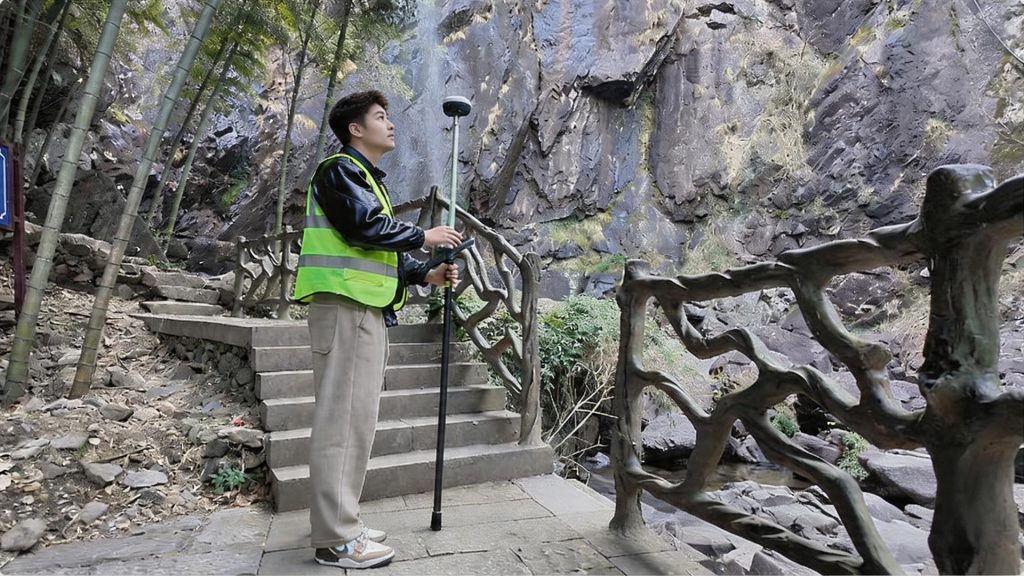
When working near walls, fences, property boundaries, building edges, equipment, vegetation, or restricted zones, surveyors may not have enough space to operate in a conventional way.
Typical challenges include:
- Limited access to the exact target location
- Physical barriers preventing direct approach
- Difficulty maintaining vertical alignment
- Increased risk of stepping outside permitted or safe working areas
- Frequent repositioning to find a workable angle
- Slower confirmation when the target point is close to an obstacle
As a result, surveyors often spend more time adjusting their position than completing the actual measurement or stakeout task.
A More Adaptive Survey Workflow
To improve efficiency in these conditions, the workflow needs to shift from position-dependent operation to flexibility-driven operation.
Instead of forcing the operator to reach the perfect position every time, a more adaptive GNSS workflow focuses on:
- Allowing measurement from non-ideal positions
- Reducing dependence on strict vertical alignment
- Maintaining continuity even when movement is restricted
This enables operators to complete tasks without needing perfect access to every point.
For boundary and obstacle-heavy environments, the goal is not only to measure accurately, but to keep the workflow moving smoothly despite physical constraints.
Step 1: Accept Indirect Access as Part of the Workflow
In constrained environments, reaching the exact point physically is not always practical.
For example, the target point may be close to a wall, fence, curb, building corner, equipment area, or restricted boundary. Forcing direct access may slow down the task or create unnecessary safety risks.
Instead of searching for a “perfect” access position, operators should first identify the closest feasible working position.
A more practical approach includes:
- Identifying the safest and most accessible working angle
- Maintaining positioning stability from that location
- Using workflow tools that support indirect or flexible operation
- Avoiding unnecessary repositioning when access is limited
This reduces time spent searching for ideal access points and helps operators complete the task more efficiently.
Step 2: Maintain Efficiency with Flexible Positioning
Strict vertical positioning often becomes a bottleneck near obstacles.
When the pole must remain perfectly vertical, operators may need to stop, re-level, step back, or reposition repeatedly. This is especially inefficient when working close to fences, walls, edges, narrow corridors, or uneven ground.
A more flexible positioning workflow allows operators to:
- Work closer to barriers without repeated repositioning
- Avoid unnecessary leveling adjustments
- Maintain workflow continuity near obstacles
- Complete tasks more smoothly in confined spaces
With IMU-based tilt functionality, operators can measure or stake out points more flexibly, even when perfect vertical alignment is difficult to maintain.
This helps reduce interruptions and keeps the workflow moving forward.
Step 3: Use Visual Guidance to Navigate Constrained Spaces
When movement is limited, directional uncertainty increases.
In open areas, operators can usually adjust their path freely. But near boundaries and obstacles, every movement may be restricted by physical space, safety limits, or site conditions.
Visual guidance helps operators understand their relative position more intuitively during movement.
It can help reduce:
- Back-and-forth movement
- Overcorrection near the target point
- Confusion caused by obstacles or narrow working areas
- Time spent checking direction repeatedly
By combining visual cues with positioning data, operators can align more confidently, even in tight spaces.
This makes the workflow easier to control and helps speed up final positioning.
Step 4: Reduce Repositioning by Combining Multiple Inputs
Efficient field workflows rarely depend on only one type of feedback.
When surveying near boundaries and obstacles, operators benefit from combining:
- GNSS positioning
- Visual feedback
- IMU-based tilt compensation
- Operator movement awareness
Instead of repeatedly stopping to verify position, operators can maintain a smoother workflow with fewer interruptions.
This combined approach helps surveyors make better decisions in complex field conditions. They can understand where they are, how they should move, and how to complete the task without unnecessary resets.
For everyday surveying, reducing repositioning often makes a major difference in total field efficiency.
What Affects Performance Near Boundaries
Working near obstacles introduces additional variables that can affect both efficiency and workflow stability.
Common factors include:
- Signal reflection and multipath interference
- Limited sky visibility for GNSS tracking
- Restricted operator movement
- Safety constraints near edges, boundaries, or restricted zones
- Difficulty keeping the pole vertical in tight spaces
- Site conditions such as uneven ground, walls, fences, or machinery
In addition, visual-based workflows also depend on proper operating conditions, including:
- Clear screen visibility under field lighting conditions
- Stable sensor integration
- Proper IMU initialization before operation
- Consistent interaction between GNSS positioning and visual feedback
Understanding these factors helps surveyors set up the workflow correctly and maintain consistent results in constrained environments.
Why This Workflow Fits Real-World Survey Conditions
In many real-world projects, ideal conditions are the exception rather than the norm.
Surveyors often work near buildings, boundaries, walls, roads, slopes, equipment, vegetation, or construction zones where direct access and perfect positioning are not always possible.
Surveying systems like the PRECISE X are designed to support more flexible workflows by integrating:
- Reliable GNSS positioning under partial obstruction
- Visual stakeout capabilities for intuitive alignment
- IMU-based tilt functionality for non-vertical operation
- A more adaptive workflow for boundary and obstacle-heavy environments
This combination allows operators to work efficiently even when access is limited.
By reducing unnecessary repositioning and improving movement flexibility, survey teams can maintain productivity in complex field conditions.
Conclusion
Boundaries and obstacles are unavoidable in most survey environments, but inefficiency does not have to be.
By adopting a more flexible workflow that reduces dependence on perfect positioning conditions, survey teams can maintain efficiency, improve consistency, and complete tasks with fewer interruptions.
In constrained environments, the ability to adapt is often just as important as measurement accuracy.
With the right workflow and the right equipment, GNSS surveying around boundaries and obstacles can become smoother, more flexible, and more efficient.