

Introduction
Knowing how to choose precision farming system is becoming increasingly important for farms working across different field conditions and operational needs.
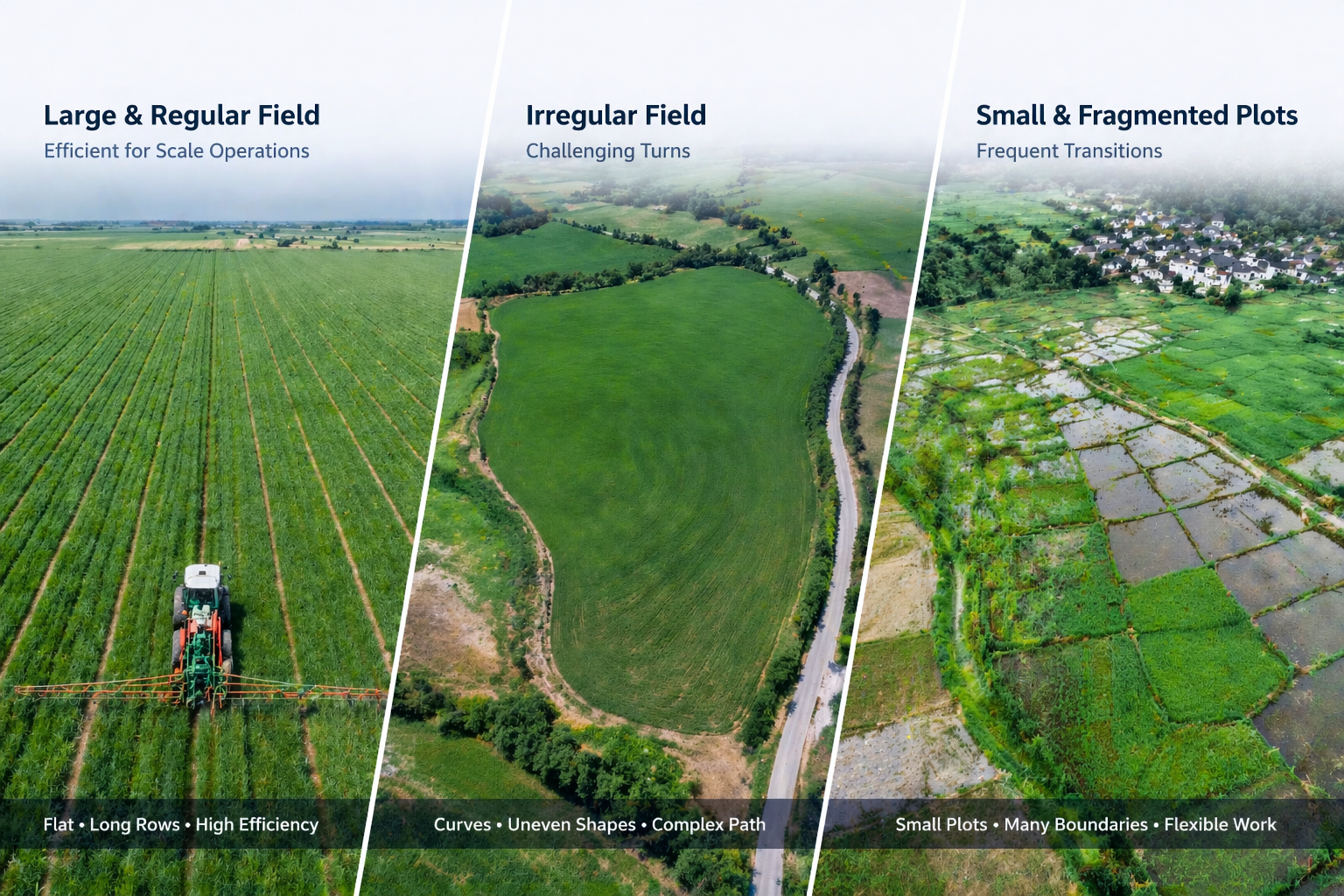
Some fields are large and open. Others are fragmented and irregular. Some operations prioritize speed, while others focus on input control or labor reduction.
Choosing the right precision farming system is not just about selecting features. It is about matching a workflow to real field conditions.
When the workflow does not match the field, even advanced equipment can underperform.
When it does match, efficiency gains become immediate and measurable.
Why a Feature-First Approach Often Fails
Many selection decisions are driven by specifications:
- Accuracy levels
- Number of features
- Compatibility lists
- System complexity
While these are important, they do not directly answer a more practical question:
“Will this system actually improve how work gets done in my fields?”
A feature-first approach often leads to:
- Over-investment in unused capabilities
- Under-utilization of key functions
- Mismatch between system design and field reality
Instead of focusing only on what a system can do, a better approach is to focus on what your workflow actually needs.
A Better Workflow Logic
A more effective decision-making approach is to start from the field and work backward.
Shift from:
“What features does this system have?”
to
“What problems does my workflow need to solve?”
This means identifying:
- Where time is lost
- Where errors occur
- Where manual effort is highest
Then selecting a system that directly addresses those points.
Key Execution Steps
1. Identify Your Primary Efficiency Bottleneck
Start by understanding where your operation loses the most efficiency.
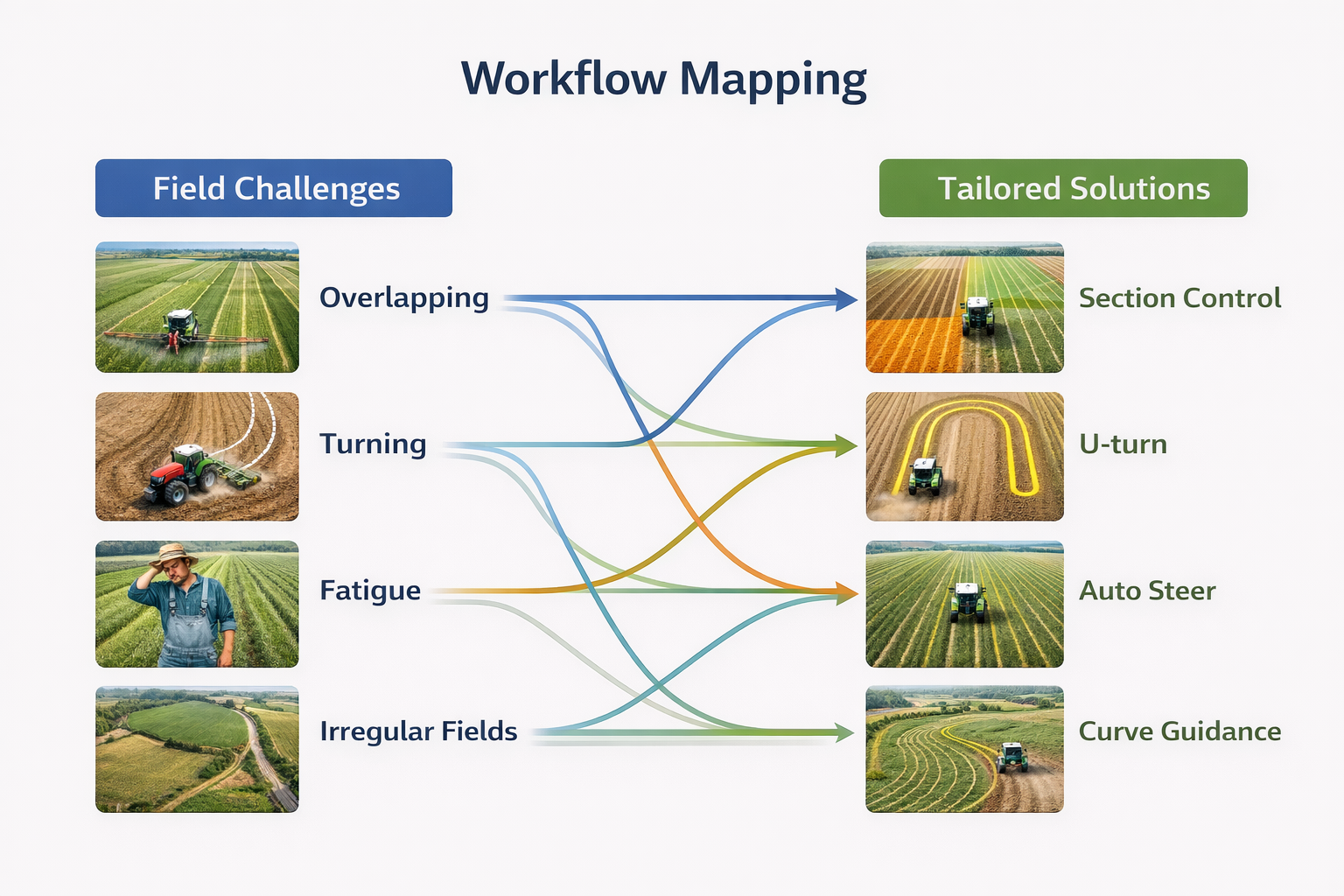
Common bottlenecks include:
- Overlap and input waste
- Slow headland turning
- Operator fatigue during long hours
- Difficulty handling irregular fields
Each of these problems requires a different optimization approach.
2. Match Workflow Needs to System Capabilities
Once bottlenecks are clear, map them to workflow improvements:
- Input waste → Section control
- Headland inefficiency → Automated U-turn
- Operator workload → Auto steering + simplified controls
- Irregular fields → Curve guidance
The goal is not to use every feature, but to use the right combination.
3. Consider Field Conditions and Operation Scale
System selection should reflect real operating conditions:
- Field size and shape
- Terrain complexity
- Number of operators
- Duration of daily operations
For example:
- Large, open fields benefit from speed and consistency
- Irregular fields require adaptability
- Labor-limited operations need automation
Matching system capability to field reality is critical.
4. Evaluate Integration, Not Just Individual Features
A system should not be judged by isolated functions alone.
Instead, consider how well different components work together:
- Steering + implement control
- Guidance + section control
- Turning + path planning
A fragmented setup can reduce efficiency, even if individual features are strong.
An integrated workflow reduces:
- Setup complexity
- Operator confusion
- Transition delays between tasks
5. Prioritize Ease of Use and Learning Curve
A technically advanced system only creates value if it is consistently used.
Consider:
- How quickly operators can learn the system
- Whether the interface is intuitive
- How easily workflows can be repeated
In many cases, a slightly simpler system that is fully used performs better than a complex system that is only partially used.
What Affects the Results
Even with the right system, outcomes still depend on:
Setup quality
Incorrect configuration reduces system effectiveness.
Operator familiarity
Training and workflow understanding remain important.
Field variability
Different plots may require different strategies.
Positioning reliability
Stable GNSS and RTK performance underpin all automation.
Selecting the right system is only the first step. Using it correctly determines the final result.
Why This Workflow Fits Modern Farming Operations
Modern farming is moving toward fewer operators managing larger areas, with higher expectations for efficiency and consistency.
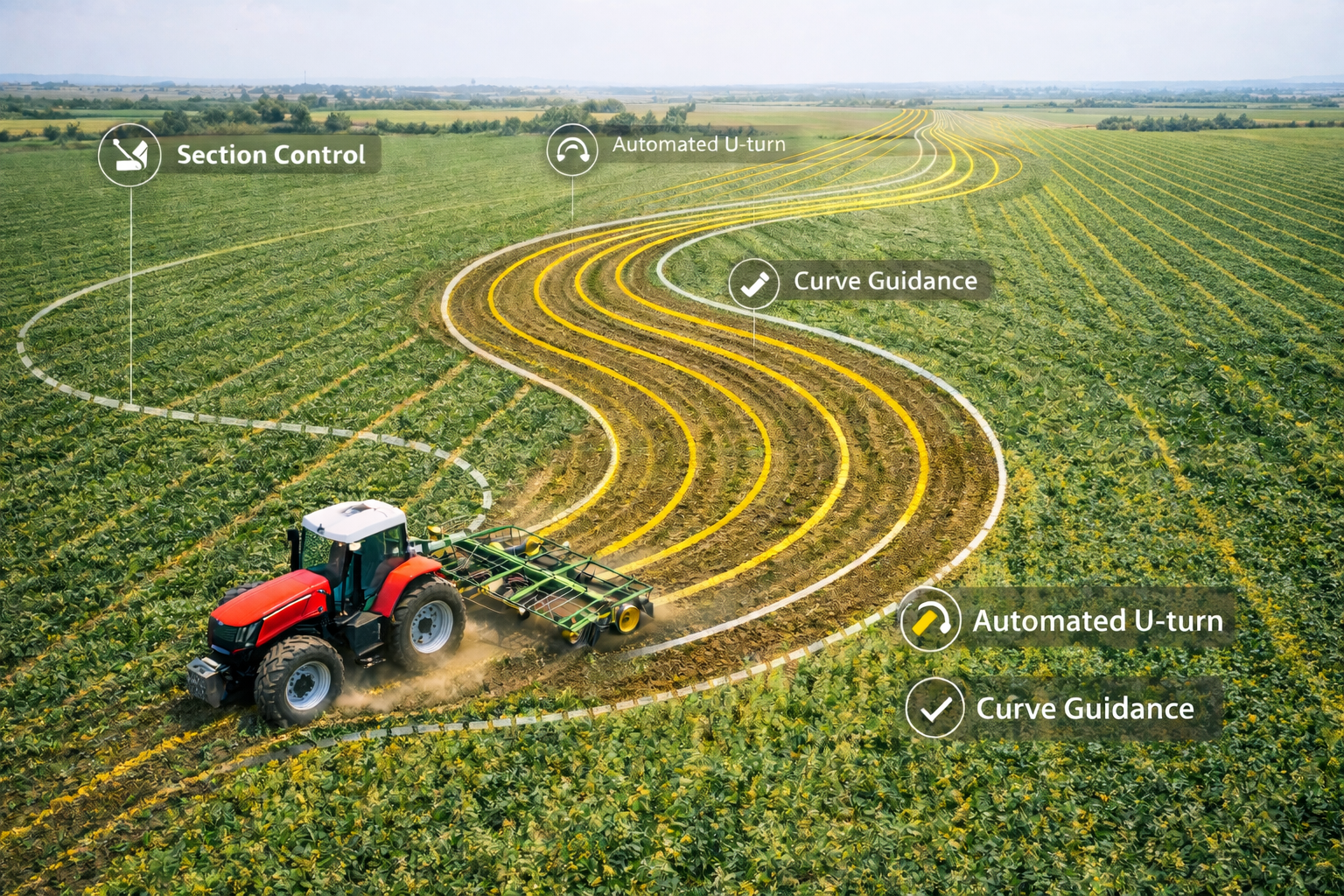
A system like the PRECISE A Pro is designed to support this shift by combining:
- Auto steering
- Smart U-turn
- ISOBUS-based implement control
- Section control capabilities
into a unified workflow.
Rather than forcing operators to manage multiple systems independently, this integrated approach helps align guidance, turning, and application control into a smoother operational process.
This is particularly valuable for operations that:
- Want to reduce labor dependency
- Need consistent performance across long working hours
- Operate across varied field conditions
Conclusion
Choosing the right precision farming system is not about selecting the most features. It is about selecting the right workflow.
By starting from field conditions and operational needs:
- System selection becomes clearer
- Implementation becomes smoother
- Efficiency gains become more consistent
In precision farming, the best system is not the most advanced one. It is the one that fits how your work actually gets done.