
Choosing the most efficient survey method for each field situation is one of the most important factors in maintaining field surveying efficiency. In many cases, it depends on how the measurement method is chosen before the work even begins.
On real job sites, delays often do not come from difficult points themselves. They come from using the wrong approach for the situation. Surveyors frequently work in conditions where direct access is possible but inefficient, visibility is clear but orientation is confusing, positioning is stable but movement is restricted, or multiple methods are available while only one is truly optimal.
In these situations, choosing the right method becomes more important than the measurement itself.
This article explains how to select the most efficient survey method in real field conditions in order to reduce unnecessary time loss and improve workflow continuity.
Why Method Selection Has a Major Impact on Efficiency
In traditional workflows, survey methods are often applied in the same way across different scenarios:
- Approach the point
- Measure directly
- Adjust if necessary
This can work well in simple environments, but it quickly becomes inefficient when field conditions vary.
Using a single method across all situations can lead to:
- Unnecessary movement
- Repeated setup adjustments
- Inefficient positioning
- Workflow interruptions
- Increased operator fatigue
The core issue is not equipment capability. It is method mismatch.
Different site conditions require different approaches. When the method is not adapted to the environment, time is lost even when the equipment itself is fully capable.
A More Effective Approach: Match Method to Condition
Instead of relying on a single workflow, a more efficient approach is to evaluate the situation before measuring, choose the method that minimizes effort, and maintain continuity across the task sequence.
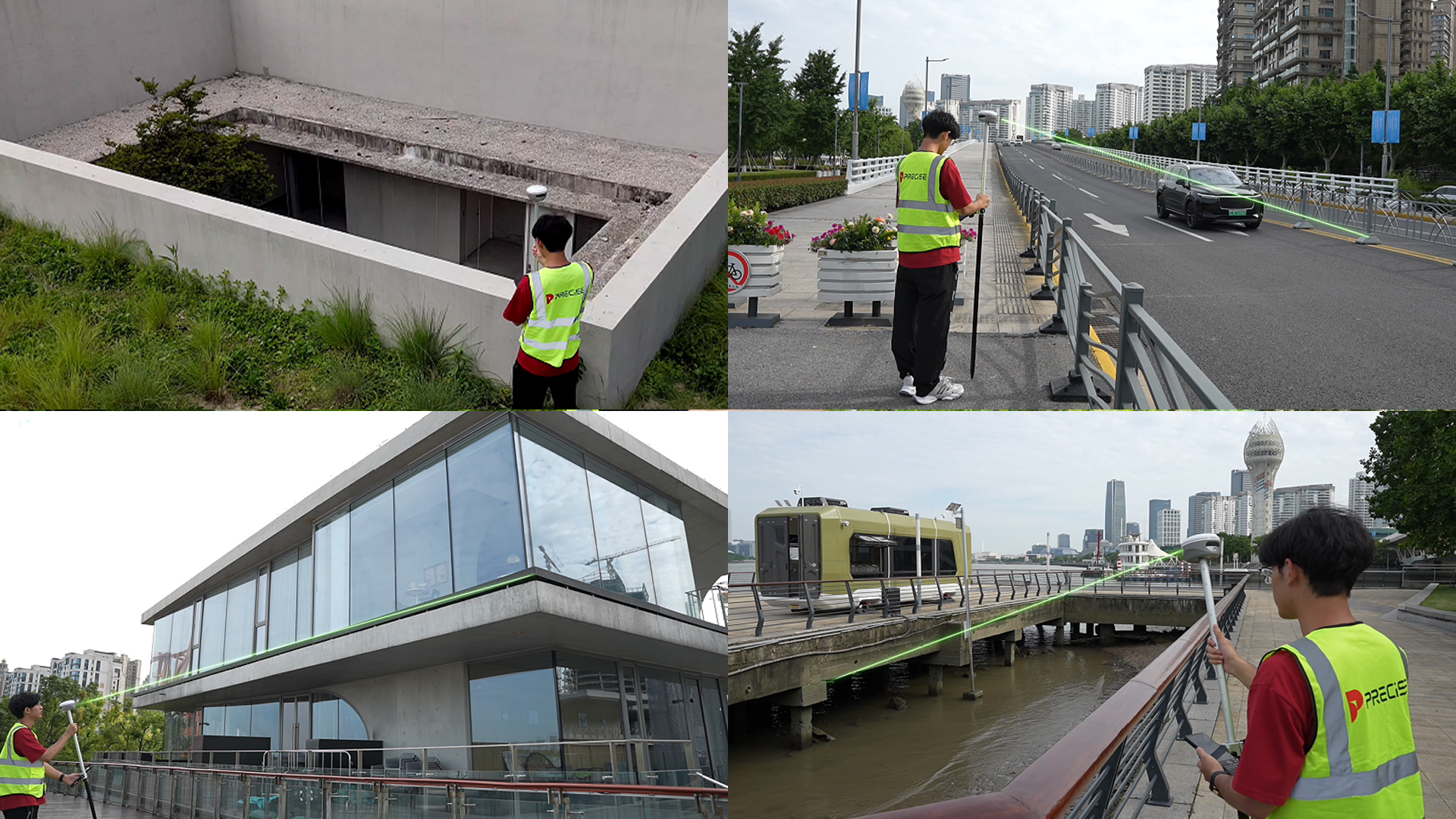
An integrated system such as the PRECISE X7 supports this approach by enabling multiple measurement strategies within one workflow, including:
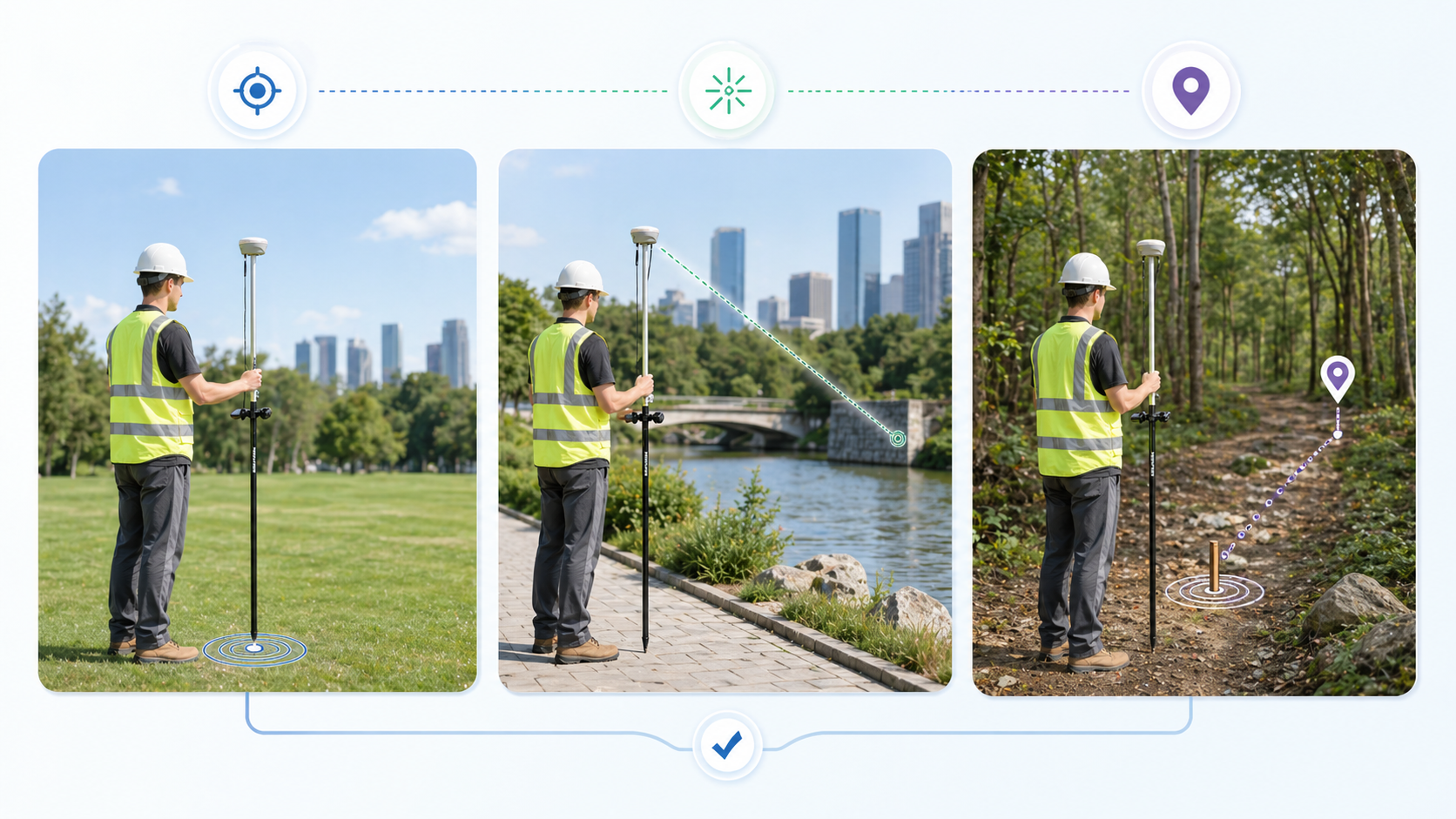
- Direct GNSS measurement for accessible points
- Laser-assisted measurement for difficult or distant targets
- Visual stakeout for orientation in complex environments
- Tilt-supported surveying for constrained positioning
The real advantage is not simply having more features. It is having the flexibility to choose the right method for the actual condition.
Step-by-Step Decision Workflow
Step 1: Assess Accessibility
Start by asking:
- Can the point be reached easily?
- Will reaching it require detours or repeated repositioning?
- Does direct access create unnecessary effort or safety concerns?
If direct access is inefficient, alternative methods should be considered immediately.
Step 2: Evaluate Visibility and Orientation
Even when a point is accessible, visibility and orientation still matter.
Ask yourself:
- Is the environment visually clear?
- Are there repeated structures, obstruction, or layout confusion?
- Will it be easy to identify the correct location?
If orientation is difficult, visual guidance may be more effective than relying on direct approach alone.
Step 3: Consider Movement Efficiency
Survey efficiency is not about one point in isolation. It is about the sequence of work.
Consider:
- Will approaching this point interrupt the workflow?
- Does the task require breaking movement rhythm?
- Can the point be measured without disrupting the current sequence?
The best method is usually the one that keeps the workflow moving smoothly.
Step 4: Select the Measurement Method
Once accessibility, visibility, and movement conditions are clear, choose the method that best fits the situation:
- Direct measurement for open and accessible points
- Laser-assisted measurement for distant or obstructed targets
- Visual stakeout for complex or visually confusing environments
- Tilt-supported measurement for constrained or uneven areas
The goal is not consistency for its own sake. The goal is efficiency.
Step 5: Avoid Over-Correction
One common mistake is switching methods too often.
To prevent this:
- Do not change approach unnecessarily
- Avoid second-guessing stable measurements
- Trust the chosen workflow once it has been validated
Efficiency depends on confidence as much as capability.
Step 6: Maintain Workflow Continuity Across Multiple Points
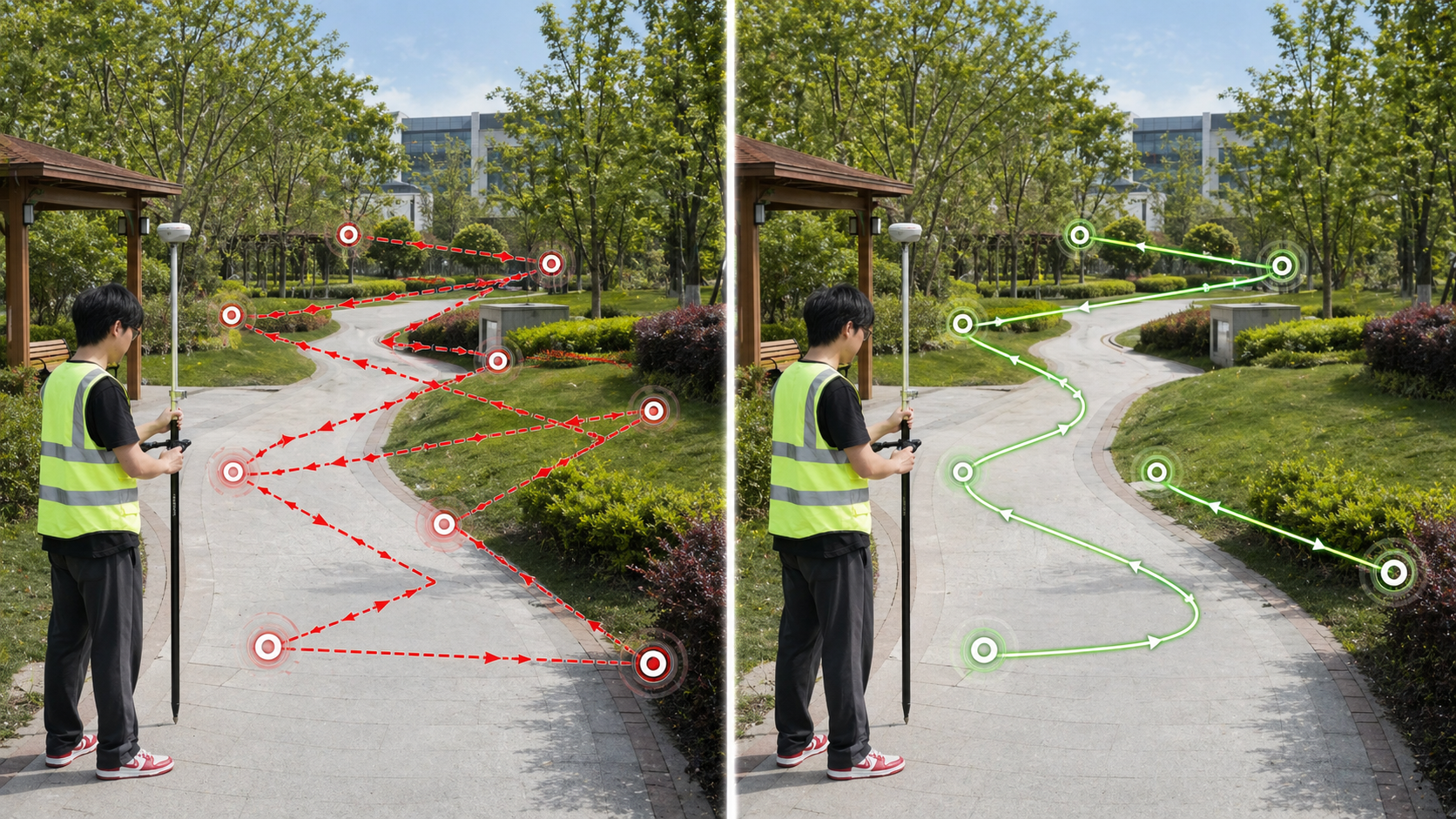
When measuring multiple points, overall workflow planning becomes especially important.
To improve continuity:
- Group points with similar conditions together
- Avoid jumping randomly between very different environments
- Plan movement paths in advance
A well-structured sequence reduces cumulative time loss across the site.
What Affects Method Selection in Practice
Several factors influence how effectively the right method is chosen in the field:
- Site complexity: Greater variation requires greater flexibility
- Operator experience: Familiarity improves decision speed
- Workflow awareness: Knowing when to switch methods matters
- Equipment capability: Efficient choice depends on available measurement options
Efficient surveyors are not only accurate. They are adaptive.
When This Approach Makes the Biggest Difference
Method selection becomes especially important in:
- Mixed-condition construction sites
- Projects with both open and obstructed areas
- Large sites with repeated measurement tasks
- Environments that require frequent transitions
- Time-sensitive surveying operations
In these situations, choosing the right method often saves more time than simply trying to work faster.
Conclusion
Survey efficiency is not defined by a single technique. It is defined by how effectively different techniques are applied to different conditions.
Using one method for every situation may seem simple, but it often creates unnecessary effort and interruption.
By evaluating accessibility, visibility, and movement before measuring, surveyors can:
- Reduce unnecessary repositioning
- Maintain workflow continuity
- Complete tasks more efficiently
In modern field surveying, the most valuable skill is not just measurement. It is decision-making.
Because the right method, applied at the right time, is often the fastest path to the correct result.